The semiconductor industry is flashing a major signal.
According to the latest data, during the first 20 days of this year, semiconductor exports from South Korea—often called the “canary in the coal mine” for the global economy—totaled $10.73 billion (approximately 74.7 billion RMB), representing a massive year-over-year surge of over 70%. This indicates that global demand for semiconductors remains exceptionally robust amidst the AI (Artificial Intelligence) wave. Following the news, shares of memory chip giant Samsung Electronics spiked, rising more than 3% during intraday trading on the 21st.
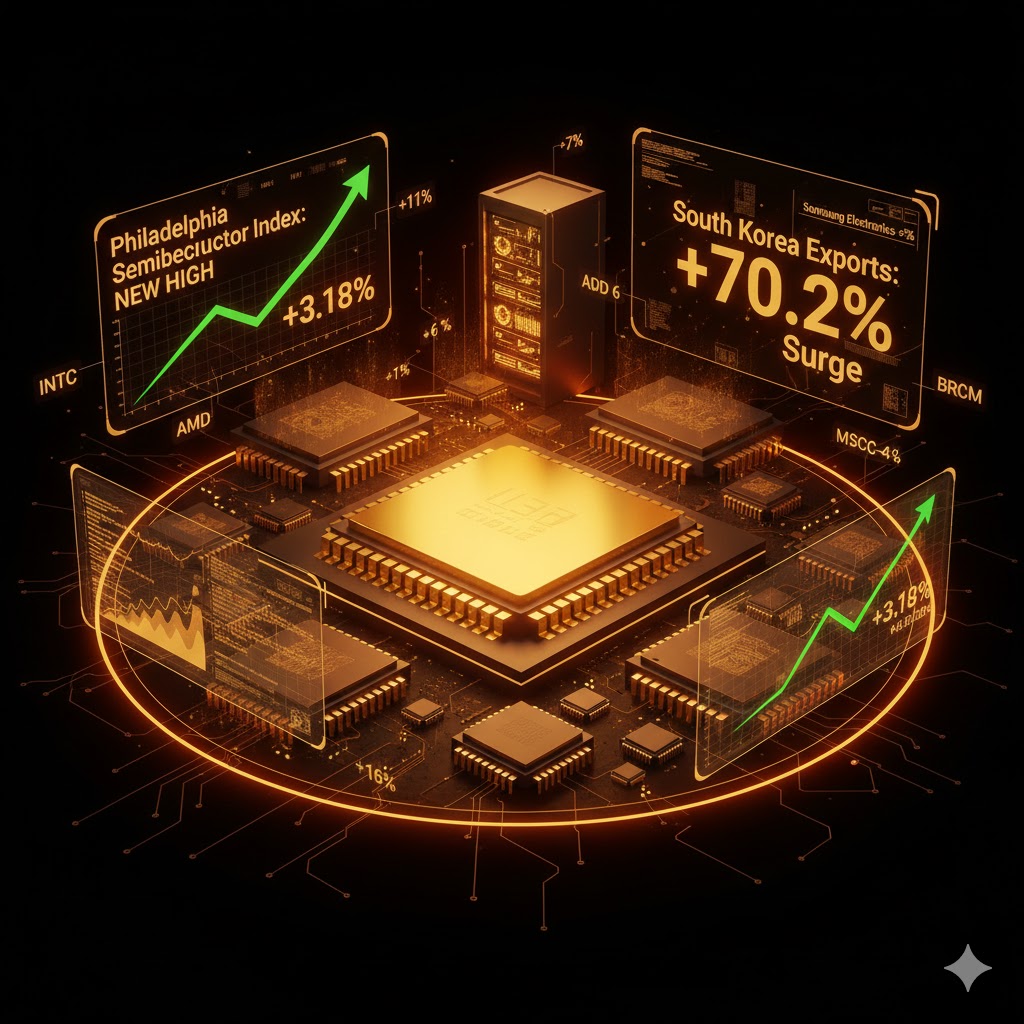
Chip stocks rallied broadly on the 21st. The Philadelphia Semiconductor Index rose 3.18%, hitting a new all-time high. Intel (NASDAQ:INTC, ) surged over 11%, Advanced Micro Devices (NASDAQ:AMD) rose more than 7%, Micron Technology (NASDAQ:MU) gained over 6%, ARM (NASDAQ:ARM) climbed over 6%, and Microchip Technology (NASDAQ:MCHP) rose over 4%, while Broadcom (NASDAQ:AVGO) fell by over 1%.
Prior to this, U.S.-listed storage chip stocks also saw a massive rally on Tuesday, with SanDisk soaring over 10% at one point. Institutional analysts pointed out that this round of price hikes in memory chips is not driven by short-term market sentiment, but by the dual factors of “limited advanced process capacity” and “rigid growth in AI server demand.” The sustainability of this trend is significantly stronger than historical cycles.
A Surge of Over 70%
On January 21, local time, data disclosed by the South Korean customs department showed that from January 1 to January 20, 2026, South Korea’s total exports reached $36.36 billion, a year-over-year increase of 14.95%. Imports totaled $36.98 billion, up 4.2%, resulting in a trade deficit of approximately $600 million.
By product category, semiconductor exports during the first 20 days of the month reached $10.73 billion, a year-over-year jump of 70.2%. This accounted for 29.5% of total exports, an increase of 9.6 percentage points compared to the same period last year.
Exports of petroleum products reached $2.46 billion (up 17.6%), and steel products totaled $2.4 billion (up 1.2%). However, automobile exports fell 10.8% to $2.87 billion, and ship exports saw a sharp decline of 18.1%.
As a major global semiconductor exporter and home to two memory giants—Samsung Electronics and SK Hynix—South Korea has become one of the biggest winners as the global AI boom drastically boosts demand for memory chips.
Driven by this demand, South Korea’s exports in December 2025 grew 13.4% year-over-year to $69.6 billion, marking the 11th consecutive month of growth.
For the full year of 2025, South Korea’s total exports reached a record high of $709.7 billion, marking the first time in history that annual exports have surpassed the $700 billion threshold.
According to the latest data from the South Korean Ministry of Science and ICT, thanks to the expansion of demand for high-value-added memory and the continuous rise in prices of general semiconductors such as DRAM, South Korea’s annual semiconductor exports in 2025 reached a record $173.48 billion, up 22.1% year-over-year. This marks the second consecutive year of double-digit growth.
Significant Upgrades
Citigroup has significantly raised the price targets for storage chip giants, most notably hiking SanDisk’s target from $280 to $490 per share—a 75% increase.
Citigroup expressed optimism regarding the strong demand for data center memory, favorable supply-demand conditions, and the company’s powerful competitive moat. SanDisk is expected to continue growing its market share in the enterprise SSD (Solid State Drive) segment.
Simultaneously, Citigroup maintained a “Buy” rating on Seagate Technology, raising its target price from $320 to $385 (an increase of about 20%). Western Digital’s target was also raised from $200 to $280 (an increase of about 40%).
The Citigroup report noted that these companies remain the primary beneficiaries of “strong demand from hyperscale data centers supporting rising storage prices.” Spending by hyperscalers “remains strong,” which will drive demand for power, storage, connectors, and fiber optics.
Divya Mathur, an emerging markets equity fund manager at ClearBridge Investments, also explicitly stated that the market is significantly undervaluing the memory chip demand driven by AI development.
Furthermore, an operations executive at Micron Technology emphasized in a recent interview that the global memory chip shortage has intensified over the past quarter and will persist beyond 2026. PC and smartphone manufacturers are also joining the “scramble” to lock in memory chip supplies for 2026 and beyond. The core reason is the explosive growth in demand for high-end semiconductors for AI infrastructure.
SK Hynix revealed that its chip production capacity for 2026 is already fully sold out, and its high-end memory products for AI are completely booked.
TrendForce also noted in its latest report that the current price increases in storage chips are not driven by temporary market sentiment. Instead, they result from the combined effects of “limited capacity in advanced processes” and “rigidly growing demand for AI servers,” making this cycle notably more durable than previous ones.
Data shows that capital expenditures by the world’s eight leading cloud providers are expected to grow by approximately 65% year-over-year in 2025. Annual reports from IDC and Gartner confirm that AI servers have become the fastest-growing segment in data center IT investment, with storage systems as critical infrastructure set to benefit significantly from this trend.