Tag Archives: MU

DRAM Supply Shortage Expected to Last Until 2028, Micron Target Price Raised by Deutsche Bank by Nearly 70%

As the storm of rising storage prices intensifies, U.S. memory chip giant Micron Technology (NASDAQ:MU) has seen its target price raised once again.

Deutsche Bank significantly raised its target price for Micron Technology while maintaining its “Buy” rating on the stock. The bank’s analysts recently stated that the current memory cycle is “different from past cycles,” which could mean that Micron’s stock still has substantial room for growth.

Deutsche Bank analyst Melissa Weathers expects the supply shortage of dynamic random-access memory (DRAM) to last until at least 2027 or even 2028—especially as the artificial intelligence (AI) boom has led to a surge in demand for high-bandwidth memory (HBM).
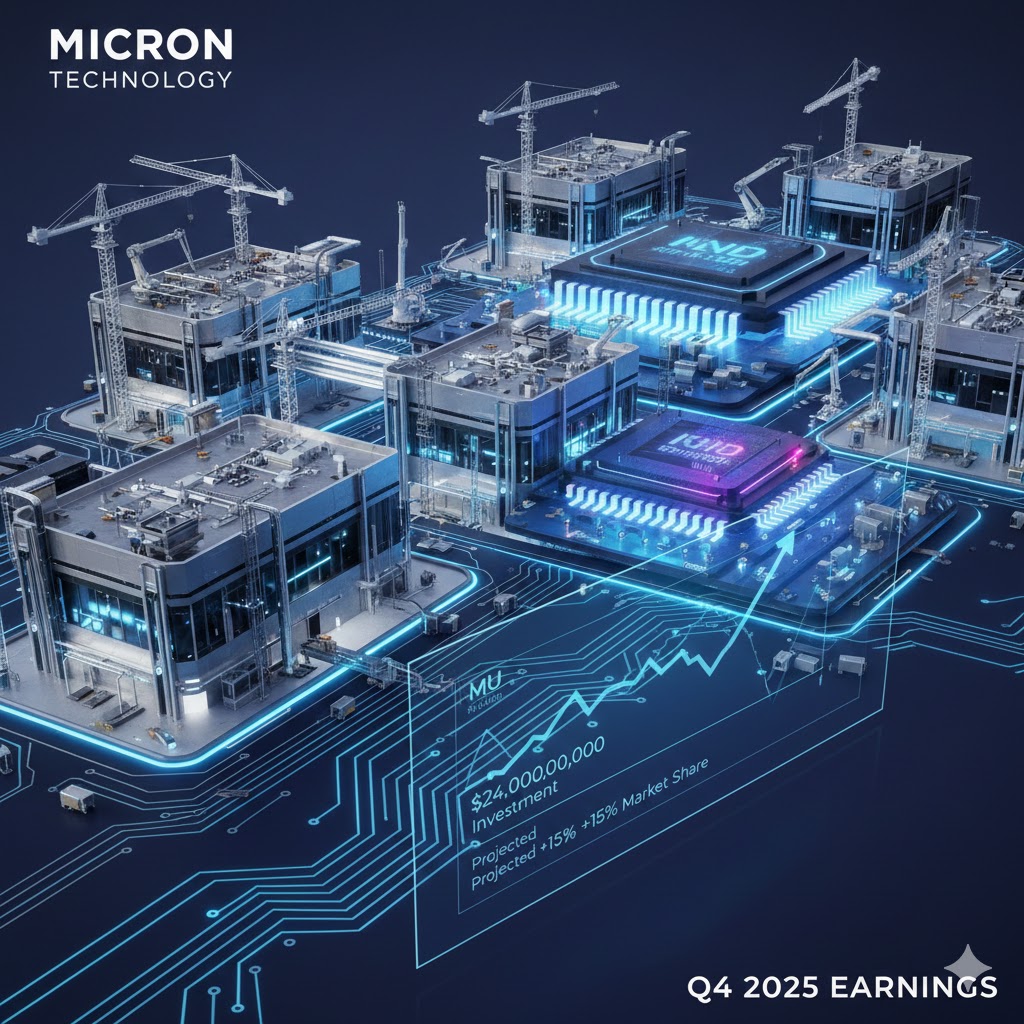
HBM is made by stacking DRAM chips and is critical for advanced AI chips, such as those designed by NVIDIA (NASDAQ:NVDA). Micron, along with South Korea’s SK Hynix and Samsung Electronics, is considered one of the “Big Three” in the global HBM market, with the three companies collectively monopolizing more than 97% of the global HBM market share.

In a report released on Tuesday, Weathers noted that compared to traditional DRAM, HBM has approximately three times the “silicon density,” meaning it requires more wafers for chip cutting. She stated that this high density “is causing a supply shock that we believe has not been fully understood.” The supply tightness has enabled companies like Micron to raise prices and sign long-term contracts with customers.

At the same time, Weathers noted that new DRAM wafer plants will take at least two years to come online, and the expansion capacity of existing plants is limited, making it difficult to alleviate the demand pressure. However, she mentioned that as new production capacity gradually comes online next year, the supply constraints may ease.

Weathers believes these trends will create “a more structurally profitable environment” for Micron, raising the stock’s target price by a substantial 67% to $500—more than 30% above the latest closing price.

Deutsche Bank also raised its earnings per share (EPS) forecast for Micron’s fiscal year 2026 to $46.50, with the new target price based on about 11 times this number.

Micron’s stock fell 2.67% on Tuesday, continuing the downward trend from Monday, after reports surfaced that Micron’s competitor Samsung plans to begin mass production of next-generation HBM4 later this month, for use by NVIDIA (NASDAQ:NVDA) in its upcoming Vera Rubin graphics processing unit (GPU).

Over the past year, Micron’s stock has surged by an impressive 300%. Recently, several investment banks, including UBS, Mizuho, and HSBC, have raised their ratings on the stock.

Last month, during Micron’s first-quarter fiscal year 2026 earnings call, the company stated that all of its HBM capacity for 2026 had already been sold out, and it expects the total addressable market (TAM) for HBM to reach $100 billion by 2028 (up from $35 billion in 2025).
Micron Announces Construction of New NAND Factory with $24 Billion Investment

On Tuesday, Micron Technology (NASDAQ: MU) announced that it will invest an additional $24 billion in Singapore over the next decade to build a new NAND flash wafer fabrication plant, aiming to address the tight supply of storage chips driven by artificial intelligence. Micron’s stock price surged more than 5% in pre-market trading.

This new facility will be Singapore’s first dual-layer wafer plant, with a cleanroom area of 700,000 square feet. Wafer production is expected to begin in the second half of 2028. The project will create approximately 1,600 new jobs.

This move highlights the intensifying supply-demand imbalance in the global storage chip market. With the rapid expansion of AI infrastructure driving a surge in NAND demand, Micron, along with its South Korean competitors SK Hynix and Samsung Electronics, has shifted its production focus to high-end AI chips, leaving PC and smartphone manufacturers facing a shortage of storage chips.

Micron’s Large-Scale Expansion a Key Part of Global Capacity Strategy
Micron’s significant capacity expansion is a key component of its global production strategy. The company recently broke ground on a $100 billion facility in New York to alleviate what it calls “unprecedented supply shortages.”

AI Demand Drives NAND Price Surge
NAND flash, which serves as a replacement for hard disk drives, is in increasing demand due to its faster access speeds in AI infrastructure. These chips are typically sold in solid-state drive (SSD) form and can be directly plugged into a computer’s hard disk interface.

Counterpoint Research Director MS Hwang noted, “The importance of NAND in the AI field has grown significantly, and NAND prices have risen sharply. Suppliers are reducing their focus on traditional consumer markets, such as PC SSDs and mobile flash, while increasing their supply of enterprise-grade SSDs for data center servers.”

The global storage market is dominated by Micron and its two South Korean competitors. Since last year, the three companies have prioritized the production of high-end chips needed for AI infrastructure, diverting resources away from other segments of the storage chip market, leading PC and smartphone manufacturers to warn that storage chip shortages are impacting their businesses.

Global Capacity Expansion to Alleviate Supply Constraints
To ease supply constraints, Micron is significantly expanding its production capacity worldwide. In addition to the Singapore project, the company recently began construction on a $100 billion facility in New York.

Singapore is already one of Micron’s key NAND production bases. In early 2025, Micron announced plans to invest $7 billion in Singapore over the next few years to expand its manufacturing capabilities to meet the demand for advanced storage chips required for AI training. Micron has long relied on Singapore and Japan as critical production hubs.

The new wafer plant will work in tandem with the recently begun HBM advanced packaging facility, further solidifying Singapore’s crucial role in the global storage supply chain. Micron’s investment in Singapore aligns with the country’s strategic goals of advancing industries such as AI and cutting-edge chip manufacturing. The Singaporean government has already committed to investing over S$1 billion (US$786 million) to support local AI research.

Apple’s Eight-Week Losing Streak! Amid Storage Cost Concerns and Approaching Earnings, Goldman Sachs Contradicts Market Sentiment: “Buy the Dip Before Jan 29”

Amid investor concerns over rising hardware costs, Apple (AAPL) shares have declined for eight consecutive weeks.

At the close of U.S. markets on Friday, Apple’s stock edged down 0.12%, bringing its weekly loss to nearly 4%. This marks its longest losing streak since May 2022.

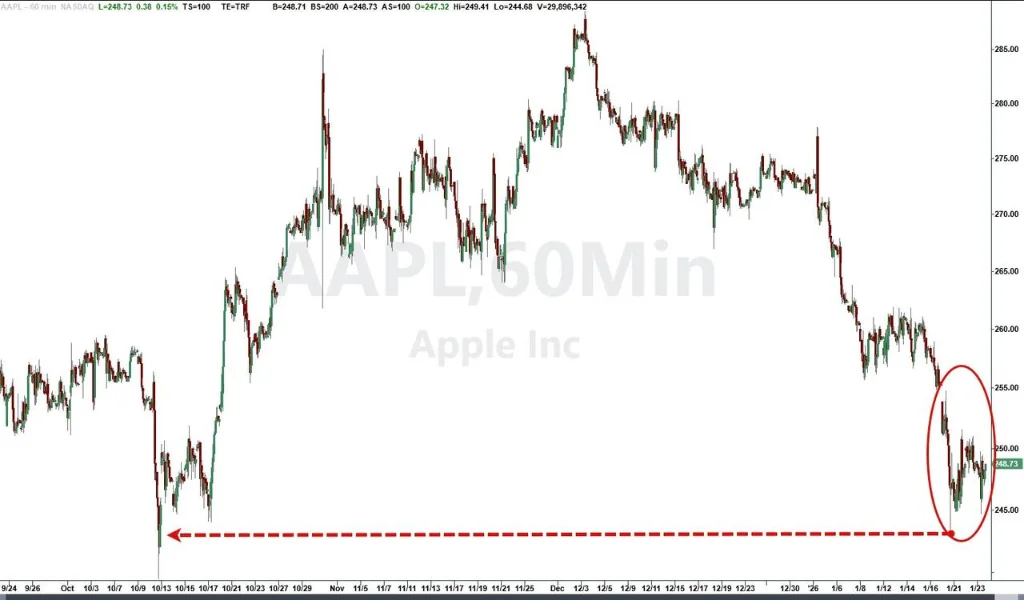
(Apple stock price has dropped to levels last seen in mid-October)

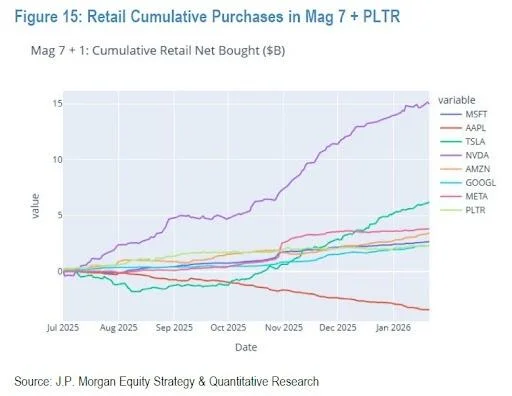
Apple’s share price has retreated approximately 13.8% from its 52-week high of $288 set in December last year to around $248 currently. Furthermore, compared to the other members of the “Magnificent Seven” tech giants, Apple has seen particularly significant capital outflows since July.

(Net capital inflow trends for the Magnificent Seven)

The core trigger for this sell-off pressure originates from supply chain warnings. Recent pessimistic guidance from chip giant Intel sparked market fears regarding skyrocketing costs for storage components. Due to a surge in demand for AI hardware, memory chip prices are undergoing a sharp increase, leading to widespread concern that this will severely erode the gross margins of consumer electronics giants, including Apple.

However, despite the subdued market sentiment, Wall Street Insights notes that Goldman Sachs has maintained its “Buy” rating on Apple. The firm suggests that investors should ignore short-term noise and “buy the dip” ahead of the company’s fiscal 2026 first-quarter earnings report on January 29.

Goldman Sachs believes that a robust iPhone replacement cycle and the implementation of AI features will bolster performance beyond expectations.

Surging Storage Costs Spark Margin Fears

The market’s pessimistic outlook on Apple’s recent performance is primarily driven by the rapid rise in memory chip prices.

According to Wall Street Insights, Intel CFO David Zinsner admitted after the earnings release that while the company has secured supply for the first half of the year, storage pricing could become a challenge in the second half.

Data from Counterpoint Research has further fueled these concerns, forecasting that storage component costs will surge by 40% to 50% this quarter—driven by AI hardware demand—following a similar spike in the fourth quarter of 2025.

This trend poses a direct threat to Apple. IDC research indicates that storage components account for approximately 10% to 15% of the total Bill of Materials (BOM) for high-end smartphones like the iPhone. Benchmark analyst Cody Acree noted:

“Rising component costs, particularly those related to memory prices, could have unknown negative impacts on shipment volumes and revenue potential.”

Additionally, as memory manufacturers such as Micron(MU) and SanDisk(SAND) shift capacity toward more lucrative AI data center components, supply for traditional DRAM and NAND used in smartphones and PCs has tightened.

UBS analyst David Vogt warned in a report that while Apple’s supply agreements might mitigate the impact in the March quarter, risks will significantly increase in the June and September quarters as production for the next-generation iPhone ramps up.

Vogt estimates that memory chip shortages could hit Apple’s gross margin by 50 to 100 basis points. Based on this, UBS maintains a “Neutral” rating on Apple with a price target of $280.

Goldman Sachs’ View: Retracement is a Buying Opportunity

Despite inflationary pressures on the cost side, Goldman Sachs analyst Michael Ng argues that now is the optimal time to buy Apple stock.

Goldman has set a price target of $320 for Apple and expects the company to deliver an outstanding performance in the upcoming earnings report.

The firm forecasts that Apple’s revenue for the first quarter of fiscal 2026 will reach $137.4 billion, an 11% year-over-year increase. The iPhone business is expected to be the primary growth engine, with revenue projected to rise 13% year-over-year to $78 billion. This growth is driven by two main factors:

  1. Volume Growth: A projected 5% year-over-year increase in shipments, notably bolstered by a 26% surge in shipments in China, reflecting a strong recovery in a key market.
  2. Average Selling Price (ASP): An 8% year-over-year increase, indicating robust demand for high-end models.

Furthermore, Goldman Sachs emphasized the support for the stock price from the future product pipeline. The report noted that with demand for the iPhone 17 series expected to outperform its predecessor, and the anticipated launch of a foldable iPhone (iPhone Fold), Apple is shifting toward a “two-updates-per-year” release cycle.

Combined with upgrades to iOS and Siri, as well as the partnership with Google Gemini, the iPhone’s position as the preferred hardware gateway for the AI era will be further consolidated, thereby extending the upgrade super-cycle.

Wall Street Consensus and Valuation Outlook

From a valuation perspective, Apple currently trades at a forward P/E ratio of approximately 30x. While slightly above the industry average, analysts generally consider this premium justified given the stability of its earnings growth.

Goldman Sachs expects Apple’s first-quarter earnings per share (EPS) to reach $2.66, consistent with market consensus, while maintaining a steady gross margin of 47.7%.

Overall, Wall Street remains bullish on Apple. Out of 42 analysts covering the stock, 21 give it a “Strong Buy” rating. Evercore ISI reaffirmed an “Outperform” rating and a $330 price target, projecting a 17% year-over-year increase in iPhone sales.

Wedbush analyst Dan Ives provided a street-high price target of $350, describing 2026 as a “milestone year” for the full deployment of Apple’s AI strategic roadmap.

As the January 29 earnings date approaches, the market is waiting with bated breath to see if Apple can reshape its growth narrative through strong AI terminal demand, even under the shadow of rising storage costs.