Tag Archives: NVDA

Nvidia Earnings Report Coming Soon, Citi Provides Optimistic Outlook, AI Inference Roadmap Could Be a New Catalyst

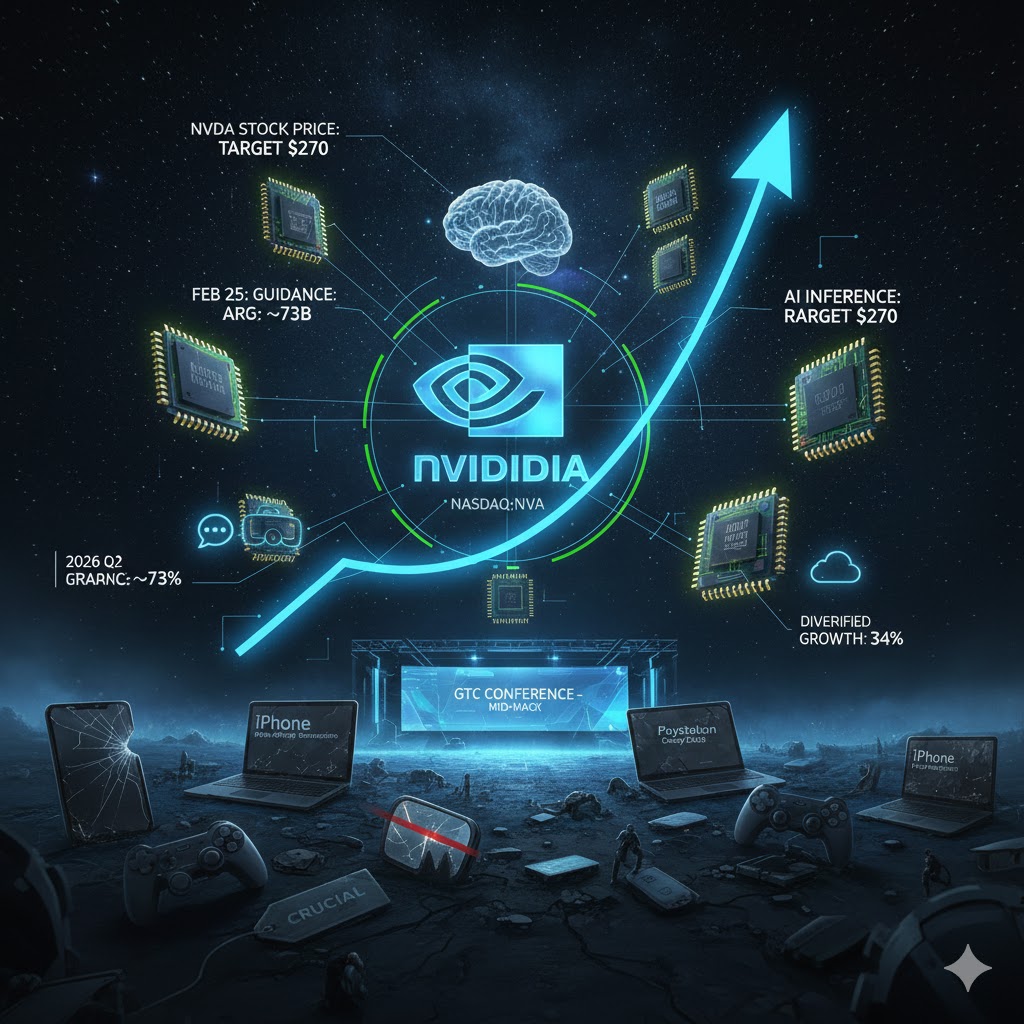
Nvidia (NASDAQ:NVDA) is set to release its latest quarterly earnings and guidance on February 25. Citi Group has given an optimistic outlook for the chip giant, led by Jensen Huang, and expects the company to release strong performance guidance.

In a report to clients, Citi analyst Atif Malik stated that his model predicts Nvidia’s revenue for the fiscal quarter ending in January will be approximately $67 billion, exceeding Wall Street’s consensus estimate of $65.6 billion. Furthermore, he expects the company’s guidance for the fiscal quarter ending in April to be around $73 billion, notably higher than the market’s expectation of $71.6 billion.

Malik pointed out that the continued ramp-up of B300 products, coupled with the launch of the Rubin architecture, will drive Nvidia’s sales to accelerate by 34% year-over-year in the second half of 2026, significantly outperforming the 27% growth expected for the first half of 2026. He believes that investors’ focus has shifted away from the current earnings report and towards the annual GTC conference scheduled for mid-March, where Nvidia is expected to focus on its inference roadmap. This will include details on how the company plans to utilize Groq’s low-latency SRAM intellectual property and provide its first preliminary outlook on AI-related sales from 2026 to 2027.

Based on this outlook, Malik maintains a “Buy” rating on Nvidia and sets a target price of $270.

Looking at the company from a longer-term perspective, Malik further stated that Nvidia’s current valuation “appears attractive.” As market visibility on its 2026 performance improves, the stock is expected to outperform the broader market in the second half of 2026.

He also mentioned that the inference market is evolving toward being “more diversified,” which will offer more choices for model scale and application scenario customization. This also means that the use of AI accelerators will take on more diverse forms. However, from a system-level perspective, he expects Nvidia to continue to lead in workloads focused on training as well as inference and logical deduction, and he believes that MLPerf remains the most valuable benchmark for comparing different AI accelerators.

DRAM Supply Shortage Expected to Last Until 2028, Micron Target Price Raised by Deutsche Bank by Nearly 70%

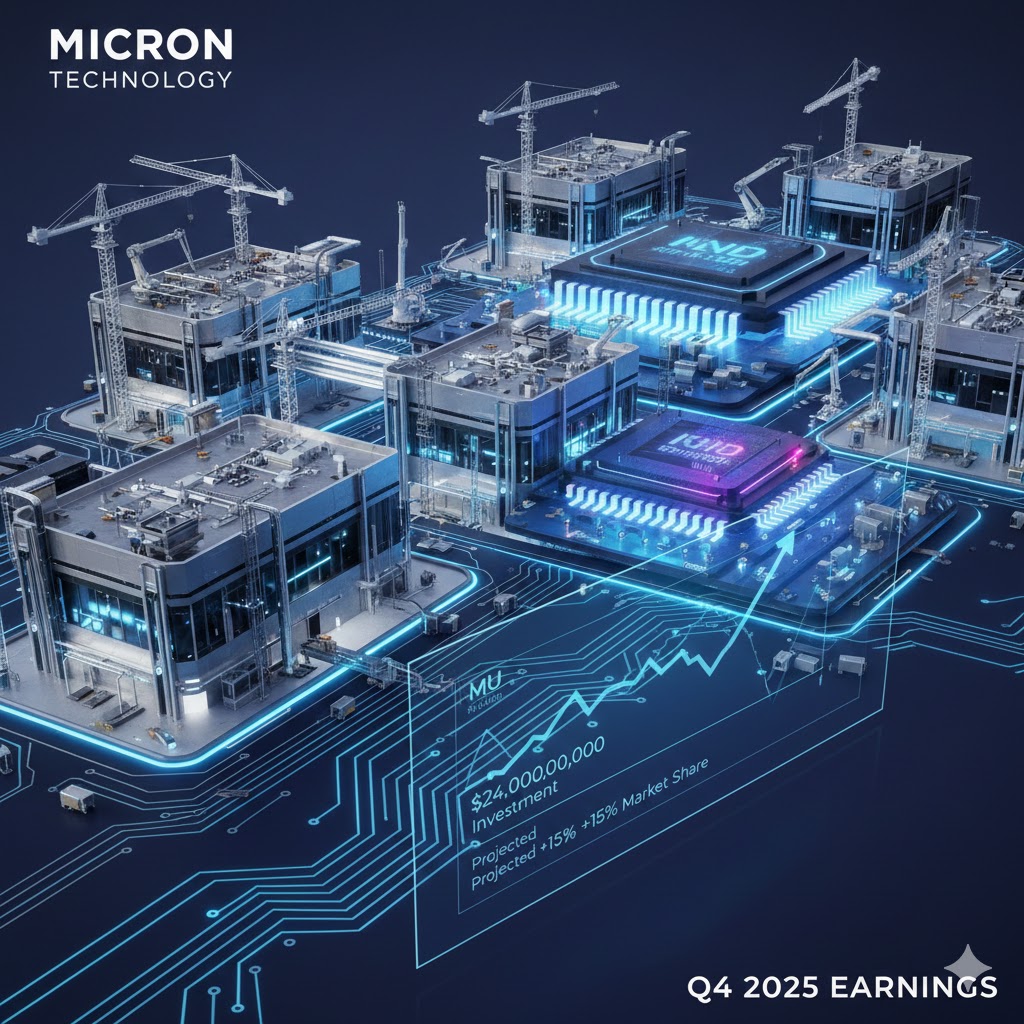
As the storm of rising storage prices intensifies, U.S. memory chip giant Micron Technology (NASDAQ:MU) has seen its target price raised once again.

Deutsche Bank significantly raised its target price for Micron Technology while maintaining its “Buy” rating on the stock. The bank’s analysts recently stated that the current memory cycle is “different from past cycles,” which could mean that Micron’s stock still has substantial room for growth.

Deutsche Bank analyst Melissa Weathers expects the supply shortage of dynamic random-access memory (DRAM) to last until at least 2027 or even 2028—especially as the artificial intelligence (AI) boom has led to a surge in demand for high-bandwidth memory (HBM).

HBM is made by stacking DRAM chips and is critical for advanced AI chips, such as those designed by NVIDIA (NASDAQ:NVDA). Micron, along with South Korea’s SK Hynix and Samsung Electronics, is considered one of the “Big Three” in the global HBM market, with the three companies collectively monopolizing more than 97% of the global HBM market share.

In a report released on Tuesday, Weathers noted that compared to traditional DRAM, HBM has approximately three times the “silicon density,” meaning it requires more wafers for chip cutting. She stated that this high density “is causing a supply shock that we believe has not been fully understood.” The supply tightness has enabled companies like Micron to raise prices and sign long-term contracts with customers.

At the same time, Weathers noted that new DRAM wafer plants will take at least two years to come online, and the expansion capacity of existing plants is limited, making it difficult to alleviate the demand pressure. However, she mentioned that as new production capacity gradually comes online next year, the supply constraints may ease.

Weathers believes these trends will create “a more structurally profitable environment” for Micron, raising the stock’s target price by a substantial 67% to $500—more than 30% above the latest closing price.

Deutsche Bank also raised its earnings per share (EPS) forecast for Micron’s fiscal year 2026 to $46.50, with the new target price based on about 11 times this number.

Micron’s stock fell 2.67% on Tuesday, continuing the downward trend from Monday, after reports surfaced that Micron’s competitor Samsung plans to begin mass production of next-generation HBM4 later this month, for use by NVIDIA (NASDAQ:NVDA) in its upcoming Vera Rubin graphics processing unit (GPU).

Over the past year, Micron’s stock has surged by an impressive 300%. Recently, several investment banks, including UBS, Mizuho, and HSBC, have raised their ratings on the stock.

Last month, during Micron’s first-quarter fiscal year 2026 earnings call, the company stated that all of its HBM capacity for 2026 had already been sold out, and it expects the total addressable market (TAM) for HBM to reach $100 billion by 2028 (up from $35 billion in 2025).

OpenAI Races Towards $100 Billion Financing, Altman Claims ChatGPT’s Monthly Growth Rate Returns to Over 10%

Amid growing competitive pressure, OpenAI CEO Sam Altman has informed both employees and investors that the company is maintaining strong momentum in its development.

According to an internal Slack message seen by the media, Altman told OpenAI employees last Friday that the company’s popular AI chatbot, ChatGPT, has “reached a monthly growth rate of over 10% once again.” He also mentioned that OpenAI is preparing to launch an “upgraded chatbot model” this week.

Currently, ChatGPT has surpassed 800 million weekly users, but Google(GOOGL) and Anthropic are steadily eating into its market share. In December last year, OpenAI announced that it had entered a “Code Red” state to make comprehensive improvements to ChatGPT, temporarily putting several projects on hold and concentrating resources on this goal.

In Friday’s internal communication, Altman also mentioned that OpenAI’s programming product Codex had seen a growth of about 50% over the past week.

Codex competes directly with Anthropic’s Claude Code, which has gained a large number of users over the past year.

Last week, OpenAI released a new Codex model—GPT-5.3-Codex—and launched a standalone app for users with Apple computers. According to internal messages, Altman described the growth of Codex as “absolutely crazy.”

“It’s been an amazing week,” Altman wrote.

Investor Messaging
Insiders revealed that as OpenAI approaches completing a financing round that could reach up to $100 billion, Altman and CFO Sarah Friar have been actively pitching the company’s growth story to investors.

In private discussions, the two executives emphasized OpenAI’s advantages in the consumer sector, the expanding enterprise business, and its access to computing resources.

As part of the fundraising discussions, OpenAI presented investors with several charts. According to internal data, Codex is steadily capturing market share from Claude Code.

Insiders said that OpenAI expects the fundraising negotiations to intensify over the next two weeks.

As previously reported, OpenAI’s financing round may occur in two phases. The first phase could involve funding from Microsoft(MSFT), NVIDIA(NVDA), and Amazon(AMZN), with Amazon discussing a potential $50 billion investment in OpenAI. Following this, additional investments from entities like SoftBank could come into play, with SoftBank reportedly considering a $30 billion investment.

However, the specific details of this financing round are still in flux, and the final structure may change.

Ad Testing Launched
On Monday, OpenAI announced the launch of an ad test for ChatGPT in the United States, available to certain free and Go plan subscribers.

OpenAI stated that these ads will be clearly labeled and will appear at the bottom of the chatbot’s responses without affecting the content of the answers.

The digital advertising market has long been dominated by Google and Meta, with Amazon gradually becoming an important player in recent years.

It is reported that OpenAI expects that, in the long term, ad revenue will account for less than half of its overall earnings.