Tag Archives: AVGO

U.S. Babies May Join “Retail Investor Headquarters” Right at Birth, Wall Street Giants Eyeing the Opportunity

Recent reports reveal that the U.S. government is preparing to appoint financial technology firm Robinhood as the trustee for the “Trump Account” program, which would allow millions of newborns in America to join the “retail investor headquarters” right from birth.

As background, the so-called “Trump Account” is a deferred-tax investment program established under the “Big and Beautiful” bill passed last year, which is expected to go live this July.

The bill itself only proposes a $1,000 allocation for children born between 2025 and 2028, but any child under 18 in the U.S. will be able to open an account and receive the grant. Funds provided by Congress will be required to be immediately invested in low-fee U.S. stock funds, with investments locked until the beneficiary turns 18.

According to a forecast from the White House Economic Advisory Council last year, based on the 18-year rolling returns of the S&P 500 index from 1975 onwards, if only the $1,000 provided by the U.S. government is stored in the “Trump Account,” under a low return (annualized 5.4%) scenario, the account would grow to $2,577 by the time the baby turns 18. Under a medium return (annualized 10.3%) and high return (annualized 18.5%) scenario, the same amount would grow to $5,839 and $21,229, respectively.
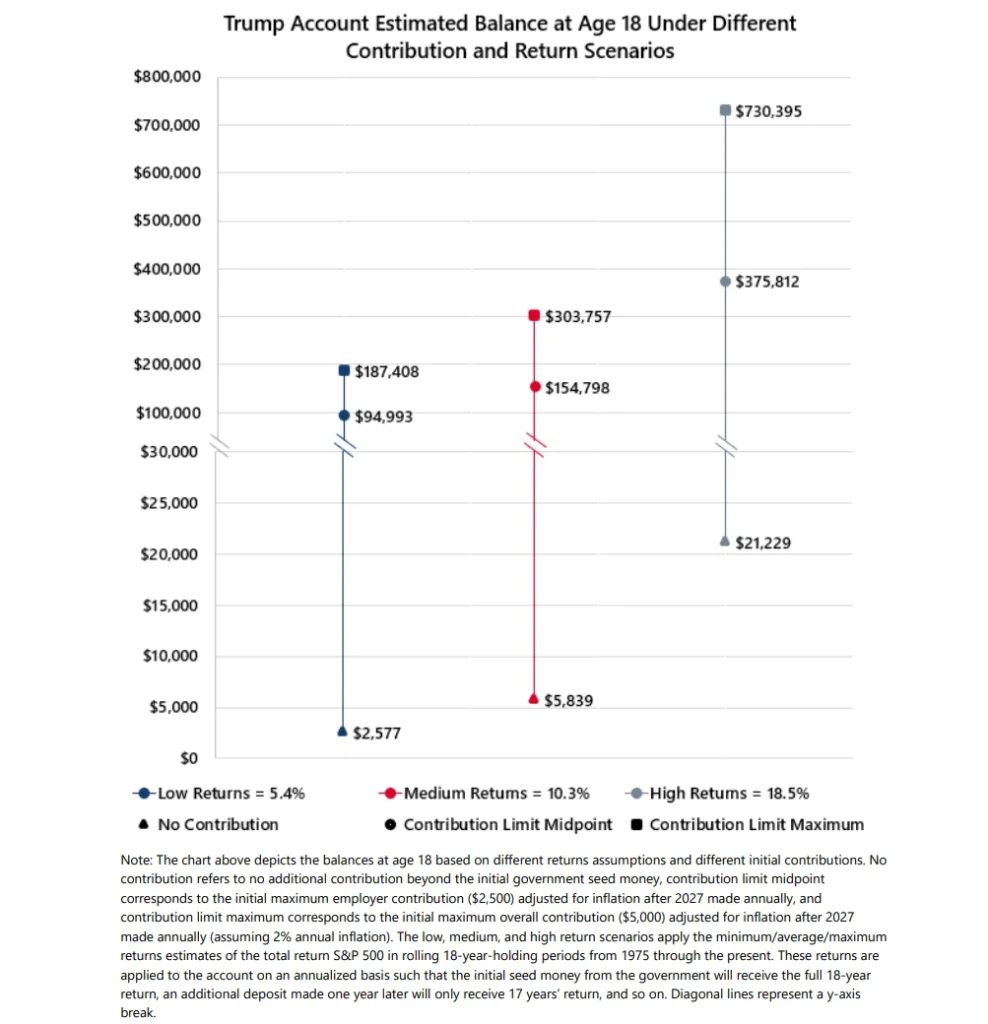
Meanwhile, children who save the maximum allowed for the “Trump Account” will see their balances at age 18 reach $180,000, $300,000, and $730,000 in these three scenarios.

Robinhood Stands Out, Wall Street Giants Also Have Plans

According to Friday’s latest reports, the financial technology brokerage Robinhood, known as the “retail investor headquarters,” has begun preparations internally to become the trustee for the program. In contrast, large fund management companies like Fidelity Investments and Vanguard have not yet been included in the list of candidates and have not been consulted about the matter.

Sources say that the U.S. Department of the Treasury is expected to announce the brokerages selected for the project soon, with up to three companies likely to serve as initial trustees.

For Robinhood, a brokerage that was founded just over a decade ago and made a name for itself during the pandemic, this program could bring millions of new customers. The competition for this trustee role reportedly began last summer. Shortly after the bill was signed by Trump, Robinhood CEO Vlad Tenev publicly stated that the company was “actively engaged in this process.”

At the same time, Wall Street giants like JPMorgan (NYSE:JPM) are adopting a “wait-and-see” strategy: these banks will seek to manage the rollover accounts rather than be the first-choice institutions for managing the initial accounts. Given that many of the account holders may not even know what a “fund” is, how to handle the needs of millions of new clients will be a significant challenge. Some banks believe taking on a secondary role would be a simpler and more cost-effective way to participate.

Assets Under Management Are Expected to Keep Growing

In addition to the initial $1,000, many wealthy individuals and large corporations are adding money to these accounts.

According to unofficial statistics, Michael Dell, founder of Dell Technologies, and his wife Susan have contributed $6.25 billion to open accounts for 25 million children under the age of 10 who are not eligible for government funding, with $250 allocated to each account.

The U.S. Treasury has also launched an initiative called the “50-State Challenge,” urging wealthy individuals in each state to donate to their local “Trump Accounts.” Notable investors Ray Dalio and his wife Barbara Dalio have pledged $75 million to provide $250 for each of over 300,000 eligible children in Connecticut.

Additionally, companies like JPMorgan (NYSE:JPM), Bank of America (NYSE:BAC), Robinhood (NASDAQ:HOOD), Coinbase (NASDAQ:COIN), Broadcom (NASDAQ:AVGO), and Intel (NASDAQ:INTC) have announced their participation in this policy, injecting funds into their employees’ children’s “Trump Accounts.” According to rules released by the White House, each child’s parent’s employer can contribute up to $2,500 per year to the account


South Korea’s Semiconductor Exports Surge Over 70%! Philadelphia Semiconductor Index Hits Record High as Global “Chip War” Escalates

The semiconductor industry is flashing a major signal.

According to the latest data, during the first 20 days of this year, semiconductor exports from South Korea—often called the “canary in the coal mine” for the global economy—totaled $10.73 billion (approximately 74.7 billion RMB), representing a massive year-over-year surge of over 70%. This indicates that global demand for semiconductors remains exceptionally robust amidst the AI (Artificial Intelligence) wave. Following the news, shares of memory chip giant Samsung Electronics spiked, rising more than 3% during intraday trading on the 21st.

Chip stocks rallied broadly on the 21st. The Philadelphia Semiconductor Index rose 3.18%, hitting a new all-time high. Intel (NASDAQ:INTC, ) surged over 11%, Advanced Micro Devices (NASDAQ:AMD) rose more than 7%, Micron Technology (NASDAQ:MU) gained over 6%, ARM (NASDAQ:ARM) climbed over 6%, and Microchip Technology (NASDAQ:MCHP) rose over 4%, while Broadcom (NASDAQ:AVGO) fell by over 1%.

Prior to this, U.S.-listed storage chip stocks also saw a massive rally on Tuesday, with SanDisk soaring over 10% at one point. Institutional analysts pointed out that this round of price hikes in memory chips is not driven by short-term market sentiment, but by the dual factors of “limited advanced process capacity” and “rigid growth in AI server demand.” The sustainability of this trend is significantly stronger than historical cycles.

A Surge of Over 70%

On January 21, local time, data disclosed by the South Korean customs department showed that from January 1 to January 20, 2026, South Korea’s total exports reached $36.36 billion, a year-over-year increase of 14.95%. Imports totaled $36.98 billion, up 4.2%, resulting in a trade deficit of approximately $600 million.

By product category, semiconductor exports during the first 20 days of the month reached $10.73 billion, a year-over-year jump of 70.2%. This accounted for 29.5% of total exports, an increase of 9.6 percentage points compared to the same period last year.

Exports of petroleum products reached $2.46 billion (up 17.6%), and steel products totaled $2.4 billion (up 1.2%). However, automobile exports fell 10.8% to $2.87 billion, and ship exports saw a sharp decline of 18.1%.

As a major global semiconductor exporter and home to two memory giants—Samsung Electronics and SK Hynix—South Korea has become one of the biggest winners as the global AI boom drastically boosts demand for memory chips.

Driven by this demand, South Korea’s exports in December 2025 grew 13.4% year-over-year to $69.6 billion, marking the 11th consecutive month of growth.

For the full year of 2025, South Korea’s total exports reached a record high of $709.7 billion, marking the first time in history that annual exports have surpassed the $700 billion threshold.

According to the latest data from the South Korean Ministry of Science and ICT, thanks to the expansion of demand for high-value-added memory and the continuous rise in prices of general semiconductors such as DRAM, South Korea’s annual semiconductor exports in 2025 reached a record $173.48 billion, up 22.1% year-over-year. This marks the second consecutive year of double-digit growth.

Significant Upgrades

Citigroup has significantly raised the price targets for storage chip giants, most notably hiking SanDisk’s target from $280 to $490 per share—a 75% increase.

Citigroup expressed optimism regarding the strong demand for data center memory, favorable supply-demand conditions, and the company’s powerful competitive moat. SanDisk is expected to continue growing its market share in the enterprise SSD (Solid State Drive) segment.

Simultaneously, Citigroup maintained a “Buy” rating on Seagate Technology, raising its target price from $320 to $385 (an increase of about 20%). Western Digital’s target was also raised from $200 to $280 (an increase of about 40%).

The Citigroup report noted that these companies remain the primary beneficiaries of “strong demand from hyperscale data centers supporting rising storage prices.” Spending by hyperscalers “remains strong,” which will drive demand for power, storage, connectors, and fiber optics.

Divya Mathur, an emerging markets equity fund manager at ClearBridge Investments, also explicitly stated that the market is significantly undervaluing the memory chip demand driven by AI development.

Furthermore, an operations executive at Micron Technology emphasized in a recent interview that the global memory chip shortage has intensified over the past quarter and will persist beyond 2026. PC and smartphone manufacturers are also joining the “scramble” to lock in memory chip supplies for 2026 and beyond. The core reason is the explosive growth in demand for high-end semiconductors for AI infrastructure.

SK Hynix revealed that its chip production capacity for 2026 is already fully sold out, and its high-end memory products for AI are completely booked.

TrendForce also noted in its latest report that the current price increases in storage chips are not driven by temporary market sentiment. Instead, they result from the combined effects of “limited capacity in advanced processes” and “rigidly growing demand for AI servers,” making this cycle notably more durable than previous ones.

Data shows that capital expenditures by the world’s eight leading cloud providers are expected to grow by approximately 65% year-over-year in 2025. Annual reports from IDC and Gartner confirm that AI servers have become the fastest-growing segment in data center IT investment, with storage systems as critical infrastructure set to benefit significantly from this trend.

ARK Invest Tracker: Cathie Wood Buys 30K+ Broadcom Shares, Sweeps Up eVTOL Leaders Joby and Archer

On Thursday, U.S. time, the three major stock indices closed mixed. While tech giants like Nvidia pulled back, the defense sector saw a broad rally fueled by President Trump’s proposal to increase military spending.

Against this backdrop, Cathie Wood is executing a clear sector rotation: doubling down on the “low-altitude economy” and AI hardware, while locking in profits or trimming positions in the recently red-hot defense and space sectors.

Accumulation: Bullish on the “Low-Altitude Economy,” Buying Broadcom on the Dip

The most striking moves in ARK’s latest buy list are the massive bets on the eVTOL (Electric Vertical Take-off and Landing) sector, purchasing over 160,000 shares of Joby Aviation (JOBY) and over 70,000 shares of Archer Aviation (ACHR).

As we enter 2026, the market widely regards this as the “Year of Commercialization” for eVTOLs. Wood’s heavy investment in these two industry leaders sends a strong signal: she believes the tipping point for regulatory approval (such as FAA certification) and commercial operations has arrived. Rather than waiting for a distant future, she is positioning for the imminent launch of “air taxi” services—a bet not just on technology, but on the transformation of urban mobility.

In the AI hardware space, ARK added 31,600 shares of Broadcom (AVGO). As the leader in networking chips and custom ASIC solutions, Broadcom plays an indispensable role in AI data center construction. This move suggests Wood remains confident in the sustained demand for AI infrastructure. Compared to some overvalued AI stocks, Broadcom is viewed as a more resilient core AI asset due to its robust cash flow and monopoly in Ethernet switching.

Divestment: Trimming Defense and Space Stocks

In sharp contrast to her purchases of “civilian” aircraft, Wood hit the sell button on the military and space sectors.

  • Palantir (PLTR): Reduced by 58,700 shares. As a leader in AI and defense data analytics, this move is likely profit-taking or valuation-driven portfolio management.
  • Rocket Lab (RKLB): Sold 24,900 shares. ARK chose to reduce exposure to this commercial space newcomer amid recent volatility.
  • Kratos Defense (KTOS) & AeroVironment (AVAV): Trimmed by 20,100 and 2,017 shares, respectively. Both are major players in the military drone space.

This creates a fascinating “hedge”: selling military drones to buy civilian eVTOLs. It suggests Wood may judge that defense sector premiums have become overextended in the short term, whereas the growth potential and value proposition of the civilian low-altitude economy are currently more attractive.