Category Archives: Best Stocks To Buy For 2026

Fed’s Internal Debate: Is AI a Reason for Rate Cuts or an Inflation Concern?

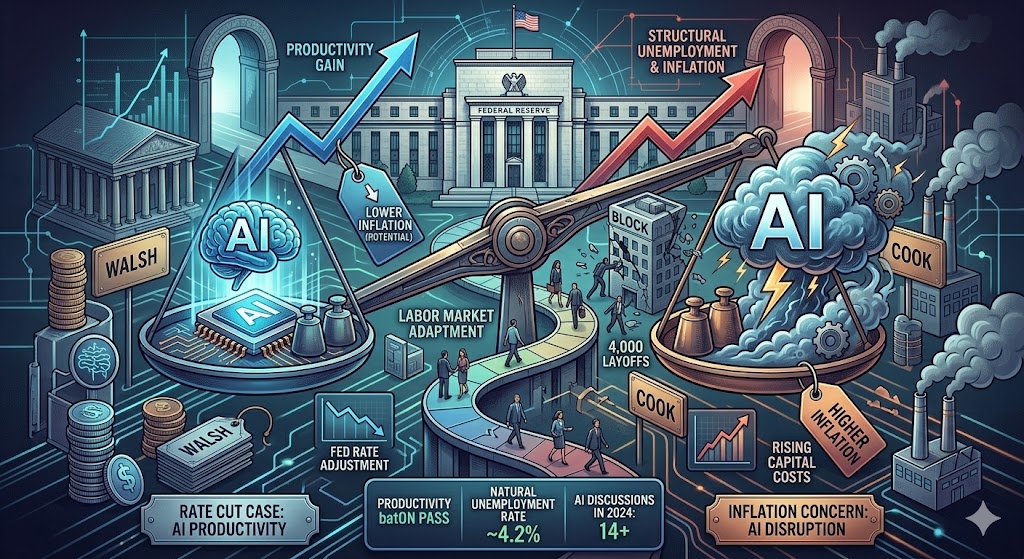
Throughout the history of the Federal Reserve, no technology has caused as much concern among policymakers as AI. Will AI create room for rate cuts, as predicted by Walsh, or, as Cook suggests, lead to structural unemployment and rising inflation?

Fed officials have generally accepted that artificial intelligence will bring about significant changes to the economy, but they are struggling to grasp the timing and extent of these changes. Internal divisions are emerging regarding AI’s potential impacts on the labor market and prices.

On Thursday, tech company Block announced it would lay off 40% of its workforce (about 4,000 employees) due to changes in employment practices driven by AI. This news highlights the current risks.

Traditionally, layoffs typically push central banks toward more accommodative monetary policies. However, the transformation caused by AI is generating different reactions. Officials suggest that rising unemployment may become a norm, with displaced workers taking longer to find new jobs. Meanwhile, rising capital returns and wage increases for those still employed will continue to exert upward pressure on inflation.

“We are in the positive, real-shock phase of the cycle, but its main manifestation is an increase in real income, rather than a significant decline in inflation,” said Adam Posen, director of the Peterson Institute for International Economics, during a discussion on inflation. He noted that the rise in stock prices has increased household wealth, while large-scale capital investment has driven up electricity and construction costs in some regions, and he expects U.S. price pressures to intensify as a result. Those who believe AI will be a deflationary force in the short term are “completely wrong,” he stated.

Is Walsh Betting on AI-Driven Rate Cuts?

This group includes Fed Chair nominee Walsh, who believes interest rates should be lowered in part to accommodate productivity gains driven by AI, thereby helping to control inflation.

Walsh, whose Senate nomination and confirmation are still pending, argued in a November 2022 Wall Street Journal column that AI is “an important inflationary force that can raise productivity and enhance U.S. competitiveness,” and that the Fed should lower interest rates to adapt to this change.

Walsh likened his position to the forward-thinking stance taken by former Fed Chairman Alan Greenspan in the mid-1990s. However, Fed policymakers are becoming increasingly cautious about this view. They are concerned about how quickly AI translates into actual labor adjustments and whether the historical principle that “new technologies replace old jobs but ultimately create more employment” still holds true.

A thought experiment published last week by Citrini Research warned of a potential “job apocalypse,” triggering a brief but significant stock market sell-off. This indicates the level of concern investors and the public have about AI. The statement by Block, which owns financial tech services Square and Cash App, seems to highlight the disruptive potential of AI: unlike past automation developments that mainly impacted blue-collar production jobs, AI may be better suited to taking over white-collar tasks such as coding or data analysis.

Programming assistants may increase employee productivity, but Block CEO Jack Dorsey stated that AI, “combined with smaller, flatter teams, is fostering a completely new way of working that will fundamentally change the way companies are built and operated. And this process is accelerating.”

An increasing body of research suggests that AI can perform various tasks, including many knowledge-based jobs that high schools, colleges, and business schools have long focused on as part of workforce “future-proofing” efforts. A 2024 paper by Brookings Institution analysts found that over 30% of U.S. workers’ job tasks could be “disrupted,” and this proportion is likely even higher today.

Fed Struggles to Keep Up

The Fed is scrambling to keep pace. A statistical review of Fed research papers and speeches by policymakers on AI, machine learning, and related topics shows that before the release of ChatGPT in late 2022, there were few such discussions. In 2023, the number increased to five, with about 17 last year, and this year, the total has already reached 14, indicating a significant acceleration.

Minutes from the Fed’s January meeting reveal that AI and productivity were thoroughly discussed, including their implications for monetary policy. At least five policymakers have spoken on the topic over the past month.

As a group, they are far from considering AI as a reason for immediate rate cuts. While they agree that productivity seems to be improving, they are reluctant to credit AI for this, preferring to attribute it to more conventional efficiency gains driven by labor shortages during the pandemic.

Even as the “productivity baton” is being passed on, policymakers seem more inclined to view AI as leading to a structurally higher unemployment rate. If interest rates are lowered to mitigate this unemployment, it could risk pushing inflation higher.

The Fed’s framework is underpinned by a long-term “natural” unemployment rate, currently thought to be around 4.2%. If unemployment falls below this level, inflationary pressures tend to accumulate.

“If AI continues to improve productivity, economic growth could remain strong, even if severe disruptions in the labor market lead to higher unemployment rates,” said Fed Governor Cook last month. “During such productivity booms, rising unemployment may not necessarily mean a surplus of idle labor. Therefore, our conventional demand-side monetary policies may not be able to alleviate AI-driven unemployment without increasing inflationary pressures.” This view has been echoed by several of his colleagues.

The issue is far from settled.

Krishna Guha, Vice Chairman of Evercore ISI, argued that the loss of workers’ bargaining power could be a reason for a lower natural unemployment rate. As employees become more willing to keep their jobs and accept lower wage increases, downward pressure on inflation could occur. This argument aligns with Walsh’s conclusion on rate cuts, though for different reasons.

However, Fed officials’ public statements paint a more complicated picture: some workers are facing job pressures, others are gaining new productive potential, wealth growth is driving consumption in some households, resource constraints during the AI build-out, and high expected investment returns may push up the base interest rate.

“There are all sorts of predictions about AI’s rollout, effectiveness, energy efficiency, and its effects on the labor market,” said Richmond Fed President Barkin last week. “The only thing that’s certain is that these predictions will certainly be wrong. Whether overly optimistic or overly pessimistic, you can only figure it out as you go along.”

Starlink Enters Air Traffic, Bringing Low Earth Orbit High-Speed Internet to Flying Taxis

On Friday (February 27), electric vertical takeoff and landing (eVTOL) company Archer Aviation (NYSE:ACHR) announced on its official website that it will collaborate with Starlink to provide stable, reliable, and high-speed internet service for air taxis.

Under the agreement, Archer will install Starlink’s Low Earth Orbit (LEO) satellite internet system on its electric air taxi, Midnight, and conduct testing. The system is designed to provide high-speed, low-latency network connectivity for Midnight’s operations.

Archer stated that this marks Starlink’s official entry into the emerging air traffic sector, making it the industry’s first such collaboration.

In addition to providing internet access for passengers, Archer plans to use Starlink for communication between the aircraft, pilots, and ground engineering teams, thereby supporting the development of the company’s air taxi connectivity infrastructure.

Archer and Starlink also plan to work together to develop an interconnected solution to aid the development of future autonomous aircraft.

Archer emphasized that, unlike systems that rely on ground-based stations, Starlink’s constellation of Low Earth Orbit satellites can provide stable, high-bandwidth network coverage even in dense urban environments where low-altitude flight and cellular network coverage are typically unstable.

The press release pointed out, “These features make Starlink ideal for next-generation aviation platforms, such as air taxis operating at around 1,500 feet (approximately 457 meters) above cities and their surrounding areas.”

Archer’s founder and CEO, Adam Goldstein, said, “For Midnight flights, network connectivity is crucial. The uniqueness of Starlink lies in its ability to provide this connectivity.”

“This groundbreaking collaboration will offer our passengers and pilots seamless, high-speed network connections and the necessary conveniences.”

However, it’s important to note that Archer is still awaiting final approval from the Federal Aviation Administration (FAA) before it can officially begin commercial passenger operations.

GlaxoSmithKline Acquires 35Pharma for $950 Million, Adding Pulmonary Arterial Hypertension Drug HS235 to Its Portfolio

British pharmaceutical giant GlaxoSmithKline (NYSE:GSK) announced on Wednesday that it would acquire Canadian biotech company 35Pharma for $950 million in cash. This marks the second major deal under the leadership of new CEO Luke Miels, who aims to accelerate the company’s drug development pipeline.

Miels took over as CEO from Emma Walmsley last month. Currently, GSK faces pressure as patents for its core HIV medications are set to expire. To address the potential revenue decline, Miels has pursued a series of “strengthening acquisitions” to expand the company’s product pipeline. In January of this year, GSK agreed to acquire RAPT Therapeutics for $2.2 billion.

This acquisition brings 35Pharma’s experimental pulmonary arterial hypertension drug HS235 into GSK’s portfolio, bolstering the company’s future pipeline in respiratory diseases. 35Pharma focuses on developing novel protein-based therapies.

GSK Chief Scientific Officer Tony Wood said, “Pulmonary arterial hypertension affects millions of patients worldwide, but there remains an unmet medical need. We are excited to bring HS235 into our development pipeline. It is an innovative drug with the potential to be best-in-class, offering differentiated features that could reduce bleeding risks and provide potential metabolic benefits relevant to pulmonary hypertension patients.”

Pulmonary arterial hypertension is a life-threatening disease characterized by abnormally high blood pressure in the lungs, with over 80 million patients globally. Current treatment options include the injection drug Winrevair, launched by Merck.

The global pulmonary hypertension treatment market is expected to reach $18 billion by 2032, with therapies based on “Activin signaling pathway inhibitors” projected to capture approximately 50% of the market share.

So far this year, GSK’s stock price has risen nearly 21%. After a turbulent 2025, the company’s stock has rebounded significantly, outperforming several European peers.

Miels previously stated that GSK will continue to focus on the “downstream” complications of obesity, such as liver disease and heart disease, as the market for weight loss treatments becomes increasingly crowded.

HS235 is currently in the early stages of development and is being designed to treat obese patients with certain heart conditions, as well as those who have previously received pulmonary arterial hypertension treatment. It is a candidate drug with the potential to become “best-in-class.”

In experiments with obese mice suffering from “heart failure with preserved ejection fraction” (HFpEF), HS235 selectively reduced fat mass and improved heart function. If clinical trials are successful, the injectable drug may be administered once every four weeks, with the possibility of extending the dosing interval.

Additionally, on Tuesday, GSK reached a deal worth up to $1 billion for global development rights to Frontier Biotechnologies’ treatments for kidney diseases.