Tag Archives: MSFT

Wall Street Analysts: The Selloff Has Gone Too Far—U.S. Software Stocks Have Fallen Into a “Golden Pit”

Mark Luschini, Chief Investment Strategist at Janney Montgomery Scott, said: “It seems people now think software prices will fall in a straight line to zero. This one-sided trade is so obvious that it could actually set the stage for a rebound.”
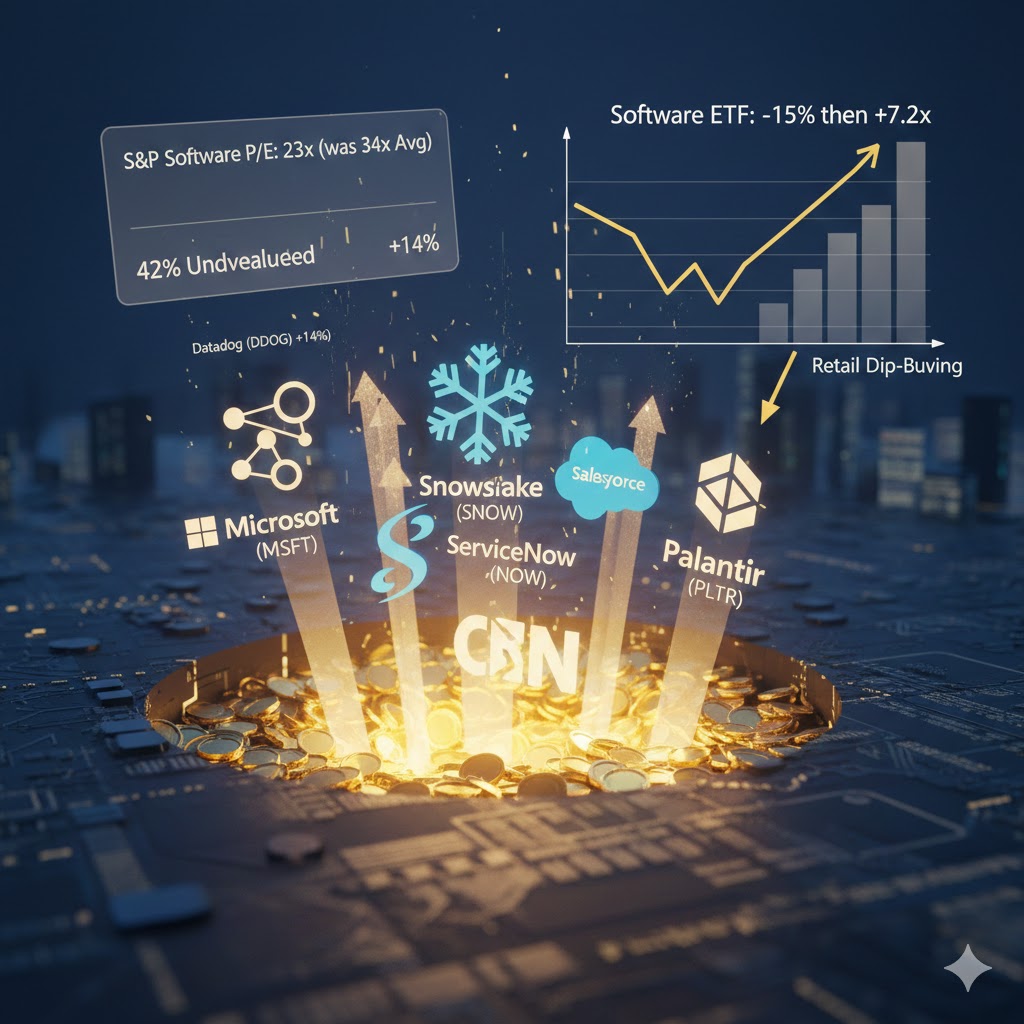
These stocks are currently at historic lows. The forward price-to-earnings ratio of the S&P North American Software Index fell below 20 for the first time last week. Although it has since rebounded to around 23 times as stocks recovered somewhat, it remains well below its long-term average P/E of 34.

Jefferies studied the 64 software stocks under its coverage and found that “42% are trading at or near their historical undervaluation levels,” analysts led by Brent Thill wrote in a report to clients on Sunday.

Michael Toomey of Jefferies’ equity trading desk said, “I think software stocks are about to see a strong rebound.” Technical traders at BTIG expressed a similar view, writing in a report last week that software stocks are “on the verge of capitulation and should find a tactical bottom here.”

The rebound appears to have already begun. A closely watched ETF tracking the software industry fell 15% over eight consecutive trading days from January 26 to February 4, but has since rebounded 7.2%. According to Vanda Research, retail investor buying of the ETF “hit a record,” which Vanda described as “one of the most aggressive instances of dip-buying in tech stocks—particularly software stocks—that we have observed in our dataset.”

Although uncertainty still hangs over the sector, the selloff has been so broad that many companies previously expected to be long-term winners have not been spared. Companies most frequently cited by market experts include Microsoft (NASDAQ:MSFT), Snowflake (NYSE:SNOW), ServiceNow (NYSE:NOW), Salesforce (NYSE:CRM), and Palantir (NASDAQ:PLTR).

Data analytics software company Snowflake fell 27% in just six trading days from January 29 to February 5. However, the company holds a favorable position within the artificial intelligence ecosystem. Last week, Snowflake signed a $200 million multi-year partnership agreement with OpenAI and reached a similar deal with Anthropic PBC in December. In a February 5 report to clients, Thill wrote that Snowflake is “one of the clearest AI beneficiaries in the entire public software universe.” Institutions including UBS, Loop Capital, Wedbush, Bank of America, and DA Davidson have also spoken highly of Snowflake.

Michael Mullaney, Director of Global Market Research at Boston Partners, noted the weakness in Salesforce, ServiceNow (NYSE:NOW), and Workday (NASDAQ:WDAY). He said that if he were focused on growth stocks rather than value stocks, he would be buying these names on the dip.

Datadog (NASDAQ:DDOG) was also mentioned. Its shares surged 14% on Tuesday, marking the biggest gain since November, after the company reported strong results and issued better-than-expected revenue guidance.

AI coding—using artificial intelligence to write software code—is at the core of the market’s bearish sentiment toward software. If AI services offered by companies such as Anthropic or OpenAI can replace existing software packages, it would put significant pressure on the revenues, margins, and pricing power of the displaced companies. The recent stock market plunge was largely triggered by Anthropic’s launch of a legal workflow automation tool, followed by another tool focused on financial research. Earlier, an AI tool from Alphabet Inc. had also caused sharp declines in video game and mobile advertising stocks.

So far, this disruptive shift has largely been anticipated, but its magnitude remains difficult to quantify. Industry research forecasts that earnings growth for the software and services sub-sector will reach 14.1% in 2026. While this growth rate is below the broader technology sector’s expected 31.7% expansion—driven by the booming semiconductor industry—it exceeds the S&P 500 Index’s projected growth rate of 13.7%. Software sales are showing a similar trend.

Luschini of Janney said: “There’s a lot of speculation about what might happen, but so far nothing has actually happened. The market is trying to price in future risks, but at this point, that speculation seems more hypothetical than real.”

Even so, software skeptics do have some warning signs to point to. Shares of monday.com (NASDAQ:MNDY) fell 21% earlier this week after the company issued disappointing revenue guidance. S&P Global (NYSE:SPGI) also dropped 9.7% on Tuesday after releasing similarly disappointing earnings guidance.

However, most of these cases appear to be isolated. Data show that of the 10 software companies in the S&P 500 that have reported earnings so far this season, all 10 exceeded earnings expectations and eight beat revenue estimates. This outperformance rate exceeds that of the broader S&P 500, where 81% of companies have beaten earnings expectations and 66% have topped revenue forecasts.

Mullaney said such performance demonstrates that current trends are not severe enough to justify investors abandoning the software sector altogether. “A mere slowdown in earnings growth does not explain the magnitude of these stock declines,” he said. “However, I do believe that concerns about AI-driven disruption provide a reasonable justification for profit-taking.”

OpenAI Races Towards $100 Billion Financing, Altman Claims ChatGPT’s Monthly Growth Rate Returns to Over 10%

Amid growing competitive pressure, OpenAI CEO Sam Altman has informed both employees and investors that the company is maintaining strong momentum in its development.

According to an internal Slack message seen by the media, Altman told OpenAI employees last Friday that the company’s popular AI chatbot, ChatGPT, has “reached a monthly growth rate of over 10% once again.” He also mentioned that OpenAI is preparing to launch an “upgraded chatbot model” this week.

Currently, ChatGPT has surpassed 800 million weekly users, but Google(GOOGL) and Anthropic are steadily eating into its market share. In December last year, OpenAI announced that it had entered a “Code Red” state to make comprehensive improvements to ChatGPT, temporarily putting several projects on hold and concentrating resources on this goal.

In Friday’s internal communication, Altman also mentioned that OpenAI’s programming product Codex had seen a growth of about 50% over the past week.

Codex competes directly with Anthropic’s Claude Code, which has gained a large number of users over the past year.

Last week, OpenAI released a new Codex model—GPT-5.3-Codex—and launched a standalone app for users with Apple computers. According to internal messages, Altman described the growth of Codex as “absolutely crazy.”

“It’s been an amazing week,” Altman wrote.

Investor Messaging
Insiders revealed that as OpenAI approaches completing a financing round that could reach up to $100 billion, Altman and CFO Sarah Friar have been actively pitching the company’s growth story to investors.

In private discussions, the two executives emphasized OpenAI’s advantages in the consumer sector, the expanding enterprise business, and its access to computing resources.

As part of the fundraising discussions, OpenAI presented investors with several charts. According to internal data, Codex is steadily capturing market share from Claude Code.

Insiders said that OpenAI expects the fundraising negotiations to intensify over the next two weeks.

As previously reported, OpenAI’s financing round may occur in two phases. The first phase could involve funding from Microsoft(MSFT), NVIDIA(NVDA), and Amazon(AMZN), with Amazon discussing a potential $50 billion investment in OpenAI. Following this, additional investments from entities like SoftBank could come into play, with SoftBank reportedly considering a $30 billion investment.

However, the specific details of this financing round are still in flux, and the final structure may change.

Ad Testing Launched
On Monday, OpenAI announced the launch of an ad test for ChatGPT in the United States, available to certain free and Go plan subscribers.

OpenAI stated that these ads will be clearly labeled and will appear at the bottom of the chatbot’s responses without affecting the content of the answers.

The digital advertising market has long been dominated by Google and Meta, with Amazon gradually becoming an important player in recent years.

It is reported that OpenAI expects that, in the long term, ad revenue will account for less than half of its overall earnings.

AI Arms Race Sparks Semiconductor Surge, NVIDIA Rises Nearly 8%, Achieving the Strongest Rally in 10 Months

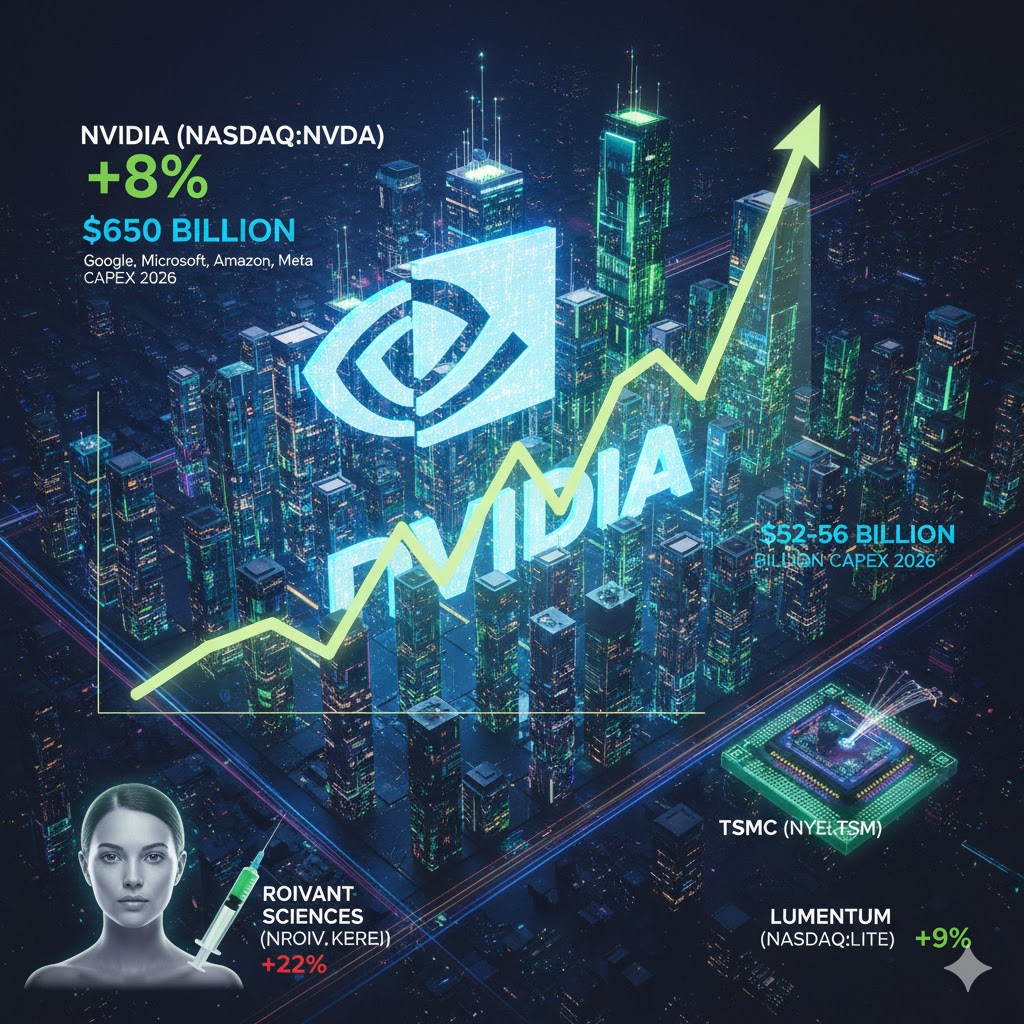
The AI “arms race” has triggered a semiconductor frenzy, with NVIDIA (NASDAQ:NVDA) stock surging nearly 8%, marking its strongest rise in nearly 10 months. Earlier, six of the seven tech giants had already reported their earnings, with the most noteworthy being that Google (NASDAQ:GOOGL), Microsoft (NASDAQ:MSFT), Amazon (NASDAQ:AMZN), and Meta Platforms (NASDAQ:META) will collectively spend approximately $650 billion on capital expenditures in 2026.

Last week, Meta announced its capital expenditures would rise to as much as $135 billion for the year, representing an 87% increase. Meanwhile, Microsoft reported a 66% year-on-year growth in its capital expenditures for Q2, and analysts predict its fiscal year capital spending through June will approach $105 billion.

Jensen Huang, CEO of NVIDIA, specifically praised OpenAI and Anthropic, two leading AI labs, stating that both are “making a lot of money.” NVIDIA invested $10 billion in Anthropic last year, and Huang earlier this week indicated plans to significantly invest in OpenAI’s next funding round. He mentioned, “If they can have twice the computing power, their revenue will increase fourfold.”

Earlier, Taiwan Semiconductor Manufacturing Company (NYSE:TSM), the world’s leading semiconductor foundry, set new performance records and announced plans to significantly increase its capital expenditures to $52-56 billion in 2026, far exceeding market expectations. This is aimed at accelerating the expansion of advanced manufacturing capacity to address the ongoing global shortage of AI chips.

CPO Industry Accelerates, Lumentum Surges Over 9%

NVIDIA, in a recent webinar, announced that three partners—CoreWeave (NYSE:CRWV), Lambda, and TACC—will deploy the IB CPO system in the first half of 2026, and Ethernet CPO products are expected to start shipping in the second half of 2026. The company believes that the CPO industry is advancing more quickly than expected, with the technology first landing in scale-out scenarios and expanding into larger market spaces. As a next-generation optical interconnect solution, the commercial value of CPO continues to become clearer, and its market potential is expanding.

Lumentum (NASDAQ:LITE) CEO Michael Hurlston stated in a recent earnings call that the company’s ongoing growth is primarily driven by cloud optical modules, OCS, and CPO. The development of the OCS business has exceeded expectations, with the first $10 million quarterly revenue target, initially set for Q3, being reached ahead of schedule. Demand for OCS from three core customers has surged, and Hurlston revealed that there is a backlog of over $400 million in OCS orders, most of which are planned to be delivered in the second half of 2026. Orders and revenue are expected to continue growing as they enter 2027.

Roivant Sciences Surges Over 22% After Promising Skin Disease Results

Roivant Sciences (NASDAQ:ROIV) saw its stock rise more than 22% after its subsidiary Priovant Therapeutics reported positive results from the phase 2 trial of its experimental drug brepocitinib. The drug showed improvements in the activity of skin nodular disease at higher doses. Another subsidiary, Pulmovant, also announced the completion of phase 2 trial enrollment involving around 120 patients for its experimental drug mosliciguat, aimed at treating pulmonary arterial hypertension associated with lung disease.

Priovant reported that patients taking a 45 mg dose showed a 22.3-point improvement on a key skin scoring system at week 16, while the placebo group showed only a 0.7-point improvement. The company noted that all patients in the 45 mg group showed significant improvement, with 62% achieving near-complete skin clearance, and 69% achieving complete or nearly complete clearance, while none of the placebo group patients achieved similar results.

Priovant plans to launch phase 3 trials in 2026, following consultations with the U.S. Food and Drug Administration (FDA).