Tag Archives: PLTR

Wall Street Analysts: The Selloff Has Gone Too Far—U.S. Software Stocks Have Fallen Into a “Golden Pit”

Mark Luschini, Chief Investment Strategist at Janney Montgomery Scott, said: “It seems people now think software prices will fall in a straight line to zero. This one-sided trade is so obvious that it could actually set the stage for a rebound.”
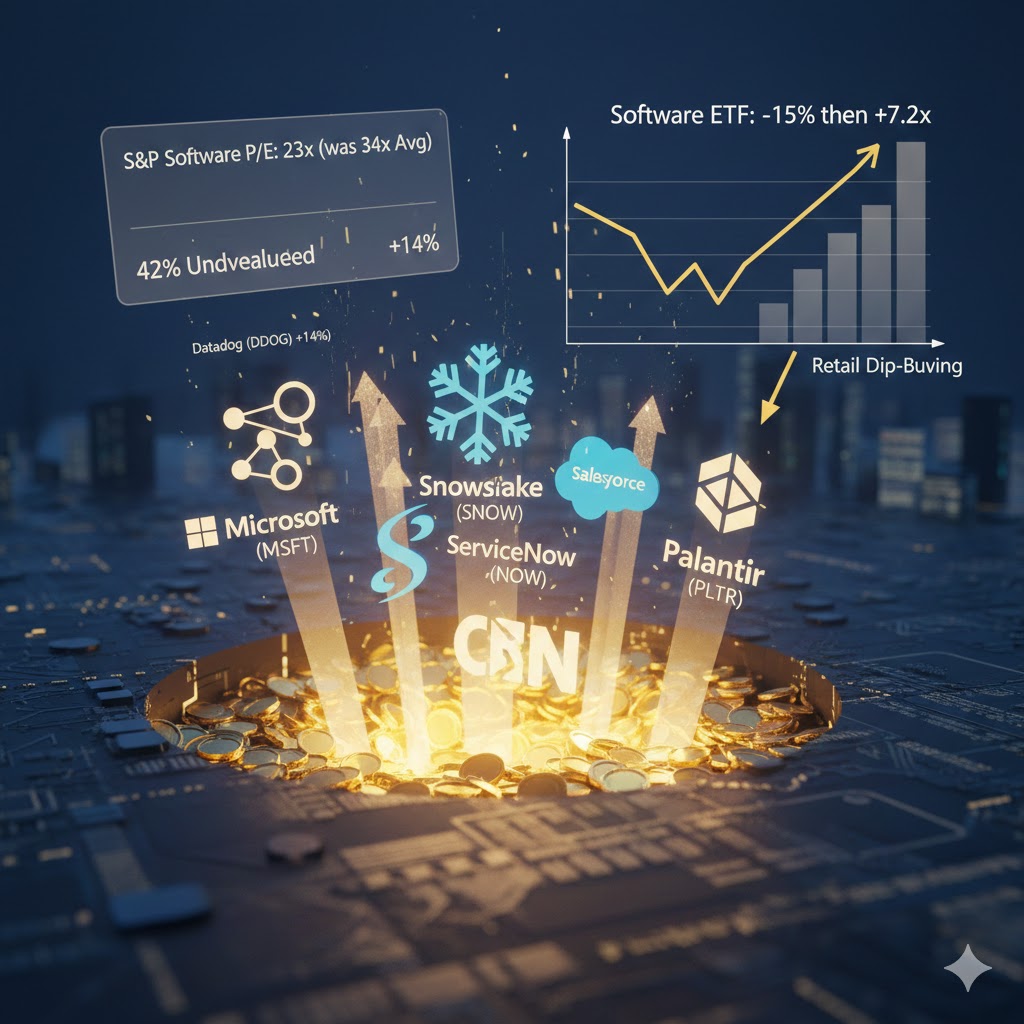
These stocks are currently at historic lows. The forward price-to-earnings ratio of the S&P North American Software Index fell below 20 for the first time last week. Although it has since rebounded to around 23 times as stocks recovered somewhat, it remains well below its long-term average P/E of 34.

Jefferies studied the 64 software stocks under its coverage and found that “42% are trading at or near their historical undervaluation levels,” analysts led by Brent Thill wrote in a report to clients on Sunday.

Michael Toomey of Jefferies’ equity trading desk said, “I think software stocks are about to see a strong rebound.” Technical traders at BTIG expressed a similar view, writing in a report last week that software stocks are “on the verge of capitulation and should find a tactical bottom here.”

The rebound appears to have already begun. A closely watched ETF tracking the software industry fell 15% over eight consecutive trading days from January 26 to February 4, but has since rebounded 7.2%. According to Vanda Research, retail investor buying of the ETF “hit a record,” which Vanda described as “one of the most aggressive instances of dip-buying in tech stocks—particularly software stocks—that we have observed in our dataset.”

Although uncertainty still hangs over the sector, the selloff has been so broad that many companies previously expected to be long-term winners have not been spared. Companies most frequently cited by market experts include Microsoft (NASDAQ:MSFT), Snowflake (NYSE:SNOW), ServiceNow (NYSE:NOW), Salesforce (NYSE:CRM), and Palantir (NASDAQ:PLTR).

Data analytics software company Snowflake fell 27% in just six trading days from January 29 to February 5. However, the company holds a favorable position within the artificial intelligence ecosystem. Last week, Snowflake signed a $200 million multi-year partnership agreement with OpenAI and reached a similar deal with Anthropic PBC in December. In a February 5 report to clients, Thill wrote that Snowflake is “one of the clearest AI beneficiaries in the entire public software universe.” Institutions including UBS, Loop Capital, Wedbush, Bank of America, and DA Davidson have also spoken highly of Snowflake.

Michael Mullaney, Director of Global Market Research at Boston Partners, noted the weakness in Salesforce, ServiceNow (NYSE:NOW), and Workday (NASDAQ:WDAY). He said that if he were focused on growth stocks rather than value stocks, he would be buying these names on the dip.

Datadog (NASDAQ:DDOG) was also mentioned. Its shares surged 14% on Tuesday, marking the biggest gain since November, after the company reported strong results and issued better-than-expected revenue guidance.

AI coding—using artificial intelligence to write software code—is at the core of the market’s bearish sentiment toward software. If AI services offered by companies such as Anthropic or OpenAI can replace existing software packages, it would put significant pressure on the revenues, margins, and pricing power of the displaced companies. The recent stock market plunge was largely triggered by Anthropic’s launch of a legal workflow automation tool, followed by another tool focused on financial research. Earlier, an AI tool from Alphabet Inc. had also caused sharp declines in video game and mobile advertising stocks.

So far, this disruptive shift has largely been anticipated, but its magnitude remains difficult to quantify. Industry research forecasts that earnings growth for the software and services sub-sector will reach 14.1% in 2026. While this growth rate is below the broader technology sector’s expected 31.7% expansion—driven by the booming semiconductor industry—it exceeds the S&P 500 Index’s projected growth rate of 13.7%. Software sales are showing a similar trend.

Luschini of Janney said: “There’s a lot of speculation about what might happen, but so far nothing has actually happened. The market is trying to price in future risks, but at this point, that speculation seems more hypothetical than real.”

Even so, software skeptics do have some warning signs to point to. Shares of monday.com (NASDAQ:MNDY) fell 21% earlier this week after the company issued disappointing revenue guidance. S&P Global (NYSE:SPGI) also dropped 9.7% on Tuesday after releasing similarly disappointing earnings guidance.

However, most of these cases appear to be isolated. Data show that of the 10 software companies in the S&P 500 that have reported earnings so far this season, all 10 exceeded earnings expectations and eight beat revenue estimates. This outperformance rate exceeds that of the broader S&P 500, where 81% of companies have beaten earnings expectations and 66% have topped revenue forecasts.

Mullaney said such performance demonstrates that current trends are not severe enough to justify investors abandoning the software sector altogether. “A mere slowdown in earnings growth does not explain the magnitude of these stock declines,” he said. “However, I do believe that concerns about AI-driven disruption provide a reasonable justification for profit-taking.”

ARK Invest Tracker: Cathie Wood Buys 30K+ Broadcom Shares, Sweeps Up eVTOL Leaders Joby and Archer

On Thursday, U.S. time, the three major stock indices closed mixed. While tech giants like Nvidia pulled back, the defense sector saw a broad rally fueled by President Trump’s proposal to increase military spending.

Against this backdrop, Cathie Wood is executing a clear sector rotation: doubling down on the “low-altitude economy” and AI hardware, while locking in profits or trimming positions in the recently red-hot defense and space sectors.

Accumulation: Bullish on the “Low-Altitude Economy,” Buying Broadcom on the Dip

The most striking moves in ARK’s latest buy list are the massive bets on the eVTOL (Electric Vertical Take-off and Landing) sector, purchasing over 160,000 shares of Joby Aviation (JOBY) and over 70,000 shares of Archer Aviation (ACHR).

As we enter 2026, the market widely regards this as the “Year of Commercialization” for eVTOLs. Wood’s heavy investment in these two industry leaders sends a strong signal: she believes the tipping point for regulatory approval (such as FAA certification) and commercial operations has arrived. Rather than waiting for a distant future, she is positioning for the imminent launch of “air taxi” services—a bet not just on technology, but on the transformation of urban mobility.

In the AI hardware space, ARK added 31,600 shares of Broadcom (AVGO). As the leader in networking chips and custom ASIC solutions, Broadcom plays an indispensable role in AI data center construction. This move suggests Wood remains confident in the sustained demand for AI infrastructure. Compared to some overvalued AI stocks, Broadcom is viewed as a more resilient core AI asset due to its robust cash flow and monopoly in Ethernet switching.

Divestment: Trimming Defense and Space Stocks

In sharp contrast to her purchases of “civilian” aircraft, Wood hit the sell button on the military and space sectors.

  • Palantir (PLTR): Reduced by 58,700 shares. As a leader in AI and defense data analytics, this move is likely profit-taking or valuation-driven portfolio management.
  • Rocket Lab (RKLB): Sold 24,900 shares. ARK chose to reduce exposure to this commercial space newcomer amid recent volatility.
  • Kratos Defense (KTOS) & AeroVironment (AVAV): Trimmed by 20,100 and 2,017 shares, respectively. Both are major players in the military drone space.

This creates a fascinating “hedge”: selling military drones to buy civilian eVTOLs. It suggests Wood may judge that defense sector premiums have become overextended in the short term, whereas the growth potential and value proposition of the civilian low-altitude economy are currently more attractive.

First Trading Day of the New Year for U.S. Stocks: Defensive Sectors Like Energy Lead Gains While Tech Stocks Slide

On the first trading day of 2026, the U.S. stock market continued the market rotation trend seen at the end of 2025. Investors persisted in shifting from last year’s leading tech stocks toward defensive sectors such as energy and utilities. The $Dow Jones Industrial Average (.DJI)$ outperformed the $Nasdaq Composite Index (.IXIC)$ and the $S&P 500 Index (.SPX)$.

On Friday, the S&P 500 rose 0.2%, the Dow Jones Industrial Average climbed 0.7%, and the Nasdaq Composite fell slightly by 0.1%, marking its fifth consecutive trading day of losses. Tech stocks such as $Palantir (PLTR)$, $Applovin (APP)$, and $Microsoft (MSFT)$ dragged down the performance of major indices, while share prices in the energy, materials, and utilities sectors rose.

This market shift reflects simmering investor concerns regarding valuations and profitability within the artificial intelligence sector. Traders are rotating away from the “star stocks” of the AI field toward more defensive or diversified industry choices.

Tech Stocks Continue to Show Weakness

Performance among tech giants was mixed during Friday’s trading.

Shares of $Amazon (AMZN)$ and $Meta Platforms (META)$ retreated, while $Tesla (TSLA)$ fell 2.6% after reporting another year of declining delivery figures. Tesla shares have now fallen for seven consecutive trading days, setting a record for the stock’s longest losing streak in over a year.

Chipmakers $NVIDIA (NVDA)$ and $Micron Technology (MU)$ saw their shares rise, and data storage companies $Western Digital (WDC)$ and SanDisk also saw gains, serving as rare highlights within the tech sector.

The precious metals market experienced sharp volatility this week. Silver prices rose 0.6% on Friday, while gold suffered a cumulative weekly decline of 4.9%, marking its largest one-week drop since 2021.

AI Hype Faces a Critical Test

Following three consecutive years of strong stock market gains, whether artificial intelligence can drive major indices to new heights in 2026 has become a central concern for investors. In the final weeks of 2025, anxieties over AI spread across Wall Street, with critics pointing to overstretched tech valuations and expressing concern over the circular nature of certain transactions among major industry players.

David Bahnsen, Chief Investment Officer at The Bahnsen Group, stated: “The theme entering 2026 is a continuation of what we saw in late 2025—a very interesting and somewhat unexpected broadening of the market. There is a great deal of uncertainty surrounding how AI will be monetized.”

Jed Ellerbroek, Portfolio Manager at Argent Capital Management, noted that investors experienced a similar panic early last year when the Chinese company DeepSeek launched a low-cost AI model, yet the market rebounded quickly after a sell-off and continued to climb throughout the year. “Back then, it was more fear than fact,” Ellerbroek said.

Cautiously Optimistic Market Outlook

Although trading this week was relatively light and influenced by the New Year holiday, the rotation by investors was clearly visible. The Dow Jones outperformed the Nasdaq and S&P 500 in both November and December as traders shifted toward more defensive or diversified industry allocations.

Many investors still expect the stock market to continue rising in 2026. According to Dow Jones Market Data, the “January Barometer” hypothesis has been validated over the past four years—when the S&P 500 rises in January, there is a 79% probability that it will finish the year higher.

However, Bahnsen believes the market needs more clarity on AI concerns and economic direction before a clear upward trend can emerge in the early weeks of 2026. “Most market participants are neither brave enough to be excessively bullish nor excessively bearish,” he said. “That often leads to a sideways market.”