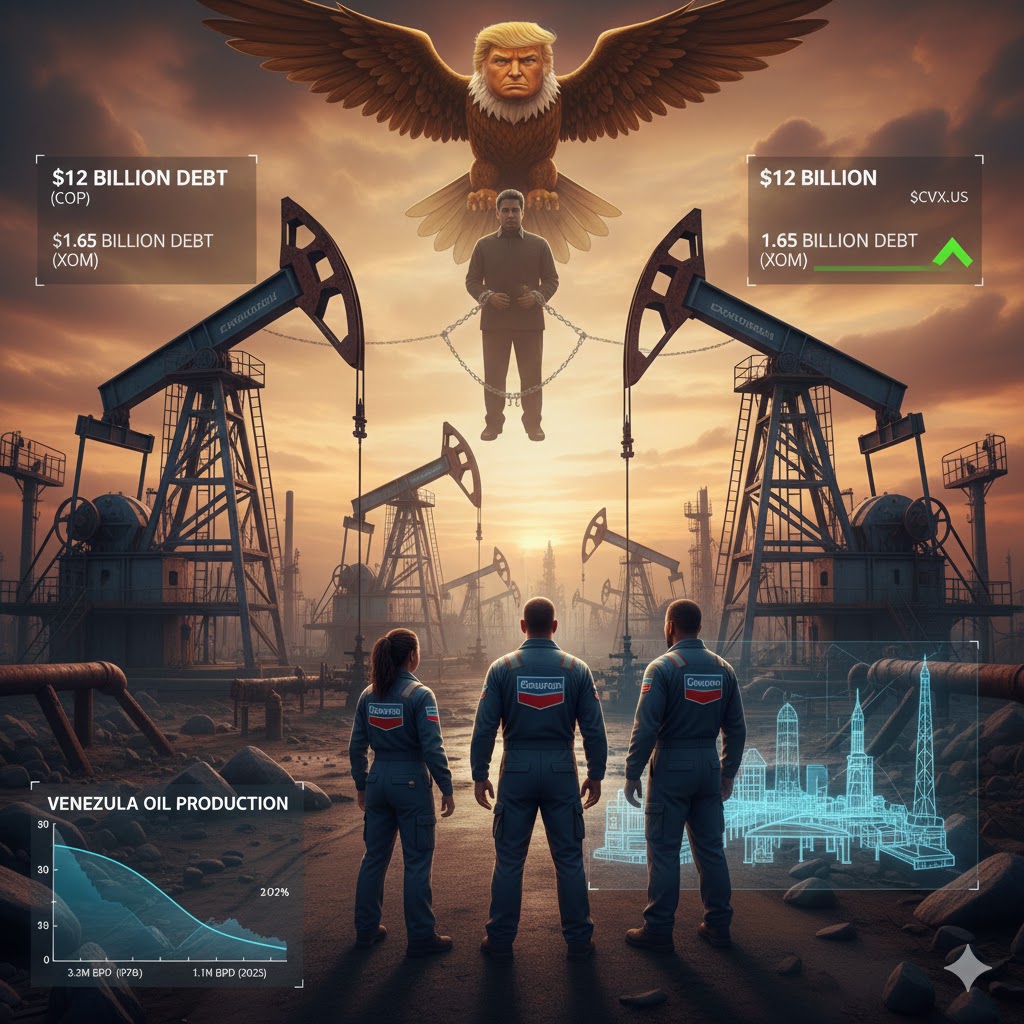
President Donald Trump stated on Sunday that he may move to block ExxonMobil (XOM) from investing in Venezuela, following comments by the company’s CEO describing the country as a market that currently lacks investment value.
The dispute stems from a meeting of oil executives held at the White House last Friday. During the session, ExxonMobil CEO Darren Woods told Trump bluntly that Venezuela would not be an attractive investment target unless it overhauled its legal framework.
Woods specifically noted that ExxonMobil’s assets had been confiscated by local authorities on two separate occasions since the company first entered Venezuela in the 1940s. His remarks highlight a persistent reluctance among top energy groups to commit massive capital without security guarantees, despite Trump’s attempts to lure them with promises of future prospects and a push for “at least $100 billion” in investment to boost production and lower U.S. gas prices.
Woods’ stance was a significant blow to Trump, who is currently lobbying U.S. oil giants to spend hundreds of billions to help revitalize Venezuela’s oil industry.
“I didn’t like the response from Exxon,” Trump told reporters Sunday while traveling back to Washington on Air Force One. “I’ll probably leave Exxon out. I wasn’t happy with their answer; they were being very cute.”
ExxonMobil has not yet issued an immediate comment on the matter.
Mixed Reactions from Industry Leaders
In contrast to Exxon’s hardline stance, other executives at the White House meeting reacted more positively to Trump’s proposal, suggesting a potential influx of capital in the short term.
- Chevron (CVX) stated it could increase production by 50% within 18 to 24 months by expanding its existing 240,000-barrel-per-day project.
- Shell (SHEL) CEO Wael Sawan noted the European giant has identified “billions of dollars in investment opportunities” and is “ready to go” as soon as U.S. sanction waivers are provided.
- Repsol claimed it could triple its production to 150,000 barrels per day within two to three years, while Italy’s Eni, which holds 4 billion barrels in reserves, also signaled readiness to increase investment.
Under further questioning from Trump during the meeting, Woods softened his tone slightly, stating that Exxon would send a technical team to Venezuela within weeks to assess the situation and expressed “confidence” that necessary reforms could be implemented.
However, even Harold Hamm, founder of Continental Resources and a long-time Trump ally, declined to make specific commitments. While he praised Venezuela’s reserves as “true gems,” he admitted the country presents both “exciting prospects” and “challenges” that the industry must navigate.
No Compensation for the Past
The mixed signals from Friday’s meeting reflect the dilemma facing oil companies: a desire to capture a share of the market versus a deep-seated fear of a politically volatile nation with a history of expropriating foreign assets.
“Investing heavily in Venezuela to meet the administration’s goals carries extremely high legal, political, and geopolitical risks,” noted Meghan O’Sullivan, a geopolitical and energy expert at Harvard University.
Despite his urgency for investment, Trump does not appear inclined to offer substantive concessions regarding compensation or financial guarantees.
For companies whose assets were previously seized, Trump made it clear that reimbursement is unlikely. He told Ryan Lance, CEO of ConocoPhillips (COP)—which suffered a $12 billion loss due to expropriation—”You’re going to make a lot of money in the future, but we aren’t going to look at the past.”
“We’re starting over,” Trump emphasized. “We’re not going to worry about who lost what in the past; that was their fault. That was during another presidency.”
Furthermore, Trump ruled out using U.S. taxpayer money to indemnify corporate investment risks, despite having mentioned the idea previously. “It’s not going to take government money,” he told the executives. “Our oil giants are going to spend at least $100 billion—that’s your money, not the government’s.”
When asked about financial backstops, Trump said he hoped they wouldn’t be necessary but suggested the U.S. government could provide some form of security and legal guarantees—a key demand from the industry. “You’re going to have absolute security,” he promised.
However, regarding physical security, Trump suggested that protection would be provided by the Venezuelan regime rather than the U.S. military. “I think the people of Venezuela are going to give you very good security.”
A High-Stakes Gamble
Legal experts believe that while there is “intense interest” in Venezuelan investment, there is a long road ahead before intentions turn into action.
“The difficulty right now is that the dust hasn’t settled, and the logistical and political challenges remain severe,” said Carlos Solé, co-chair of the Latin America practice at Baker Botts. He believes the process for obtaining licenses or sanction waivers from the Office of Foreign Assets Control (OFAC) must be streamlined before companies act.
Aurelio Fernandez-Concheso, head of the Clyde & Co office in Venezuela, said that while they have received numerous inquiries from clients in the oil, gas, shipping, and insurance sectors, everyone remains “highly cautious” until the situation clears.
“Picking up the phone to talk to a consultant is one thing,” he remarked. “It is quite another to actually sign a check and put money into that country.”