Tag Archives: NVO

AI Giants Open a New Front: Anthropic Launches Compliant Healthcare AI Tools to Rival OpenAI Health

AI startup Anthropic is working to make it easier for patients and clinicians to use its AI chatbot for medical information, part of a strategic push into the lucrative healthcare sector.

On Sunday local time—just days after OpenAI announced new tools for clinicians—Anthropic stated that its chatbot, Claude, will launch a new HIPAA-compliant healthcare service. Hospitals, providers, and consumers can use this service to process protected health data. Anthropic is also integrating scientific databases into its products and enhancing its biological research capabilities.

New Features for Consumers and Clinicians

On the consumer side, Anthropic is allowing users to export health data from applications such as Apple Health and Function Health, aiming to help them aggregate medical records and share them with healthcare providers.

These features were announced while Anthropic is reportedly raising funds at a $350 billion valuation. The back-to-back product launches from OpenAI and Anthropic signal Silicon Valley’s growing eagerness to advance in the healthcare sector to boost sales and demonstrate the broad societal benefits of AI.

“When we think about the overall economy and where AI can have the biggest impact, healthcare is a perfect fit once you get the regulatory and data pieces right,” said Mike Krieger, Anthropic’s Chief Product Officer and co-founder of Instagram. He noted the new tools are designed to “empower people with more knowledge, coming both from their data and from conversations with providers.”

Safety and Early Adoption

Founded in 2021 by former OpenAI employees, Anthropic has positioned itself as a reliable, safety-focused AI developer. While its software is particularly popular among engineers for automating coding tasks, it is beginning to see early traction with medical institutions. Notably, Anthropic CEO Dario Amodei is a trained biophysicist.

Anthropic reported that Banner Health, one of the largest non-profit healthcare systems in the U.S., has more than 22,000 clinical providers using Claude. Among them, 85% reported faster work speeds and higher accuracy. Anthropic is also collaborating with other major clients, including Novo Nordisk(NVO) and Stanford Health Care.

Competition and Privacy Risks

The makers of Claude face intense competition not only from OpenAI but also from traditional tech vendors and emerging startups aiming to apply AI advancements to drug discovery, medical paperwork, and patient record analysis. However, as AI handles sensitive personal data and provides advice on high-stakes health issues, these firms introduce new privacy and security risks.

To address these concerns, Anthropic stated that its medical answers reference citations from reputable publications like PubMed and the NPI Registry, ensuring clinicians can have greater confidence in the results. Anthropic also emphasized that it does not use medical user data to train its models.
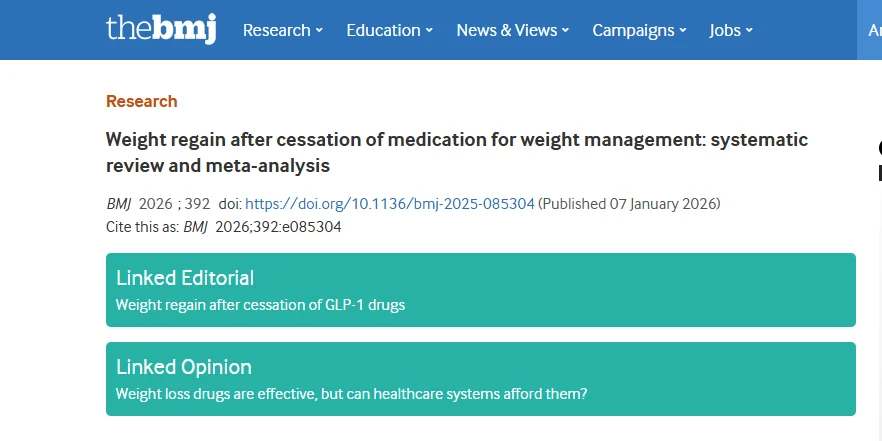
Meta-Analysis: Weight and Metabolic Benefits Revert to Baseline Within Two Years of Discontinuing Weight-Loss Drugs

A large-scale meta-analysis of previous studies has found that the benefits gained in weight loss and other health indicators by obese or overweight patients typically disappear within two years once they stop taking weight-loss medications.

Researchers analyzed data from 9,341 obese or overweight patients across 37 studies who had used 18 different weight-loss drugs. The results showed that after discontinuation, patients regained an average of nearly 1 pound (approx. 0.4 kg) per month. It is estimated that patients return to their pre-treatment weight levels within 1.7 years.

“Effect Zeroed Out” in Less Than Two Years

The study, published in The BMJ (British Medical Journal), indicates that as medication is stopped, cardiovascular risk factors improved by the treatment—including blood pressure and cholesterol levels—return to pre-treatment levels within an average of 1.4 years. Essentially, the clinical benefits are “zeroed out” in less than two years.

Among all subjects, approximately half had used GLP-1 receptor agonists. This included 1,776 individuals treated with the newest generation of more potent drugs: Semaglutide (marketed as Ozempic and Wegovy) by Novo Nordisk (NVO), and Tirzepatide (marketed as Mounjaro and Zepbound) by Eli Lilly (LLY).

A Structural Shift in Obesity Treatment

For a long time, weight loss achieved through diet and physical activity was considered the cornerstone of obesity treatment. However, the advent of GLP-1 drugs is driving a profound structural transformation. These new medications can help patients lose 15%–20% of their baseline weight within a year while simultaneously improving cardiometabolic markers such as blood sugar, blood pressure, and lipids. They have even shown positive signals in treating fatty liver disease, sleep apnea, and reducing the incidence of cardiovascular events.

The study found that weight regain was faster among patients using Semaglutide or Tirzepatide, with an average increase of approximately 1.8 pounds (0.8 kg) per month post-discontinuation.

However, Dimitrios Koutoukidis, the lead researcher from the University of Oxford and senior author of the study, noted: “Because Semaglutide and Tirzepatide produce much larger initial weight loss, these patients ultimately reach the point of returning to baseline weight at roughly the same time as users of other weight-loss drugs.” Specifically, the return to baseline for the new generation of GLP-1 drugs is about 1.5 years, compared to the 1.7-year average for all weight-loss drugs combined.

Biological Dependence and Long-term Management

The research also discovered that regardless of how much weight was initially lost, the monthly rate of regain after stopping medication was generally faster than that seen in weight management programs relying solely on behavioral interventions (such as diet and exercise). This suggests that pharmacological weight loss is physiologically more dependent on continuous intervention; once interrupted, the body’s strong compensatory mechanisms rapidly kick in.

As this was a retrospective analysis, researchers could not determine which specific patients were more likely to successfully maintain their weight after stopping the drugs. “Figuring out ‘who can maintain weight loss and who cannot’ is almost the Holy Grail of obesity research, but no one has a definitive answer yet,” Koutoukidis said.

Investment and Industry Perspective

From an industry and capital markets perspective, this research reinforces an increasingly clear conclusion: GLP-1 weight-loss drugs are “chronic long-term management tools” rather than one-time treatments. Rather than diminishing the revolutionary value of GLP-1 drugs, the study validates their product attributes of high user “stickiness” and sustained long-term demand from a long-term perspective.