Tag Archives: META

Epic AI Computing Power Orders! Meta Drops $100 Billion to Secure AMD Chips with a Five-Year Deal to Challenge Nvidia

Meta has reached a groundbreaking five-year strategic agreement with AMD (NASDAQ:AMD), valued at up to $100 billion, to procure 6 gigawatts of computing power chips and deeply customize the MI450 processor. As part of the deal, Meta will receive warrants to purchase up to 160 million shares of AMD, potentially owning up to 10% of the company.

This move aims to secure computing power supply through equity bundling and reduce reliance on Nvidia, marking a new phase in the AI arms race where tech giants are accelerating the global competition by deep customization and reshaping their supply chains.
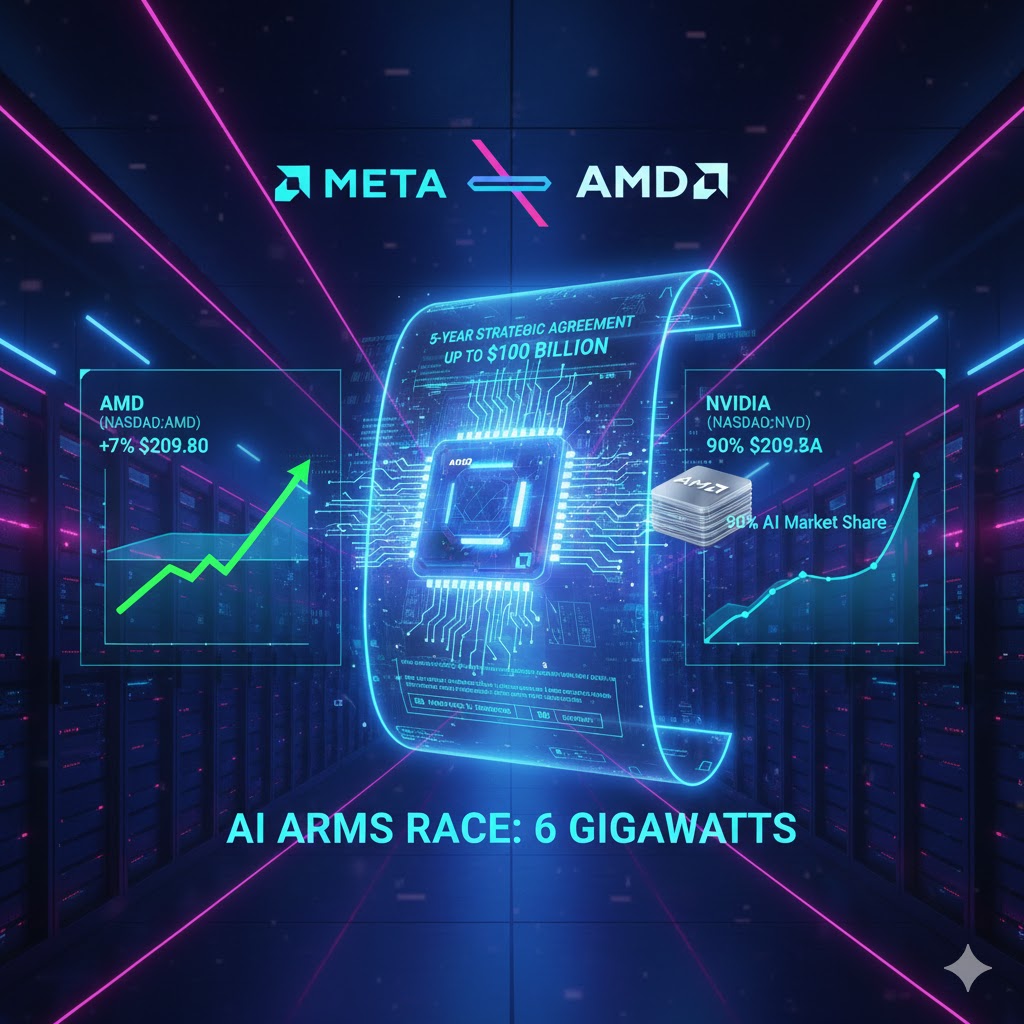
Meta Platforms (NASDAQ:META) and AMD (NASDAQ:AMD) have finalized a massive, unprecedented five-year deal to purchase AI chips and data center equipment, valued at up to $100 billion. This collaboration signals an escalation in the AI infrastructure investment race among global tech giants, while also providing AMD with a key strategic foothold in the computing power market traditionally dominated by Nvidia.

According to the latest disclosed agreement, Meta Platforms (NASDAQ:META) will purchase up to 6 gigawatts of AMD (NASDAQ:AMD) processors and data center equipment over the next five years. Reports from Reuters and The Wall Street Journal estimate the total value of the deal to be between $60 billion and over $100 billion. The first batch of devices, featuring the new MI450 graphics processing unit (GPU) from AMD, is set to begin deployment in the second half of this year.

As part of an innovative financial arrangement, Meta Platforms (NASDAQ:META) will receive warrants to buy up to 160 million shares of AMD (NASDAQ:AMD) at a price of $0.01 per share. If specific technical and business milestones are met and AMD’s stock price reaches $600 in the future, Meta could potentially acquire around 10% of AMD, becoming one of its core shareholders.

The announcement quickly triggered a strong market reaction, with AMD (NASDAQ:AMD) shares rising nearly 7% in early trading, reaching $209.80. This deal not only boosts AMD’s revenue prospects but also highlights how large tech companies are reshaping industry supply chains through equity-linked partnerships to secure AI computing power.

Deep Customization and Accelerated Computing Power Deployment

At the heart of this partnership is a highly customized hardware solution. AMD (NASDAQ:AMD) will provide Meta Platforms (NASDAQ:META) with a range of products, including customized central processing units (CPUs), optimized for Meta’s low-power, high-performance needs.

According to Bloomberg, AMD CEO Lisa Su stated that the company is providing “high-performance, energy-efficient infrastructure optimized for Meta’s workloads,” and noted that Meta assisted in the design of the MI450 chip. This chip is primarily optimized for the “inference” phase of AI (the process by which AI models respond to user queries). The Wall Street Journal pointed out that the MI450 uses a “chiplet” architecture design, which makes it easier to customize compared to traditional monolithic silicon chips.

“We have very ambitious goals,” said Santosh Janardhan, Meta’s global infrastructure head, in an interview. “Being able to define the required technical specifications more tightly was one of the key reasons why Meta and AMD formed this deep partnership.”

Challenging Nvidia’s Market Dominance

This deal holds significant strategic importance for AMD (NASDAQ:AMD). Currently, Nvidia (NASDAQ:NVDA) controls approximately 90% of the global AI chip market, with a market value of $4.66 trillion, while AMD’s market cap is around $320 billion.

Just last week, Meta pledged to purchase millions of Nvidia processors to fuel its AI expansion. However, to reduce supply chain risks and enhance bargaining power, tech giants are actively seeking reliable “second suppliers.” Ben Bajarin, a chip analyst at Creative Strategies, pointed out:

“Meta is in a unique position to control the entire tech stack—they can use anyone’s computing power. This deal also underscores the current limitations in the computing power industry.”

Santosh Janardhan added that given Meta’s massive need for data centers and infrastructure, multiple chip suppliers and technological paths are required. He emphasized that Meta will continue to procure chips from Nvidia while also advancing its in-house AI chip development projects.

Equity Bundling and High Capital Expenditures

The structure of Meta’s acquisition of AMD (NASDAQ:AMD) stock warrants has drawn attention to financing models in the AI industry. Last October, OpenAI also reached a very similar agreement with AMD (NASDAQ:AMD). This model, known as “circular financing,” involves customers securing equity or investment commitments from suppliers through large procurement orders. It is increasingly becoming a common method for AI giants to lock in key technologies.

This partnership also reflects the massive capital expenditure pressures facing tech giants in the AI era. Meta Platforms (NASDAQ:META) CEO Mark Zuckerberg has previously identified AI as the company’s top priority, announcing ambitious plans to build “tens of gigawatts” or even “hundreds of gigawatts” of computing power. According to Meta’s earnings report released last month, the company’s capital expenditures for 2026 could reach up to $135 billion, with plans to build around 30 data centers in the U.S. and globally to keep up with the intense global AI race and compete with companies like OpenAI.

Lisa Su remarked that the Meta-AMD partnership is “moving to the next level.” For AMD, which achieved $34.6 billion in revenue last year, even an additional $10 billion in annual sales would significantly accelerate its race to catch up with Nvidia (NASDAQ:NVDA) in the AI chip market.

Meta AI Glasses Sales Surpass 7 Million Units Last Year, Tripling the Total of the Previous Two Years

On Thursday, after the European market opened, the world’s largest eyewear manufacturer, EssilorLuxottica (EPA:EL), saw its shares surge by more than 5%. This came after the company disclosed that sales of the AI glasses launched in collaboration with American tech company Meta Platforms (NASDAQ:META) surged in 2025, signaling the increasing popularity of AI wearable devices among consumers.

EssilorLuxottica’s earnings report showed that its AI glasses shipments in 2025 exceeded 7 million units, more than three times the combined sales of around 2 million units in 2023 and 2024.

Since 2019, EssilorLuxottica has been a partner with Meta for AI glasses. The two companies first launched smart glasses under the Ray-Ban brand in 2021 and later released a second-generation upgrade in 2023. In June of the previous year, their partnership expanded to include more brands, with the introduction of Oakley smart glasses aimed at athletes.

As the AI wave continues to rise, the prospects for glasses as a platform for AI devices look increasingly bright. In September of last year, Meta introduced the next-generation Ray-Ban smart glasses, which can be controlled through gestures and neural technology via a wristband. One of the lenses is equipped with a small display screen.

Meta stated in January that due to “unprecedented” demand for the $799 Ray-Ban Meta smart glasses in the U.S. market, it delayed the planned international launch, originally set for early 2026.

Last month, there were market rumors that, as sales of the Ray-Ban smart glasses steadily increase, Meta and EssilorLuxottica are discussing plans to double the annual production capacity for AI glasses, aiming to increase it to 20 million units or more by the end of this year. The two companies have also discussed the possibility of exceeding 30 million units per year if demand proves strong enough.

It is worth noting that concerns over the impact of the AI glasses’ sales surge on profit margins led to a more than 20% decline in EssilorLuxottica’s stock price over the past three months. RBC Capital Markets analysts have pointed out that the gross margin of the Ray-Ban Meta smart glasses is much lower than that of the eyewear giant’s broader product line, and the company may need to rely on rising prices and shipment volumes to offset cost pressures.

The latest earnings report revealed that, influenced by U.S. tariffs and the expanded sales of AI glasses, EssilorLuxottica’s adjusted profit margin for fiscal year 2025 is projected to be 16%, a decrease of 70 basis points compared to 2024, based on constant exchange rates.

During the earnings call, Stefano Grassi, EssilorLuxottica’s Chief Financial Officer, told analysts, “I believe that, both internally and externally, we will have the capacity to meet the demand in the coming years, and we are planning based on this assumption, maintaining close cooperation with Meta.”

Although the company did not disclose specific production targets, Grassi added, “As we have seen in recent years, we do expect that as product innovation advances, the product price mix will continue to improve.”

In its financial guidance, EssilorLuxottica expects steady overall revenue growth over the next five years, with adjusted operating profit maintaining a similar growth pace.

AI Arms Race Sparks Semiconductor Surge, NVIDIA Rises Nearly 8%, Achieving the Strongest Rally in 10 Months

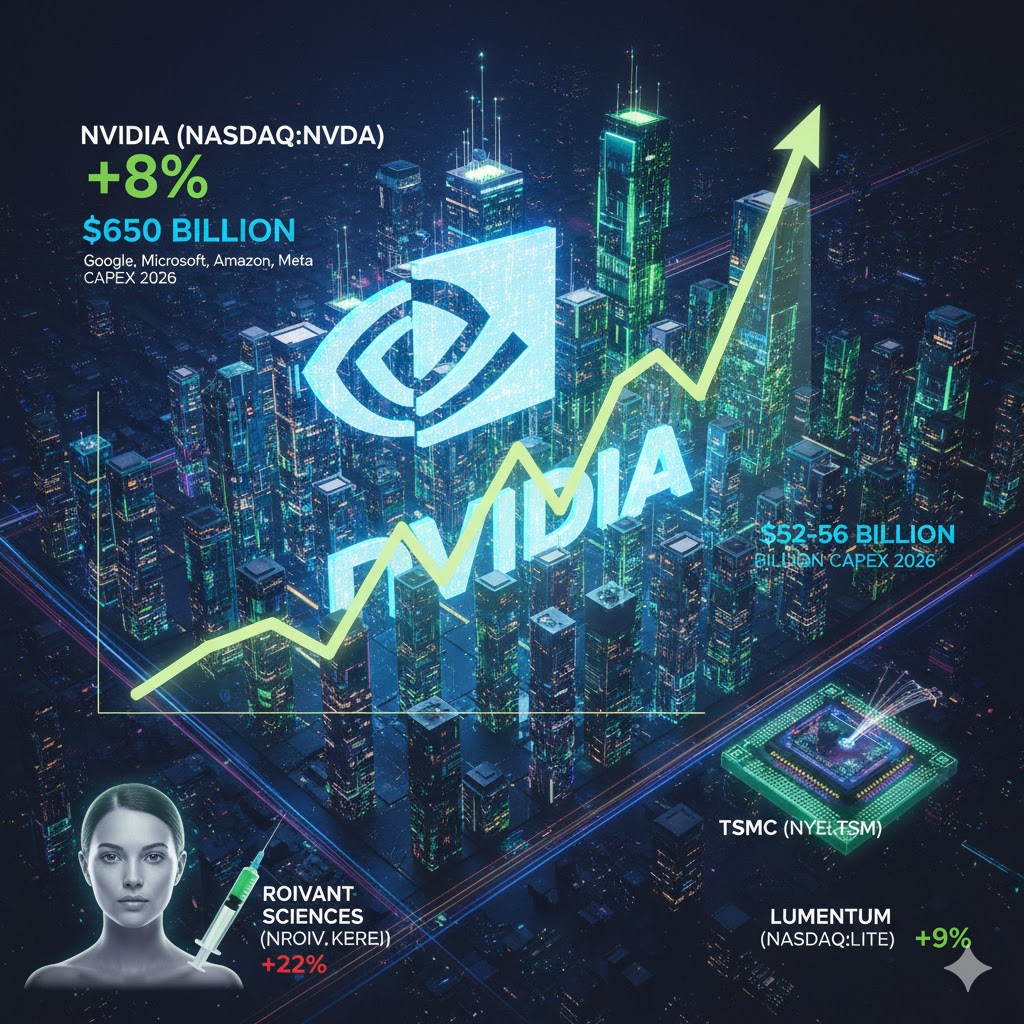
The AI “arms race” has triggered a semiconductor frenzy, with NVIDIA (NASDAQ:NVDA) stock surging nearly 8%, marking its strongest rise in nearly 10 months. Earlier, six of the seven tech giants had already reported their earnings, with the most noteworthy being that Google (NASDAQ:GOOGL), Microsoft (NASDAQ:MSFT), Amazon (NASDAQ:AMZN), and Meta Platforms (NASDAQ:META) will collectively spend approximately $650 billion on capital expenditures in 2026.

Last week, Meta announced its capital expenditures would rise to as much as $135 billion for the year, representing an 87% increase. Meanwhile, Microsoft reported a 66% year-on-year growth in its capital expenditures for Q2, and analysts predict its fiscal year capital spending through June will approach $105 billion.

Jensen Huang, CEO of NVIDIA, specifically praised OpenAI and Anthropic, two leading AI labs, stating that both are “making a lot of money.” NVIDIA invested $10 billion in Anthropic last year, and Huang earlier this week indicated plans to significantly invest in OpenAI’s next funding round. He mentioned, “If they can have twice the computing power, their revenue will increase fourfold.”

Earlier, Taiwan Semiconductor Manufacturing Company (NYSE:TSM), the world’s leading semiconductor foundry, set new performance records and announced plans to significantly increase its capital expenditures to $52-56 billion in 2026, far exceeding market expectations. This is aimed at accelerating the expansion of advanced manufacturing capacity to address the ongoing global shortage of AI chips.

CPO Industry Accelerates, Lumentum Surges Over 9%

NVIDIA, in a recent webinar, announced that three partners—CoreWeave (NYSE:CRWV), Lambda, and TACC—will deploy the IB CPO system in the first half of 2026, and Ethernet CPO products are expected to start shipping in the second half of 2026. The company believes that the CPO industry is advancing more quickly than expected, with the technology first landing in scale-out scenarios and expanding into larger market spaces. As a next-generation optical interconnect solution, the commercial value of CPO continues to become clearer, and its market potential is expanding.

Lumentum (NASDAQ:LITE) CEO Michael Hurlston stated in a recent earnings call that the company’s ongoing growth is primarily driven by cloud optical modules, OCS, and CPO. The development of the OCS business has exceeded expectations, with the first $10 million quarterly revenue target, initially set for Q3, being reached ahead of schedule. Demand for OCS from three core customers has surged, and Hurlston revealed that there is a backlog of over $400 million in OCS orders, most of which are planned to be delivered in the second half of 2026. Orders and revenue are expected to continue growing as they enter 2027.

Roivant Sciences Surges Over 22% After Promising Skin Disease Results

Roivant Sciences (NASDAQ:ROIV) saw its stock rise more than 22% after its subsidiary Priovant Therapeutics reported positive results from the phase 2 trial of its experimental drug brepocitinib. The drug showed improvements in the activity of skin nodular disease at higher doses. Another subsidiary, Pulmovant, also announced the completion of phase 2 trial enrollment involving around 120 patients for its experimental drug mosliciguat, aimed at treating pulmonary arterial hypertension associated with lung disease.

Priovant reported that patients taking a 45 mg dose showed a 22.3-point improvement on a key skin scoring system at week 16, while the placebo group showed only a 0.7-point improvement. The company noted that all patients in the 45 mg group showed significant improvement, with 62% achieving near-complete skin clearance, and 69% achieving complete or nearly complete clearance, while none of the placebo group patients achieved similar results.

Priovant plans to launch phase 3 trials in 2026, following consultations with the U.S. Food and Drug Administration (FDA).