On Friday (February 27), electric vertical takeoff and landing (eVTOL) company Archer Aviation (NYSE:ACHR) announced on its official website that it will collaborate with Starlink to provide stable, reliable, and high-speed internet service for air taxis.
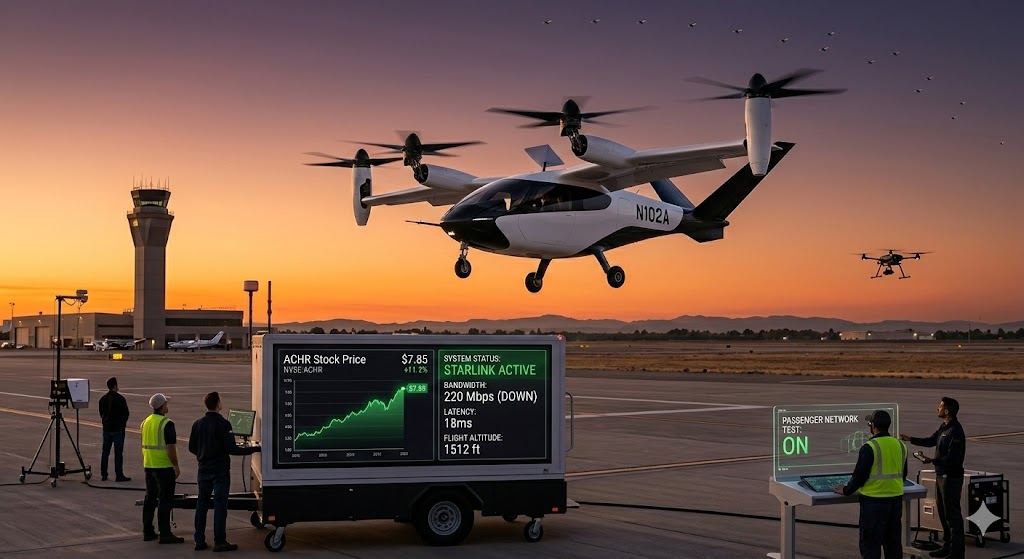
Under the agreement, Archer will install Starlink’s Low Earth Orbit (LEO) satellite internet system on its electric air taxi, Midnight, and conduct testing. The system is designed to provide high-speed, low-latency network connectivity for Midnight’s operations.
Archer stated that this marks Starlink’s official entry into the emerging air traffic sector, making it the industry’s first such collaboration.
In addition to providing internet access for passengers, Archer plans to use Starlink for communication between the aircraft, pilots, and ground engineering teams, thereby supporting the development of the company’s air taxi connectivity infrastructure.
Archer and Starlink also plan to work together to develop an interconnected solution to aid the development of future autonomous aircraft.
Archer emphasized that, unlike systems that rely on ground-based stations, Starlink’s constellation of Low Earth Orbit satellites can provide stable, high-bandwidth network coverage even in dense urban environments where low-altitude flight and cellular network coverage are typically unstable.
The press release pointed out, “These features make Starlink ideal for next-generation aviation platforms, such as air taxis operating at around 1,500 feet (approximately 457 meters) above cities and their surrounding areas.”
Archer’s founder and CEO, Adam Goldstein, said, “For Midnight flights, network connectivity is crucial. The uniqueness of Starlink lies in its ability to provide this connectivity.”
“This groundbreaking collaboration will offer our passengers and pilots seamless, high-speed network connections and the necessary conveniences.”
However, it’s important to note that Archer is still awaiting final approval from the Federal Aviation Administration (FAA) before it can officially begin commercial passenger operations.