Author Archives: admin

Best Stocks To Buy Today: ASTS, MU,ASML

As a new week begins, we are closely tracking market trends to provide multi-dimensional investment opportunities by identifying hot stock movements and top performers. Below is our selection for the Best Stocks To Buy Today.

Space Investment Fever Continues: AST SpaceMobile (ASTS) Surges Over 14% After Securing Prime Contractor Status for MDA’s “SHIELD” Project.

On the news front, U.S. satellite communications company AST SpaceMobile (ASTS) jumped over 14% last Friday. This followed confirmation that the company has been awarded prime contractor status for the U.S. Missile Defense Agency’s (MDA) “SHIELD” project. Formally known as the “Scalable Homeland Innovative Enterprise Layered Defense,” this project is part of the broader “Golden Dome” strategy, designed to build a resilient, layered defense system across air, missile, space, cyber, and hybrid warfare domains.

The award stems from the U.S. government’s public release of qualified bidders for the project on January 15, 2026. Chris Ivory, Chief Commercial Officer and Head of Government Business at AST SpaceMobile, stated: “Being selected as a prime contractor for the MDA SHIELD project is a significant validation of our unique, on-orbit dual-use technology and our growing capabilities in the defense sector.”


Micron Technology (MU) Gains 7.76% as It Warns Chip Shortage Will Extend into 2027.

Micron Technology (MU), a key supplier to Nvidia (NVDA), stated that the ongoing memory chip shortage has intensified over the past quarter. The company reiterated that due to the surge in demand for high-end semiconductors required for AI infrastructure, supply constraints will persist well beyond this year.

“The shortage we are currently seeing is truly unprecedented,” said Manish Bhatia, Executive Vice President of Global Operations at Micron, during an interview. This statement followed the groundbreaking ceremony for the company’s $100 billion manufacturing site on the outskirts of Syracuse, New York. This outlook reinforces similar forecasts provided by the company in December.

Bhatia pointed out that High Bandwidth Memory (HBM), essential for manufacturing AI accelerators, is “consuming a massive amount of available industry capacity, leading to significant supply shortages for traditional sectors like mobile phones and PCs.” He added that PC and smartphone manufacturers have already begun queuing up to lock in memory chip supplies for 2026 and beyond, while autonomous vehicles and humanoid robots are expected to drive demand for these components even higher.


ASML Holding (ASML) Rises Over 2% as Semiconductor Capital Cycle Re-accelerates

On Thursday, TSMC (TSM) released financial results showing a 35% year-on-year increase in net profit for the fourth quarter of 2025, beating expectations. The company also forecasted a Q1 operating margin of 54% to 56% (market estimate: 49.7%) and a gross margin of 63% to 65% (market estimate: 59.6%). These figures demonstrate that the chipmaker is benefiting significantly from the AI boom.

This signal was interpreted by the market as a vote of confidence in the sustained expansion of the AI industry. This directly ignited the stock prices of equipment giants like ASML and Applied Materials. Dutch photolithography leader ASML (ASML) hit a historic high, with its market capitalization surpassing the $500 billion milestone—becoming only the third European company to reach this valuation.

TSMC is one of ASML’s largest individual customers, and ASML’s lithography equipment is an “absolute necessity” for TSMC’s expansion and mass production of advanced process chips. Currently the highest-valued company in Europe, ASML’s core competitiveness lies in being the world’s only manufacturer capable of producing cutting-edge EUV lithography machines. TSMC requires this equipment to manufacture chips for everything from Apple (AAPL) smartphones to Nvidia (NVDA) AI accelerators.

BHP Raises FY2026 Copper Production Guidance, Reinforcing Copper as a Key Strategic Priority

Mining giant BHP Group (BHP) delivered a robust performance in the first half of its 2026 fiscal year (July 1, 2025, to June 30, 2026), achieving record highs in mineral operations and raising its annual production guidance for copper.

Simultaneously, the company continued to optimize its asset portfolio and reaffirmed progress on long-term growth initiatives, particularly in copper and potash.

Upward Revision of Annual Copper Guidance

On Tuesday (January 20), BHP Group (BHP) released key production figures for its second fiscal quarter (the three months ended December 31). During this period, copper production reached 490,500 tonnes, a 4% year-on-year (YoY) decrease. Iron ore production hit 69.7 million tonnes, up 5% YoY; metallurgical coal production was 4.3 million tonnes, down 3% YoY; and thermal coal production saw a significant jump of 25%, reaching 4.6 million tonnes.

Despite the quarterly dip in copper output, the metal remains a central pillar of BHP’s strategy. Driven by long-term demand from electrification, the energy transition, and power grid expansions, the company is investing heavily in copper projects. Its goal is to achieve an attributable copper production of approximately 2 million tonnes by the 2030s. Amid a favorable price environment and operational improvements, copper is increasingly viewed as a primary driver of future growth.

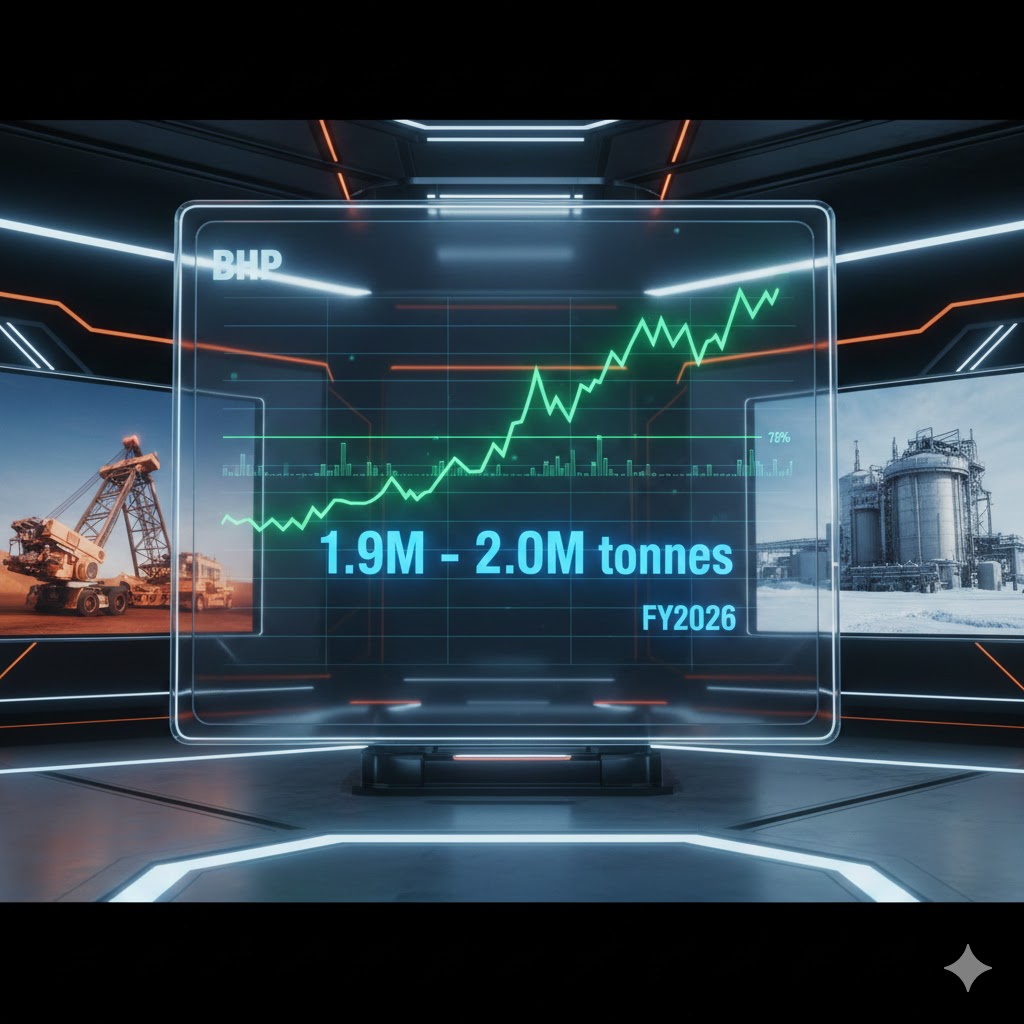
Accordingly, BHP announced an upward revision of its FY2026 copper production guidance. The group raised its overall production targets, along with specific guidance for its Escondida and Antamina mines. The total annual copper production is now expected to be between 1.9 million and 2.0 million tonnes, up from the previous forecast of 1.8 million to 2.0 million tonnes.

However, some analysts warned that expectations of increased supply could exacerbate a market surplus, potentially exerting downward pressure on copper spot prices. Without a corresponding increase in demand to offset global supply, prices may face headwinds.

Record Performance in Iron Ore and Coal

BHP’s iron ore business also achieved record-breaking results. Western Australia Iron Ore (WAIO) saw both production and shipments hit all-time highs for the first fiscal half. Additionally, iron ore production from Samarco, BHP’s Brazilian subsidiary, also increased.

The miner maintained its full-year iron ore production forecast at 284 million to 296 million tonnes, noting that the strong performance in the first half provides a solid foundation heading into the third fiscal quarter.

In the coal sector, metallurgical coal production rose due to the highest mining efficiency at its BMA subsidiary in five years. Energy coal production grew by 10% YoY, further diversifying the group’s earnings base.

Growth Project Updates

Regarding growth initiatives, BHP confirmed that its Jansen potash project in Canada remains on track for first production in mid-2027. The company reiterated that Jansen is expected to be a long-term, low-cost, and scalable asset that provides security for future commodities, aligning with global food security trends.

AI5 Chip Breakthrough: Tesla Announces Reboot of Dojo 3 Supercomputer Project to Secure Autonomous Driving Compute Independence

Tesla CEO Elon Musk recently announced that with the design of the AI5 chip now complete, Tesla (TSLA) will reboot the development of its Dojo 3 supercomputer project. The Dojo project aims to provide massive computing power for autonomous driving systems and AI models through self-developed chips and systems, reducing reliance on external suppliers.

Analysts believe the AI5 chip will support more complex Full Self-Driving (FSD) algorithms. The progress of the chip’s mass production will directly influence the rollout speed of Tesla’s FSD features and could become a critical pillar for its robotics business.

Musk’s Announcement

On January 19, Musk posted on the social media platform X that Tesla will restart the development of the Dojo 3 supercomputer project following the completion of the AI5 chip design.

Simultaneously, he posted recruitment information seeking talent interested in “developing the world’s highest-volume chip,” requiring applicants to summarize key technical challenges they have solved in three bullet points.

In subsequent posts, Musk emphasized: “Solving the AI5 chip issue is critical for Tesla. Therefore, I had to have both teams focus on this chip’s development, and I have personally spent every Saturday on it for several months.”

Musk noted that AI5 will be an exceptionally powerful chip: a single SoC’s performance is roughly equivalent to Nvidia’s Hopper(NVDA) class, while a dual-chip configuration approaches Blackwell levels—but at a significantly lower cost and power consumption. “With AI5 progressing smoothly, we finally have some bandwidth to restart the R&D for Dojo 3,” he stated.

This marks a strategic reversal. In August 2025, reports suggested that Tesla had fully suspended the Dojo project, leading to the departure of project lead Peter Bannon. At the time, the move was interpreted as Tesla abandoning its self-developed autonomous driving chip plan.

Musk previously explained that it made little sense for Tesla to divide resources between two vastly different AI chip designs. He noted that Tesla’s AI5, AI6, and subsequent chips would excel in inference and perform well in training, and that all efforts would be concentrated there. He added that integrating multiple AI5/AI6 chips onto a single circuit board for supercomputer clusters could reduce networking complexity and costs by several orders of magnitude.

First mentioned in 2019, the Dojo project carries Tesla’s grand vision for AI. It is designed to optimize neural network models and process autonomous driving video data. Morgan Stanley previously estimated that a fully operational Dojo could potentially add billions of dollars to Tesla’s valuation.

A Decisive Battle for Autonomous Driving

Musk recently revealed that the AI5 chip for FSD is nearing design completion, while AI6 is in its early stages. Tesla aims to complete design cycles for AI7, AI8, and AI9 within a nine-month cadence.

According to previously disclosed data, the AI5 chip will deliver 2,000–2,500 TOPS of computing performance—roughly five times that of the current HW4 chip—enabling more sophisticated FSD algorithms.

Sampling and small-scale deployment of the AI5 chip are scheduled for 2026, with full mass production expected in 2027. As AI5 nears the finish line, Tesla has initiated early work on AI6, which is expected to launch in 2028. AI6 will likely continue Tesla’s foundry partnership with Samsung Electronics, utilizing a modular architecture deeply integrated with the Dojo supercomputer ecosystem to create synergy across vehicles, robots, and supercomputing.

Recent reports indicate that Samsung Electronics is accelerating preparations for AI5 production at its U.S. facilities, recruiting experienced engineers to stabilize yields and ensure a smooth manufacturing process for Tesla.

Shift to FSD Subscription Era

Alongside hardware updates, Tesla’s FSD strategy is undergoing a major shift. Musk recently announced that starting February 14, Tesla will discontinue the one-time purchase option for FSD in favor of a monthly subscription model.

This marks the end of a decade-long era of one-time buyouts (previously $8,000 in the U.S. and 64,000 RMB in China). Analysts point out that this “SaaS” (Software as a Service) approach aims to lower the barrier to entry, increase penetration, and generate recurring revenue.

Musk has hinted that the next version of FSD will achieve full autonomy, even admitting that Robotaxi driverless testing has already begun. Morgan Stanley views FSD 14.3 as a potential “Steam Engine Moment” for autonomous driving, which is shaping up to be a primary investment theme for Wall Street in 2026.