Author Archives: admin

“Magnificent Seven” Group Strategy Fails: Wall Street Says It’s Time to “Pick and Choose” Best Stock in 2026

In recent years, many investors followed a simple recipe to beat the market: heavy concentration in U.S. mega-cap tech stocks.

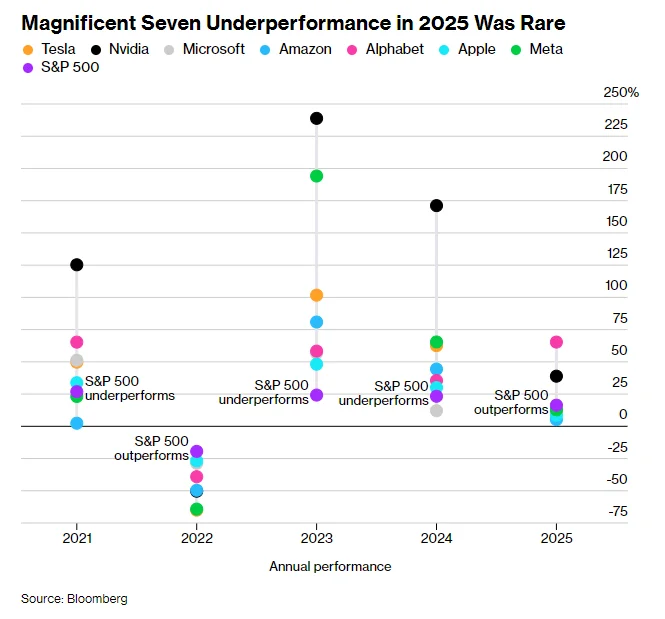
While this strategy yielded handsome rewards for a long time, it lost its luster in 2025. For the first time since the Federal Reserve began its rate-hiking cycle in 2022, the majority of the “Big Tech” firms underperformed the S&P 500 (SPX). Although an index tracking the “Magnificent Seven” rose 25% in 2025—outpacing the S&P 500’s 16%—this gain relied entirely on the explosive performance of Alphabet (GOOGL) and Nvidia (NVDA).

Many Wall Street professionals expect this divergence to persist through 2026 as earnings growth for tech giants slows and skepticism grows regarding the returns on massive Artificial Intelligence (AI) investments. Early 2026 data supports this view: the Magnificent Seven index is up only 0.5%, while the S&P 500 has climbed 1.8%. In this environment, selective stock picking within the group has become critical.

“The market is no longer a ‘one-size-fits-all’ trade,” said Jack Janasiewicz, Lead Portfolio Strategist at Natixis Investment Managers Solutions, which manages $1.4 trillion. “If you just blindly buy the whole basket, the laggards are likely to cancel out the winners.”

Cooling Enthusiasm and Narrowing Growth Gaps

This three-year bull market has been spearheaded by tech titans. Since the bull run began in October 2022, just four companies—Nvidia, Alphabet, Microsoft (MSFT), and Apple (AAPL)—have accounted for over one-third of the S&P 500’s total gains. However, as capital begins to rotate into other S&P 500 constituents, enthusiasm for Big Tech is cooling.

With earnings growth slowing, investors are no longer satisfied with the “AI will make us rich” narrative; they want tangible financial results. Data indicates that earnings growth for the Magnificent Seven is projected to be around 18% in 2026—the slowest since 2022. This narrows their lead significantly over the other 493 S&P 500 companies, which are expected to see a 13% increase.

“We are seeing the breadth of corporate earnings growth expanding, and that trend will continue,” noted David Lefkowitz, Head of U.S. Equities at UBS Global Wealth Management. “Tech is no longer the only game in town.”

One silver lining for the group is that valuations have moderated. The Magnificent Seven index currently trades at 29 times forward earnings, well below the highs of over 40 times seen at the start of the decade. By comparison, the S&P 500 trades at 22 times, and the Nasdaq 100 at 25 times.


Outlook for the Magnificent Seven in 2026:

Nvidia

The dominant AI chipmaker is under pressure from rising competition and concerns over the sustainability of capital expenditure from its largest customers. While the stock has soared roughly 1,100% since late 2022, it has retreated 8% since hitting an all-time high on October 29 last year.

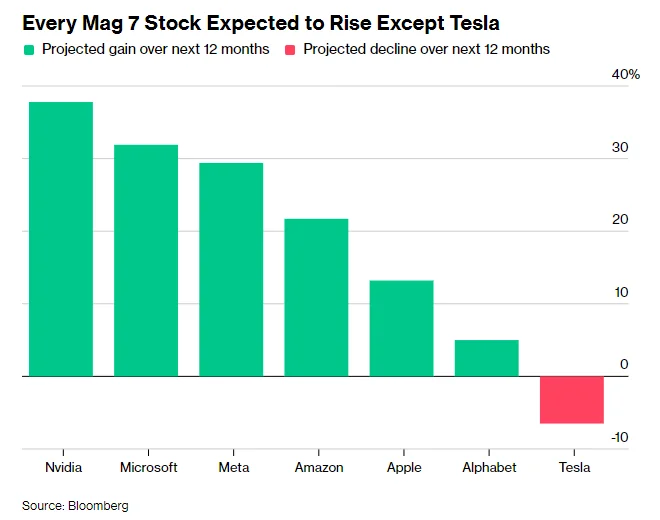
Rival AMD (AMD) has secured data center chip orders from OpenAI and Oracle (ORCL), while major customers like Google are accelerating the deployment of in-house custom chips. Nevertheless, Nvidia’s revenue continues to grow rapidly as chip demand still outstrips supply. Wall Street remains bullish: 76 out of 82 analysts rate it a “Buy,” with an average price target implying 39% upside—the highest among the Seven.

Microsoft

2025 marked the second consecutive year Microsoft underperformed the S&P 500. As a major spender in the AI race, Microsoft is expected to see capital expenditures approach $100 billion for the fiscal year ending June 2026, with analysts predicting a further climb to $116 billion the following year.

While data center expansion has boosted cloud revenue growth, the company has struggled to convince customers to pay significantly more for AI-integrated software. Brian Mulberry, Client Portfolio Manager at Zacks Investment Management, notes that investors are waiting for these massive investments to translate into real bottom-line results.

Apple

Apple took the most conservative approach to AI among the group, a strategy that weighed on its stock in early 2025, with shares falling nearly 20% by August. However, Apple subsequently became an “Anti-AI play,” attracting investors wary of high-cost AI risks, and surged 34% by the end of 2025. Strong iPhone sales have reassured investors that core demand remains robust.

The key for 2026 is accelerating growth. While the company narrowly avoided its longest losing streak since 1991 last week, momentum has slowed. Markets expect revenue to grow 9% in the fiscal year ending September 2026—the fastest since 2021. With a forward P/E of 31x (second only to Tesla), Apple’s performance must dazzle to sustain its valuation.

Alphabet (Google)

A year ago, investors feared Google was falling behind OpenAI. Today, Google is a consensus “darling,” leading the AI field on multiple fronts. Its Gemini AI model has received widespread acclaim, and its in-house TPUs are seen as a major revenue driver that could even challenge Nvidia’s dominance.

In 2025, Google was the best performer of the Seven, rising over 65%. However, with its market cap nearing $4 trillion and a P/E of 28x (well above its five-year average of 20x), analysts expect more modest gains of about 3.9% in 2026.

Amazon

After seven consecutive years as the laggard of the group, Amazon (AMZN) has staged a strong comeback in early 2026. Optimism centers on its cloud business, AWS, which recently posted its fastest growth in years. Investors expect efficiency gains from warehouse automation and robotics to pay off soon. Clayton Allison, Portfolio Manager at Prime Capital Financial, believes the market has yet to fully price in this value, drawing parallels to Google’s turnaround last year.

Meta

Meta Platforms (META.) most clearly reflects investor skepticism regarding “AI overspending.” CEO Mark Zuckerberg has spent billions on acquisitions and talent, including a $14 billion investment in Scale AI. However, after Meta raised its 2025 capex to $72 billion and forecasted “significantly higher” spending for 2026, the stock tumbled. Since its August 2025 high, the stock has dropped 17%. Meta’s primary task in 2026 is proving these investments drive profit growth.

Tesla

Tesla (TSLA) flipped from laggard to leader in the second half of 2025 as Elon Musk pivoted focus from lackluster EV sales to autonomous vehicles and robotics, sending shares up over 40%. This rally pushed Tesla’s forward P/E to a staggering 200x. While revenue is expected to return to 12% growth in 2026 after a stagnant period, Wall Street analysts remain pessimistic about the stock price, with an average target predicting a 9.1% decline over the next 12 months.

AI Giants Open a New Front: Anthropic Launches Compliant Healthcare AI Tools to Rival OpenAI Health

AI startup Anthropic is working to make it easier for patients and clinicians to use its AI chatbot for medical information, part of a strategic push into the lucrative healthcare sector.

On Sunday local time—just days after OpenAI announced new tools for clinicians—Anthropic stated that its chatbot, Claude, will launch a new HIPAA-compliant healthcare service. Hospitals, providers, and consumers can use this service to process protected health data. Anthropic is also integrating scientific databases into its products and enhancing its biological research capabilities.

New Features for Consumers and Clinicians

On the consumer side, Anthropic is allowing users to export health data from applications such as Apple Health and Function Health, aiming to help them aggregate medical records and share them with healthcare providers.

These features were announced while Anthropic is reportedly raising funds at a $350 billion valuation. The back-to-back product launches from OpenAI and Anthropic signal Silicon Valley’s growing eagerness to advance in the healthcare sector to boost sales and demonstrate the broad societal benefits of AI.

“When we think about the overall economy and where AI can have the biggest impact, healthcare is a perfect fit once you get the regulatory and data pieces right,” said Mike Krieger, Anthropic’s Chief Product Officer and co-founder of Instagram. He noted the new tools are designed to “empower people with more knowledge, coming both from their data and from conversations with providers.”

Safety and Early Adoption

Founded in 2021 by former OpenAI employees, Anthropic has positioned itself as a reliable, safety-focused AI developer. While its software is particularly popular among engineers for automating coding tasks, it is beginning to see early traction with medical institutions. Notably, Anthropic CEO Dario Amodei is a trained biophysicist.

Anthropic reported that Banner Health, one of the largest non-profit healthcare systems in the U.S., has more than 22,000 clinical providers using Claude. Among them, 85% reported faster work speeds and higher accuracy. Anthropic is also collaborating with other major clients, including Novo Nordisk(NVO) and Stanford Health Care.

Competition and Privacy Risks

The makers of Claude face intense competition not only from OpenAI but also from traditional tech vendors and emerging startups aiming to apply AI advancements to drug discovery, medical paperwork, and patient record analysis. However, as AI handles sensitive personal data and provides advice on high-stakes health issues, these firms introduce new privacy and security risks.

To address these concerns, Anthropic stated that its medical answers reference citations from reputable publications like PubMed and the NPI Registry, ensuring clinicians can have greater confidence in the results. Anthropic also emphasized that it does not use medical user data to train its models.

ARK Invest Tracker: Cathie Wood Buys 30K+ Broadcom Shares, Sweeps Up eVTOL Leaders Joby and Archer

On Thursday, U.S. time, the three major stock indices closed mixed. While tech giants like Nvidia pulled back, the defense sector saw a broad rally fueled by President Trump’s proposal to increase military spending.

Against this backdrop, Cathie Wood is executing a clear sector rotation: doubling down on the “low-altitude economy” and AI hardware, while locking in profits or trimming positions in the recently red-hot defense and space sectors.

Accumulation: Bullish on the “Low-Altitude Economy,” Buying Broadcom on the Dip

The most striking moves in ARK’s latest buy list are the massive bets on the eVTOL (Electric Vertical Take-off and Landing) sector, purchasing over 160,000 shares of Joby Aviation (JOBY) and over 70,000 shares of Archer Aviation (ACHR).

As we enter 2026, the market widely regards this as the “Year of Commercialization” for eVTOLs. Wood’s heavy investment in these two industry leaders sends a strong signal: she believes the tipping point for regulatory approval (such as FAA certification) and commercial operations has arrived. Rather than waiting for a distant future, she is positioning for the imminent launch of “air taxi” services—a bet not just on technology, but on the transformation of urban mobility.

In the AI hardware space, ARK added 31,600 shares of Broadcom (AVGO). As the leader in networking chips and custom ASIC solutions, Broadcom plays an indispensable role in AI data center construction. This move suggests Wood remains confident in the sustained demand for AI infrastructure. Compared to some overvalued AI stocks, Broadcom is viewed as a more resilient core AI asset due to its robust cash flow and monopoly in Ethernet switching.

Divestment: Trimming Defense and Space Stocks

In sharp contrast to her purchases of “civilian” aircraft, Wood hit the sell button on the military and space sectors.

  • Palantir (PLTR): Reduced by 58,700 shares. As a leader in AI and defense data analytics, this move is likely profit-taking or valuation-driven portfolio management.
  • Rocket Lab (RKLB): Sold 24,900 shares. ARK chose to reduce exposure to this commercial space newcomer amid recent volatility.
  • Kratos Defense (KTOS) & AeroVironment (AVAV): Trimmed by 20,100 and 2,017 shares, respectively. Both are major players in the military drone space.

This creates a fascinating “hedge”: selling military drones to buy civilian eVTOLs. It suggests Wood may judge that defense sector premiums have become overextended in the short term, whereas the growth potential and value proposition of the civilian low-altitude economy are currently more attractive.