Mark Luschini, Chief Investment Strategist at Janney Montgomery Scott, said: “It seems people now think software prices will fall in a straight line to zero. This one-sided trade is so obvious that it could actually set the stage for a rebound.”
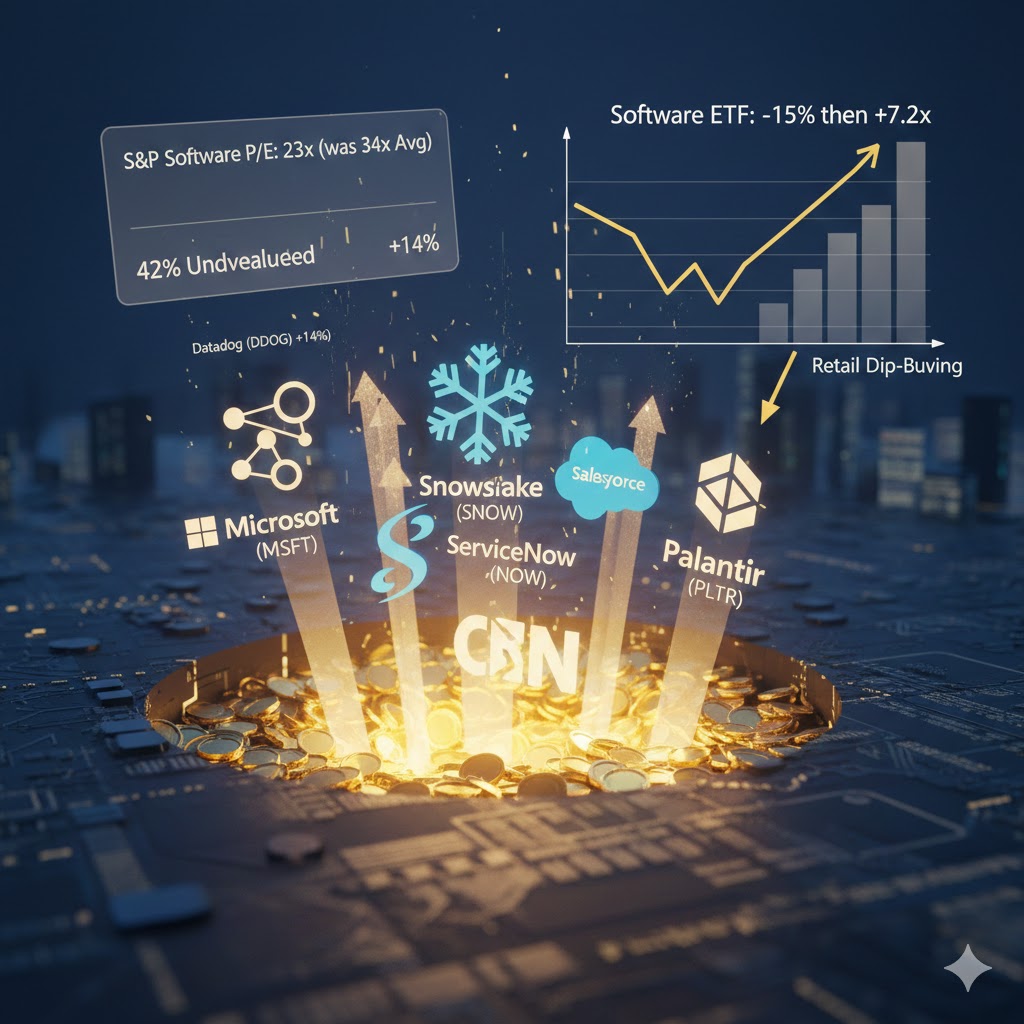
These stocks are currently at historic lows. The forward price-to-earnings ratio of the S&P North American Software Index fell below 20 for the first time last week. Although it has since rebounded to around 23 times as stocks recovered somewhat, it remains well below its long-term average P/E of 34.
Jefferies studied the 64 software stocks under its coverage and found that “42% are trading at or near their historical undervaluation levels,” analysts led by Brent Thill wrote in a report to clients on Sunday.
Michael Toomey of Jefferies’ equity trading desk said, “I think software stocks are about to see a strong rebound.” Technical traders at BTIG expressed a similar view, writing in a report last week that software stocks are “on the verge of capitulation and should find a tactical bottom here.”
The rebound appears to have already begun. A closely watched ETF tracking the software industry fell 15% over eight consecutive trading days from January 26 to February 4, but has since rebounded 7.2%. According to Vanda Research, retail investor buying of the ETF “hit a record,” which Vanda described as “one of the most aggressive instances of dip-buying in tech stocks—particularly software stocks—that we have observed in our dataset.”
Although uncertainty still hangs over the sector, the selloff has been so broad that many companies previously expected to be long-term winners have not been spared. Companies most frequently cited by market experts include Microsoft (NASDAQ:MSFT), Snowflake (NYSE:SNOW), ServiceNow (NYSE:NOW), Salesforce (NYSE:CRM), and Palantir (NASDAQ:PLTR).
Data analytics software company Snowflake fell 27% in just six trading days from January 29 to February 5. However, the company holds a favorable position within the artificial intelligence ecosystem. Last week, Snowflake signed a $200 million multi-year partnership agreement with OpenAI and reached a similar deal with Anthropic PBC in December. In a February 5 report to clients, Thill wrote that Snowflake is “one of the clearest AI beneficiaries in the entire public software universe.” Institutions including UBS, Loop Capital, Wedbush, Bank of America, and DA Davidson have also spoken highly of Snowflake.
Michael Mullaney, Director of Global Market Research at Boston Partners, noted the weakness in Salesforce, ServiceNow (NYSE:NOW), and Workday (NASDAQ:WDAY). He said that if he were focused on growth stocks rather than value stocks, he would be buying these names on the dip.
Datadog (NASDAQ:DDOG) was also mentioned. Its shares surged 14% on Tuesday, marking the biggest gain since November, after the company reported strong results and issued better-than-expected revenue guidance.
AI coding—using artificial intelligence to write software code—is at the core of the market’s bearish sentiment toward software. If AI services offered by companies such as Anthropic or OpenAI can replace existing software packages, it would put significant pressure on the revenues, margins, and pricing power of the displaced companies. The recent stock market plunge was largely triggered by Anthropic’s launch of a legal workflow automation tool, followed by another tool focused on financial research. Earlier, an AI tool from Alphabet Inc. had also caused sharp declines in video game and mobile advertising stocks.
So far, this disruptive shift has largely been anticipated, but its magnitude remains difficult to quantify. Industry research forecasts that earnings growth for the software and services sub-sector will reach 14.1% in 2026. While this growth rate is below the broader technology sector’s expected 31.7% expansion—driven by the booming semiconductor industry—it exceeds the S&P 500 Index’s projected growth rate of 13.7%. Software sales are showing a similar trend.
Luschini of Janney said: “There’s a lot of speculation about what might happen, but so far nothing has actually happened. The market is trying to price in future risks, but at this point, that speculation seems more hypothetical than real.”
Even so, software skeptics do have some warning signs to point to. Shares of monday.com (NASDAQ:MNDY) fell 21% earlier this week after the company issued disappointing revenue guidance. S&P Global (NYSE:SPGI) also dropped 9.7% on Tuesday after releasing similarly disappointing earnings guidance.
However, most of these cases appear to be isolated. Data show that of the 10 software companies in the S&P 500 that have reported earnings so far this season, all 10 exceeded earnings expectations and eight beat revenue estimates. This outperformance rate exceeds that of the broader S&P 500, where 81% of companies have beaten earnings expectations and 66% have topped revenue forecasts.
Mullaney said such performance demonstrates that current trends are not severe enough to justify investors abandoning the software sector altogether. “A mere slowdown in earnings growth does not explain the magnitude of these stock declines,” he said. “However, I do believe that concerns about AI-driven disruption provide a reasonable justification for profit-taking.”