Author Archives: admin

U.S. Babies May Join “Retail Investor Headquarters” Right at Birth, Wall Street Giants Eyeing the Opportunity

Recent reports reveal that the U.S. government is preparing to appoint financial technology firm Robinhood as the trustee for the “Trump Account” program, which would allow millions of newborns in America to join the “retail investor headquarters” right from birth.

As background, the so-called “Trump Account” is a deferred-tax investment program established under the “Big and Beautiful” bill passed last year, which is expected to go live this July.

The bill itself only proposes a $1,000 allocation for children born between 2025 and 2028, but any child under 18 in the U.S. will be able to open an account and receive the grant. Funds provided by Congress will be required to be immediately invested in low-fee U.S. stock funds, with investments locked until the beneficiary turns 18.

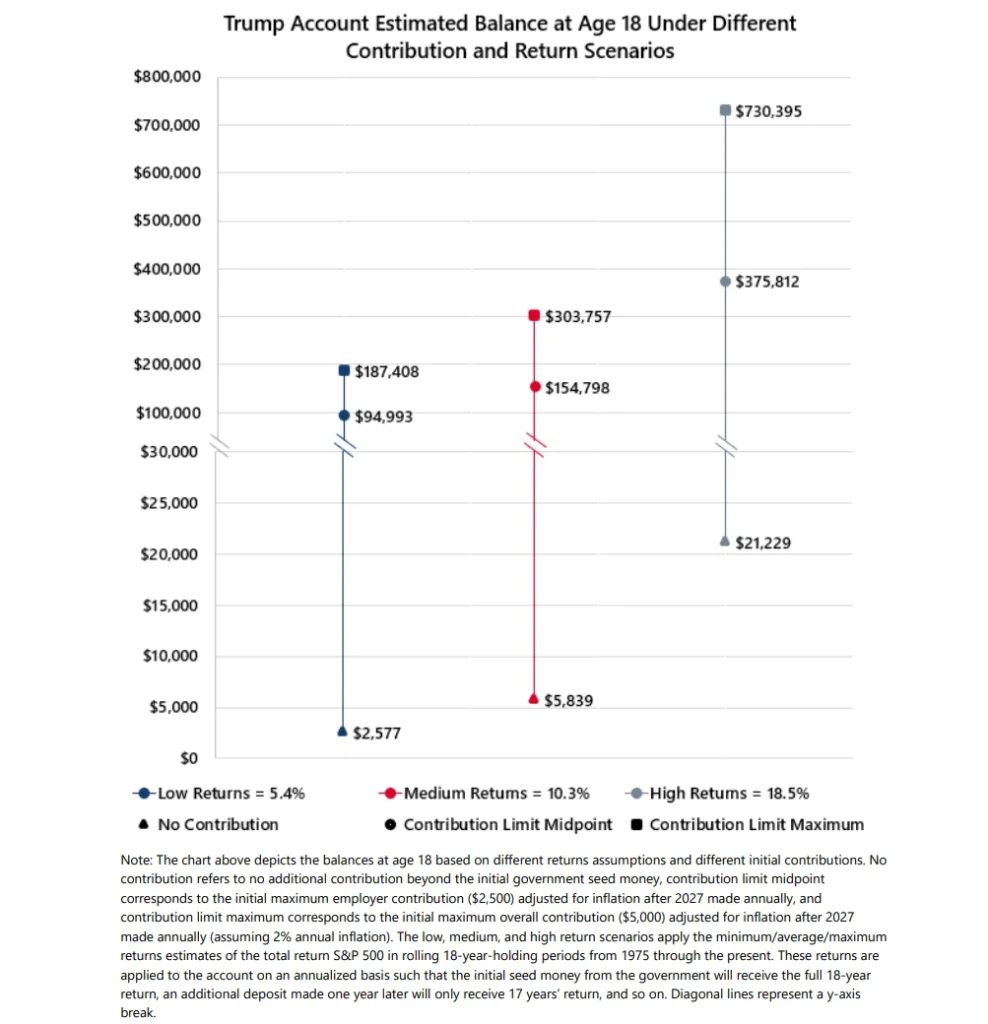
According to a forecast from the White House Economic Advisory Council last year, based on the 18-year rolling returns of the S&P 500 index from 1975 onwards, if only the $1,000 provided by the U.S. government is stored in the “Trump Account,” under a low return (annualized 5.4%) scenario, the account would grow to $2,577 by the time the baby turns 18. Under a medium return (annualized 10.3%) and high return (annualized 18.5%) scenario, the same amount would grow to $5,839 and $21,229, respectively.

Meanwhile, children who save the maximum allowed for the “Trump Account” will see their balances at age 18 reach $180,000, $300,000, and $730,000 in these three scenarios.

Robinhood Stands Out, Wall Street Giants Also Have Plans

According to Friday’s latest reports, the financial technology brokerage Robinhood, known as the “retail investor headquarters,” has begun preparations internally to become the trustee for the program. In contrast, large fund management companies like Fidelity Investments and Vanguard have not yet been included in the list of candidates and have not been consulted about the matter.

Sources say that the U.S. Department of the Treasury is expected to announce the brokerages selected for the project soon, with up to three companies likely to serve as initial trustees.

For Robinhood, a brokerage that was founded just over a decade ago and made a name for itself during the pandemic, this program could bring millions of new customers. The competition for this trustee role reportedly began last summer. Shortly after the bill was signed by Trump, Robinhood CEO Vlad Tenev publicly stated that the company was “actively engaged in this process.”

At the same time, Wall Street giants like JPMorgan (NYSE:JPM) are adopting a “wait-and-see” strategy: these banks will seek to manage the rollover accounts rather than be the first-choice institutions for managing the initial accounts. Given that many of the account holders may not even know what a “fund” is, how to handle the needs of millions of new clients will be a significant challenge. Some banks believe taking on a secondary role would be a simpler and more cost-effective way to participate.

Assets Under Management Are Expected to Keep Growing

In addition to the initial $1,000, many wealthy individuals and large corporations are adding money to these accounts.

According to unofficial statistics, Michael Dell, founder of Dell Technologies, and his wife Susan have contributed $6.25 billion to open accounts for 25 million children under the age of 10 who are not eligible for government funding, with $250 allocated to each account.

The U.S. Treasury has also launched an initiative called the “50-State Challenge,” urging wealthy individuals in each state to donate to their local “Trump Accounts.” Notable investors Ray Dalio and his wife Barbara Dalio have pledged $75 million to provide $250 for each of over 300,000 eligible children in Connecticut.

Additionally, companies like JPMorgan (NYSE:JPM), Bank of America (NYSE:BAC), Robinhood (NASDAQ:HOOD), Coinbase (NASDAQ:COIN), Broadcom (NASDAQ:AVGO), and Intel (NASDAQ:INTC) have announced their participation in this policy, injecting funds into their employees’ children’s “Trump Accounts.” According to rules released by the White House, each child’s parent’s employer can contribute up to $2,500 per year to the account

AI Data Center Power Demand Surges as Caterpillar Beats Q4 Expectations

Caterpillar (NYSE:CAT) reported its fourth-quarter earnings, delivering results that exceeded Wall Street expectations, primarily driven by surging power demand from the rapid expansion of artificial intelligence data centers, which boosted sales of the company’s power generation equipment.

According to the earnings report, fourth-quarter revenue reached USD 19.1 billion, representing a year-on-year increase of 17.9% and exceeding market expectations by USD 1.34 billion. Adjusted earnings per share for the quarter came in at USD 5.16, above the analyst consensus estimate of USD 4.69. Caterpillar’s Power & Energy segment posted a sharp 25% year-on-year increase in profit.

As one of the world’s leading manufacturers of mining and engineering machinery, Caterpillar has long been regarded as a global economic “barometer.” Today, its Power & Energy business is accelerating growth on the back of the AI data center construction boom. The company’s iconic yellow machines are present across industries and regions worldwide, and its sales performance often signals the strength of global industrial activity—or, at times, a slowdown in economic growth.

Following the earnings release, shares of the Irving, Texas–based Caterpillar (NYSE:CAT) rose nearly 7% at one point. As of the time of writing, the stock was up 1.58% in premarket trading.

The Power & Energy segment has become the company’s largest and fastest-growing business unit. Once a slower-growing part of Caterpillar’s overall operations, the segment now sells products including generators, diesel and natural gas engines, and industrial gas turbines, supplying power to construction sites, factories, and data centers.

In a market environment where investors are eager for AI-related plays after soaring valuations of major technology and semiconductor companies, this business has helped Caterpillar stand out as a clear winner. Fueled by optimism around data center–driven demand, Caterpillar’s market capitalization has surpassed USD 300 billion this month.

Wall Street Comments on ASML’s Earnings: Explosive Order Growth & Strong Guidance, Company at the Start of a New Technological Cycle!

After ASML (NASDAQ: ASML) released an earnings report that far exceeded expectations, Wall Street institutions have reached a clear consensus: the company is at the beginning of a multi-year growth cycle driven by AI computing infrastructure and storage technology upgrades. The explosive growth in orders, combined with strong performance guidance, confirms that the semiconductor equipment industry has reached a turning point.

Earnings Report Highlights

ASML’s fourth-quarter earnings report, released on January 28, showed an explosive rise in new orders, which surged to €13.2 billion, setting a new all-time high. This figure was nearly double the market’s general expectation, which ranged from €6.6 billion to €7 billion. This data signals that the semiconductor equipment industry has entered a strong upward cycle.

The order structure also showed a significant shift. Extreme Ultraviolet (EUV) lithography machine orders contributed €7.4 billion, far surpassing expectations. Notably, orders from memory chip customers accounted for 56% of the total, for the first time exceeding logic chip orders, highlighting that high-performance memory demands, such as HBM and DDR5, are becoming the core investment drivers in the industry.

ASML also provided strong guidance for 2026, forecasting a revenue midpoint of €36.5 billion, representing a year-on-year growth of about 12%. The current order backlog of €38.8 billion provides high visibility and certainty for revenue over the next two years.

“Crushing” Expectations: €13.2 Billion Orders

The most critical highlight of the quarterly earnings was the surge in new orders. ASML’s reported €13.2 billion in new orders for the fourth quarter, significantly surpassing the market consensus, which was estimated between €6.6 billion and €6.9 billion. This was an 89% to 93.6% increase over market expectations and far exceeded the most optimistic prediction of around €8 billion.

EUV orders alone accounted for €7.4 billion, well above analysts’ expectation of €4.4 billion. This demonstrates that customers are actively securing key equipment capacity in advance for future advanced processes, including those at the 2nm and below nodes.

By the end of 2025, ASML’s backlog has surged to a historical high of €38.8 billion. This scale not only fully covers the company’s sales expectations for 2026 but also extends visibility to 2027, providing strong certainty for future earnings.

Structural Shift: Exploding Demand for Memory Chips

This order data reveals a structural shift in the semiconductor industry cycle. In the fourth quarter, memory chip customers accounted for 56% of the total orders, corresponding to approximately €7.4 billion, surpassing logic chip orders (44%) for the first time. This highlights the growing demand for high-bandwidth memory (HBM) and DDR5, which are becoming the primary drivers of investment in semiconductor equipment.

UBS analysts pointed out that memory orders grew by 71% year-on-year, driven by two key trends: one is the critical shift from 6F² to 4F² for DRAM nodes, and the other is the continuous demand increase for HBM and DDR5 driven by AI applications. Customers are increasingly adding EUV layers in DRAM production.

Although memory chips have now surpassed logic chips in order volume, the logic chip sector is still showing strong momentum. Citi and Goldman Sachs both noted that logic chip customers are actively reassessing mid-term AI-driven demand and accelerating their capacity planning and equipment investment, reflecting a clear recovery and expansion in this segment.

2026 Guidance: High Certainty in Growth

Based on its substantial order backlog, ASML management has provided strong guidance for 2026. The company expects net sales to range between €34 billion and €39 billion, with a midpoint of €36.5 billion, which represents a year-on-year growth of about 12%. This is significantly higher than the previously expected low single-digit growth and is approximately 3.5% to 4% above market consensus.

In terms of profitability, management expects a gross margin range of 51% to 53% in 2026. From a product structure perspective, EUV sales are expected to experience significant growth, while deep ultraviolet (DUV) lithography sales are expected to remain stable.

In terms of regional income, management’s guidance reflects dynamic global demand. The company expects some regional markets’ revenue contribution to decline in the next year, and this structural adjustment has already been incorporated into the latest financial forecasts. This signals that ASML has confidence in the growth of other global markets and believes they are sufficient to support its overall revenue target.

Q4 Revenue and Profit Steady, Q1 Outlook Positive

In addition to the highly anticipated order data, ASML’s quarterly financial performance and short-term outlook remained strong. The company reported revenue of €9.72 billion for the fourth quarter, slightly higher than Citi’s estimate of €9.64 billion and the market consensus of €9.59 billion. This included the revenue recognition from two High-NA (High Numerical Aperture) EUV systems.

The gross margin for the quarter was 52.2%, slightly exceeding the market expectation of 52.0%. Earnings per share (EPS) stood at €7.34, slightly lower than some analysts’ predictions, such as Citi’s expected €7.61, but still within the company’s own guidance range.

For the first quarter of 2026, the company has provided a positive outlook: expected revenue will range between €8.2 billion and €8.9 billion, with a midpoint of €8.55 billion, significantly higher than the market’s previous estimate of €7.95 billion. Gross margin is expected to remain stable at 51% to 53%.

Wall Street Consensus: Company at the Start of a New Growth Cycle, Huge Potential for 2027-2028

Following the release of ASML’s latest earnings, major investment banks have reached a consensus: the company is at the beginning of a new technological upgrade cycle, and its current valuation does not fully reflect its growth potential for 2027 and 2028.

Citi maintains a “Buy” rating and a target price of €1,400, believing that market expectations for 2026 will be revised upward, with the most significant upside potential for 2027 and 2028. Citi forecasts sales of €44 billion in 2027 and an EPS of around €40, noting that the current expected P/E ratio of around 30x is still below its five-year average.

JPMorgan has given a “Overweight” rating with a target price of €1,300, calling the order performance a “blowout,” and believes there are almost no negative factors to worry about. They expect double-digit upward revisions in market expectations for 2027 and 2028 earnings.

Goldman Sachs maintains a “Buy” rating with a target price of €1,270, noting that the 2026 revenue guidance is about 5% higher than the market consensus, and the certification progress for High-NA lithography systems is smooth.

UBS also maintains a “Buy” rating with a target price of €1,400, emphasizing that the adoption of High-NA technology will become the core growth driver for the next phase, and believes the company’s current guidance remains conservative, leaving room for further upward revisions.