The “Magnificent Seven” Once Drove the Market; Now, They Are Diverging

The “Magnificent Seven” tech stocks, which once propelled the U.S. stock market to consecutive record highs, are increasingly moving in different directions. As investors grow more cautious regarding the Artificial Intelligence spending boom, the performance of this mega-cap portfolio has shown significant disparity over the past year.

Data from The Wall Street Journal reveals that in 2025, only Alphabet (GOOG) and Nvidia (NVDA) outperformed the S&P 500. The remaining five giants—Microsoft (MSFT), Meta Platforms (META), Apple (AAPL), Amazon (AMZN), and Tesla (TSLA)—all lagged behind the broader market. Fund managers note that this group is no longer synonymous with market leadership. David Bahnsen, Chief Investment Officer at The Bahnsen Group, stated:

“The correlation between them has collapsed. Today, the only thing they have in common is the trillion-dollar market cap label.”

This shift marks a new phase in the AI trade logic since the start of this bull market, as investors become more selective. Some capital is rotating toward sectors like healthcare, expecting AI dividends to spread, while others are focusing on chipmakers or energy companies. This reflects a market transition from general AI themes toward specific sub-sectors and tangible profitability.

The AI Arms Race Intensifies Internal Divergence

The AI spending frenzy is creating a structural divide within the “Magnificent Seven.” Amazon, Alphabet, Microsoft, and Meta have explicitly pivoted to become “Hyperscalers,” investing hundreds of billions of dollars to train new AI models, build data centers, and expand cloud computing infrastructure. Meanwhile, Nvidia continues to dominate the high-end AI chip market, providing the core computational power for the most advanced AI models.

In contrast, other members are falling behind. Apple’s stock underperformed the S&P 500 last year, as the iPhone maker faced market criticism for its cautious AI investment and slower progress relative to competitors. Tesla, once the market’s primary focus, has seen its stock performance significantly trail most of its peers as growth in electric vehicle sales slows down.

Michael Arone, Chief Investment Strategist at State Street Global Advisors, pointed out:

“They are at different stages of development. Previously, the rising tide lifted all boats; now, we are going to see clear winners and losers.”

Individual Investors Shift Their Focus

Individual investors, who were long-time stalwarts of the “Magnificent Seven,” are gradually turning their attention to other market segments. According to data from Vanda Research, the proportion of retail trading in these seven stocks last year was significantly lower than the levels seen in 2023 and 2024.

Taking Tesla as an example—a long-time favorite among retail traders—the decline in trading activity is particularly stark. In 2025, the average daily retail trading volume for the stock dropped by approximately 43% compared to its peak two years prior. Despite this divergence, these seven companies still wield massive influence over the market. According to Dow Jones Market Data, they collectively account for about 36% of the S&P 500’s total market capitalization, meaning their movements will continue to dictate the performance of the broader market.

Best Stocks To Buy Today: ASTS, MU,ASML

As a new week begins, we are closely tracking market trends to provide multi-dimensional investment opportunities by identifying hot stock movements and top performers. Below is our selection for the Best Stocks To Buy Today.

Space Investment Fever Continues: AST SpaceMobile (ASTS) Surges Over 14% After Securing Prime Contractor Status for MDA’s “SHIELD” Project.

On the news front, U.S. satellite communications company AST SpaceMobile (ASTS) jumped over 14% last Friday. This followed confirmation that the company has been awarded prime contractor status for the U.S. Missile Defense Agency’s (MDA) “SHIELD” project. Formally known as the “Scalable Homeland Innovative Enterprise Layered Defense,” this project is part of the broader “Golden Dome” strategy, designed to build a resilient, layered defense system across air, missile, space, cyber, and hybrid warfare domains.

The award stems from the U.S. government’s public release of qualified bidders for the project on January 15, 2026. Chris Ivory, Chief Commercial Officer and Head of Government Business at AST SpaceMobile, stated: “Being selected as a prime contractor for the MDA SHIELD project is a significant validation of our unique, on-orbit dual-use technology and our growing capabilities in the defense sector.”


Micron Technology (MU) Gains 7.76% as It Warns Chip Shortage Will Extend into 2027.

Micron Technology (MU), a key supplier to Nvidia (NVDA), stated that the ongoing memory chip shortage has intensified over the past quarter. The company reiterated that due to the surge in demand for high-end semiconductors required for AI infrastructure, supply constraints will persist well beyond this year.

“The shortage we are currently seeing is truly unprecedented,” said Manish Bhatia, Executive Vice President of Global Operations at Micron, during an interview. This statement followed the groundbreaking ceremony for the company’s $100 billion manufacturing site on the outskirts of Syracuse, New York. This outlook reinforces similar forecasts provided by the company in December.

Bhatia pointed out that High Bandwidth Memory (HBM), essential for manufacturing AI accelerators, is “consuming a massive amount of available industry capacity, leading to significant supply shortages for traditional sectors like mobile phones and PCs.” He added that PC and smartphone manufacturers have already begun queuing up to lock in memory chip supplies for 2026 and beyond, while autonomous vehicles and humanoid robots are expected to drive demand for these components even higher.


ASML Holding (ASML) Rises Over 2% as Semiconductor Capital Cycle Re-accelerates

On Thursday, TSMC (TSM) released financial results showing a 35% year-on-year increase in net profit for the fourth quarter of 2025, beating expectations. The company also forecasted a Q1 operating margin of 54% to 56% (market estimate: 49.7%) and a gross margin of 63% to 65% (market estimate: 59.6%). These figures demonstrate that the chipmaker is benefiting significantly from the AI boom.

This signal was interpreted by the market as a vote of confidence in the sustained expansion of the AI industry. This directly ignited the stock prices of equipment giants like ASML and Applied Materials. Dutch photolithography leader ASML (ASML) hit a historic high, with its market capitalization surpassing the $500 billion milestone—becoming only the third European company to reach this valuation.

TSMC is one of ASML’s largest individual customers, and ASML’s lithography equipment is an “absolute necessity” for TSMC’s expansion and mass production of advanced process chips. Currently the highest-valued company in Europe, ASML’s core competitiveness lies in being the world’s only manufacturer capable of producing cutting-edge EUV lithography machines. TSMC requires this equipment to manufacture chips for everything from Apple (AAPL) smartphones to Nvidia (NVDA) AI accelerators.

BHP Raises FY2026 Copper Production Guidance, Reinforcing Copper as a Key Strategic Priority

Mining giant BHP Group (BHP) delivered a robust performance in the first half of its 2026 fiscal year (July 1, 2025, to June 30, 2026), achieving record highs in mineral operations and raising its annual production guidance for copper.

Simultaneously, the company continued to optimize its asset portfolio and reaffirmed progress on long-term growth initiatives, particularly in copper and potash.

Upward Revision of Annual Copper Guidance

On Tuesday (January 20), BHP Group (BHP) released key production figures for its second fiscal quarter (the three months ended December 31). During this period, copper production reached 490,500 tonnes, a 4% year-on-year (YoY) decrease. Iron ore production hit 69.7 million tonnes, up 5% YoY; metallurgical coal production was 4.3 million tonnes, down 3% YoY; and thermal coal production saw a significant jump of 25%, reaching 4.6 million tonnes.

Despite the quarterly dip in copper output, the metal remains a central pillar of BHP’s strategy. Driven by long-term demand from electrification, the energy transition, and power grid expansions, the company is investing heavily in copper projects. Its goal is to achieve an attributable copper production of approximately 2 million tonnes by the 2030s. Amid a favorable price environment and operational improvements, copper is increasingly viewed as a primary driver of future growth.

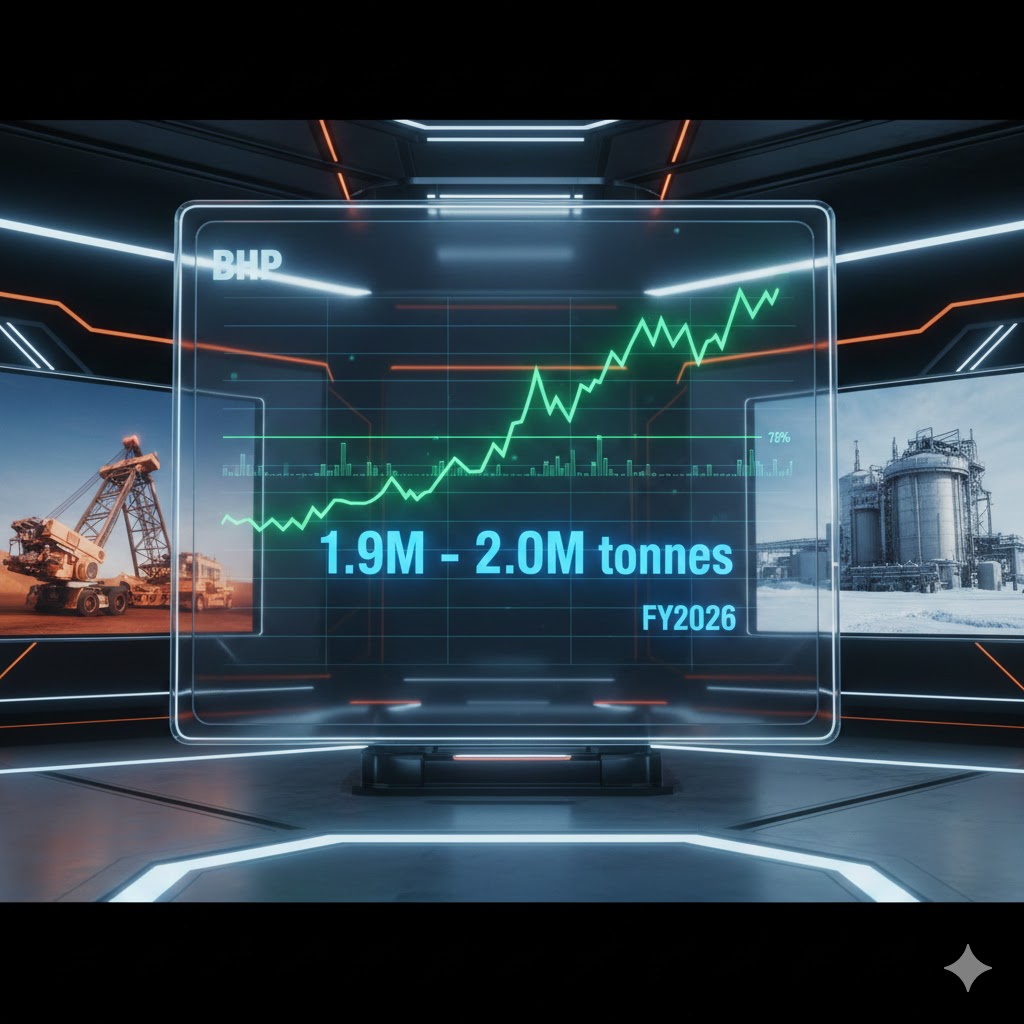
Accordingly, BHP announced an upward revision of its FY2026 copper production guidance. The group raised its overall production targets, along with specific guidance for its Escondida and Antamina mines. The total annual copper production is now expected to be between 1.9 million and 2.0 million tonnes, up from the previous forecast of 1.8 million to 2.0 million tonnes.

However, some analysts warned that expectations of increased supply could exacerbate a market surplus, potentially exerting downward pressure on copper spot prices. Without a corresponding increase in demand to offset global supply, prices may face headwinds.

Record Performance in Iron Ore and Coal

BHP’s iron ore business also achieved record-breaking results. Western Australia Iron Ore (WAIO) saw both production and shipments hit all-time highs for the first fiscal half. Additionally, iron ore production from Samarco, BHP’s Brazilian subsidiary, also increased.

The miner maintained its full-year iron ore production forecast at 284 million to 296 million tonnes, noting that the strong performance in the first half provides a solid foundation heading into the third fiscal quarter.

In the coal sector, metallurgical coal production rose due to the highest mining efficiency at its BMA subsidiary in five years. Energy coal production grew by 10% YoY, further diversifying the group’s earnings base.

Growth Project Updates

Regarding growth initiatives, BHP confirmed that its Jansen potash project in Canada remains on track for first production in mid-2027. The company reiterated that Jansen is expected to be a long-term, low-cost, and scalable asset that provides security for future commodities, aligning with global food security trends.