100% Tariffs! Trump Issues New Round of Threats to Canada; Canada Responds

On the 24th, U.S. President Donald Trump threatened to impose a 100% tariff on Canadian goods entering the United States if Canada “reaches deals” with certain countries. In response, Canadian Prime Minister Mark Carney called on citizens to “Buy Canadian” to counter external threats.

Prior to this, Carney delivered a speech at the World Economic Forum using Canada as an example to argue that “middle powers” should act in coordination to avoid becoming victims of U.S. hegemony. Analysts suggest that Carney’s remarks signal a major shift in Canada’s policy toward the United States.

Trump’s Threats

Following Trump’s latest round of tariff threats on January 25, Canadian Prime Minister Mark Carney urged the public on the 24th to “Buy Canadian” to address external challenges.

In a pre-recorded video posted on his personal social media, Carney stated: “As our economy faces threats from abroad, Canadians have made a choice: to focus on the things we can control.”

While not mentioning the United States by name, Carney reaffirmed the push for a “Buy Canadian” policy. He noted: “We cannot control the actions of other countries. But we can be our own best customers. We will buy Canadian products, and we will build our country with Canadian products.”

On the same day, Carney’s official social media account showcased a 40-second video reviewing his recent visits to China and Qatar, as well as his participation in the World Economic Forum. He stated that he is strengthening partnerships, diversifying trade, and attracting investment to secure greater economic and strategic interests for Canada.

Trump, meanwhile, posted a threat on social media stating that if Canada “reaches deals” with certain countries, he would impose 100% tariffs on all Canadian goods entering the U.S.

This follows a sharp speech by Carney at the World Economic Forum in Davos, Switzerland, where he warned nations against being coerced by great powers—a message widely interpreted as a condemnation of Trump’s leadership.

According to Reuters, Carney argued at the forum that “middle powers” must act together to avoid falling victim to U.S. hegemony. While he did not explicitly name the U.S. or Trump, The New York Times reported on the 22nd that Canada’s decision to “flip the table” on Trump stands in stark contrast to other nations that have resorted to flattery or remained low-key for fear of provoking him.

Rob Precht, a scholar at the University of British Columbia, wrote in a commentary for The Conversation that Carney’s remarks mark a significant turning point in Canada’s U.S. policy.

Trump had previously accused Canada of being ungrateful for U.S. military protection, claiming the country “exists because of the United States,” a claim Carney refuted. Additionally, just one week after Carney signed on to a so-called “Peace Commission,” Trump withdrew Canada’s invitation.

Trump also claimed Canada opposes his planned “Gold Dome” missile defense project. Although Ottawa’s exact stance remains unclear, U.S. Treasury Secretary Scott Bessent stated this week that Trump has invited Canada to participate in the project.

Escalating Tensions

Relations between Washington and Ottawa have deteriorated since Trump’s return to the White House. Trump’s earlier decisions to raise tariffs on Canadian goods sparked outrage, leading many Canadians to boycott American products and cancel trips to the U.S.

A Pew Research Center poll shows that in 2025, 64% of Canadians held a negative view of the United States, the highest level in over 20 years.

The survey further revealed that the percentage of Canadians lacking confidence in President Trump is even higher, at approximately 77%. Ninety percent of respondents described Trump as “arrogant,” and three-quarters viewed him as “dangerous.” Another poll conducted last October by the Angus Reid Institute found that nearly half of Canadians (46%) want the government to view the U.S. as an “enemy or potential threat.”

The U.S. imports approximately 4 million barrels of oil from Canada daily, serving as the primary source of crude for refineries in the American Midwest. The U.S. is also the top buyer of Canadian metals and fertilizers.

Automotive industry executives have warned the Trump administration that tariffs on auto parts—one of Canada’s primary exports—would rapidly disrupt manufacturing activities at U.S. factories.

Historically, three-quarters of Canada’s exports have gone to the U.S., but the trade conflict has already dealt a substantial blow to the Canadian economy. According to Statistics Canada data reported by the CBC, Canadian exports to the U.S. fell by approximately 2% in 2025, partly because tariffs made these goods more expensive for American importers.

In the second quarter of 2025, Canada’s GDP fell at an annual rate of 1.6%, with exports dropping by 7.5%. Bank of Canada Governor Tiff Macklem pointed out that U.S. trade actions and the resulting uncertainty have had a “severe impact” on key industries such as automotive, steel, aluminum, and lumber.

To reduce dependence on the U.S., the Carney government is pushing for an economic transformation centered on “diversification and resilience.” A recent federal budget proposal aims to double exports to non-U.S. markets within the next 10 years. Finance Minister François-Philippe Champagne stated that the plan is designed to transform the Canadian economy “from a dependence on a single trading partner to a stronger economy capable of withstanding global shocks.”
Apple’s Eight-Week Losing Streak! Amid Storage Cost Concerns and Approaching Earnings, Goldman Sachs Contradicts Market Sentiment: “Buy the Dip Before Jan 29”

Amid investor concerns over rising hardware costs, Apple (AAPL) shares have declined for eight consecutive weeks.

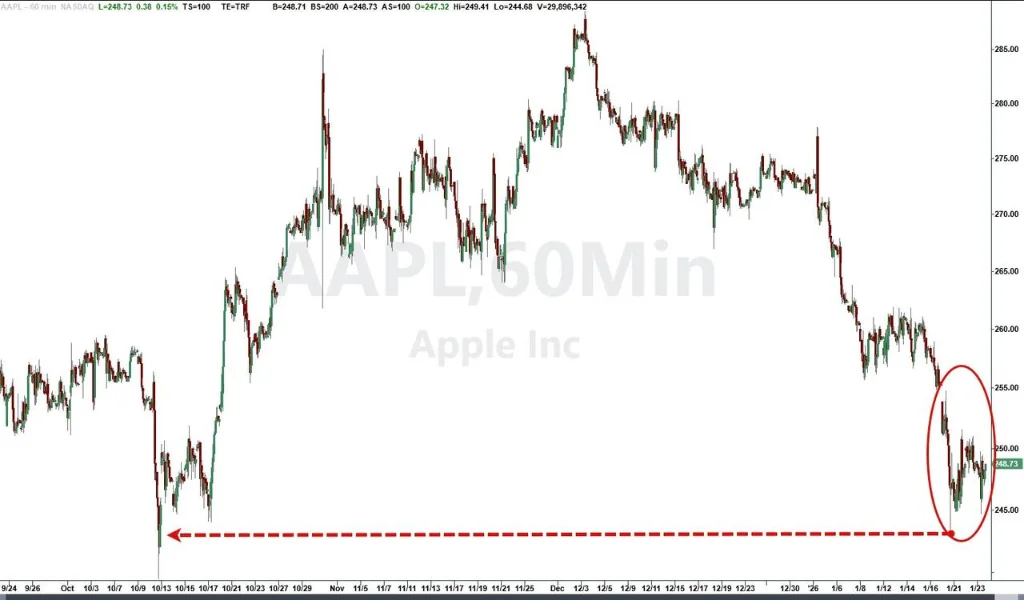
At the close of U.S. markets on Friday, Apple’s stock edged down 0.12%, bringing its weekly loss to nearly 4%. This marks its longest losing streak since May 2022.

(Apple stock price has dropped to levels last seen in mid-October)

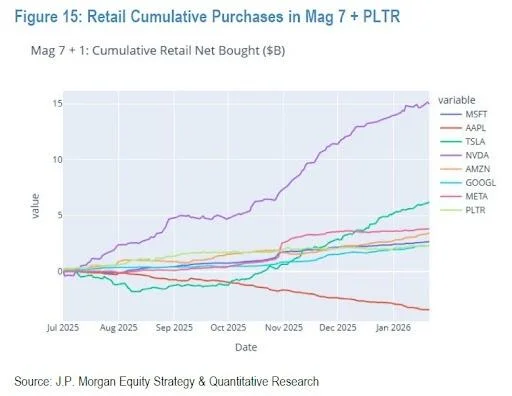
Apple’s share price has retreated approximately 13.8% from its 52-week high of $288 set in December last year to around $248 currently. Furthermore, compared to the other members of the “Magnificent Seven” tech giants, Apple has seen particularly significant capital outflows since July.

(Net capital inflow trends for the Magnificent Seven)

The core trigger for this sell-off pressure originates from supply chain warnings. Recent pessimistic guidance from chip giant Intel sparked market fears regarding skyrocketing costs for storage components. Due to a surge in demand for AI hardware, memory chip prices are undergoing a sharp increase, leading to widespread concern that this will severely erode the gross margins of consumer electronics giants, including Apple.

However, despite the subdued market sentiment, Wall Street Insights notes that Goldman Sachs has maintained its “Buy” rating on Apple. The firm suggests that investors should ignore short-term noise and “buy the dip” ahead of the company’s fiscal 2026 first-quarter earnings report on January 29.

Goldman Sachs believes that a robust iPhone replacement cycle and the implementation of AI features will bolster performance beyond expectations.

Surging Storage Costs Spark Margin Fears

The market’s pessimistic outlook on Apple’s recent performance is primarily driven by the rapid rise in memory chip prices.

According to Wall Street Insights, Intel CFO David Zinsner admitted after the earnings release that while the company has secured supply for the first half of the year, storage pricing could become a challenge in the second half.

Data from Counterpoint Research has further fueled these concerns, forecasting that storage component costs will surge by 40% to 50% this quarter—driven by AI hardware demand—following a similar spike in the fourth quarter of 2025.

This trend poses a direct threat to Apple. IDC research indicates that storage components account for approximately 10% to 15% of the total Bill of Materials (BOM) for high-end smartphones like the iPhone. Benchmark analyst Cody Acree noted:

“Rising component costs, particularly those related to memory prices, could have unknown negative impacts on shipment volumes and revenue potential.”

Additionally, as memory manufacturers such as Micron(MU) and SanDisk(SAND) shift capacity toward more lucrative AI data center components, supply for traditional DRAM and NAND used in smartphones and PCs has tightened.

UBS analyst David Vogt warned in a report that while Apple’s supply agreements might mitigate the impact in the March quarter, risks will significantly increase in the June and September quarters as production for the next-generation iPhone ramps up.

Vogt estimates that memory chip shortages could hit Apple’s gross margin by 50 to 100 basis points. Based on this, UBS maintains a “Neutral” rating on Apple with a price target of $280.

Goldman Sachs’ View: Retracement is a Buying Opportunity

Despite inflationary pressures on the cost side, Goldman Sachs analyst Michael Ng argues that now is the optimal time to buy Apple stock.

Goldman has set a price target of $320 for Apple and expects the company to deliver an outstanding performance in the upcoming earnings report.

The firm forecasts that Apple’s revenue for the first quarter of fiscal 2026 will reach $137.4 billion, an 11% year-over-year increase. The iPhone business is expected to be the primary growth engine, with revenue projected to rise 13% year-over-year to $78 billion. This growth is driven by two main factors:

  1. Volume Growth: A projected 5% year-over-year increase in shipments, notably bolstered by a 26% surge in shipments in China, reflecting a strong recovery in a key market.
  2. Average Selling Price (ASP): An 8% year-over-year increase, indicating robust demand for high-end models.

Furthermore, Goldman Sachs emphasized the support for the stock price from the future product pipeline. The report noted that with demand for the iPhone 17 series expected to outperform its predecessor, and the anticipated launch of a foldable iPhone (iPhone Fold), Apple is shifting toward a “two-updates-per-year” release cycle.

Combined with upgrades to iOS and Siri, as well as the partnership with Google Gemini, the iPhone’s position as the preferred hardware gateway for the AI era will be further consolidated, thereby extending the upgrade super-cycle.

Wall Street Consensus and Valuation Outlook

From a valuation perspective, Apple currently trades at a forward P/E ratio of approximately 30x. While slightly above the industry average, analysts generally consider this premium justified given the stability of its earnings growth.

Goldman Sachs expects Apple’s first-quarter earnings per share (EPS) to reach $2.66, consistent with market consensus, while maintaining a steady gross margin of 47.7%.

Overall, Wall Street remains bullish on Apple. Out of 42 analysts covering the stock, 21 give it a “Strong Buy” rating. Evercore ISI reaffirmed an “Outperform” rating and a $330 price target, projecting a 17% year-over-year increase in iPhone sales.

Wedbush analyst Dan Ives provided a street-high price target of $350, describing 2026 as a “milestone year” for the full deployment of Apple’s AI strategic roadmap.

As the January 29 earnings date approaches, the market is waiting with bated breath to see if Apple can reshape its growth narrative through strong AI terminal demand, even under the shadow of rising storage costs.

Tesla Discontinues Basic Autopilot to Prioritize Full Self-Driving Software

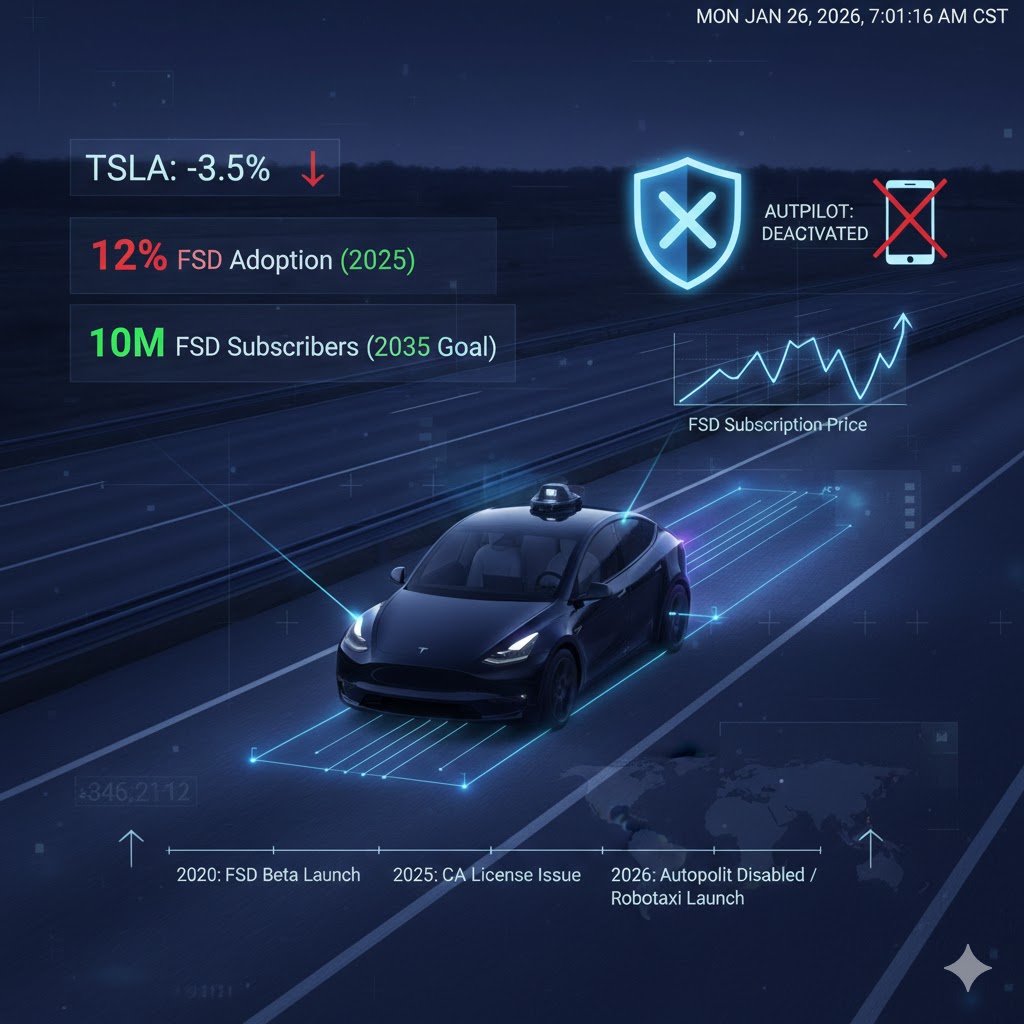
Tesla(TSLA) has officially discontinued its basic driver-assistance system, Autopilot, in a move designed to accelerate the adoption of its more advanced Full Self-Driving (Supervised) software.

The decision comes as Tesla faces a 30-day suspension of its manufacturing and dealer licenses in California—its largest U.S. market. In December, a court ruled that Tesla had engaged in years of deceptive marketing by exaggerating the actual performance of Autopilot and Full Self-Driving (FSD) features. The California Department of Motor Vehicles, which initiated the case and holds licensing authority, has granted a 60-day stay of the suspension to allow Tesla time for rectification, specifically requiring the company to stop using “Autopilot” as a functional name.

Autopilot consists of two primary features: Traffic-Aware Cruise Control, which maintains a set speed and a safe distance from the vehicle ahead, and Autosteer, which assists in steering the vehicle within its lane and navigating curves.

Tesla’s official vehicle configuration page now indicates that new cars will only come standard with Traffic-Aware Cruise Control. It remains unclear whether existing owners will be affected by this change.

Just a week before this decision, Tesla announced that starting February 14, it will eliminate the $8,000 one-time purchase option for its Full Self-Driving software. From then on, consumers will only be able to access the feature via a $99 monthly subscription. However, CEO Elon Musk noted in a post on Thursday that subscription prices will rise as software capabilities continue to improve.

Musk claimed that future Tesla models will possess “unsupervised” autonomous capabilities. With FSD software installed, he suggested drivers could “spend the whole trip on their phones or even sleep.” Last December, he stated that the latest version of FSD could already achieve the former, though it is important to note that texting while driving remains illegal in nearly every U.S. state.

On Thursday, Tesla launched its first fleet of Model Y robotaxis in Austin, Texas, operating without human safety drivers on board. These taxis are equipped with Tesla’s more advanced autonomous software, though they are still shadowed by Tesla-operated monitoring vehicles during operation.

Tesla first launched the beta version of its FSD software in late 2020, but adoption rates have consistently fallen short of expectations held by Musk and other executives. In October 2025, Tesla CFO Vaibhav Taneja revealed that only 12% of Tesla owners had paid for the software. Reaching Musk’s new $1 trillion compensation package milestones requires meeting a core “product goal”: achieving 10 million active FSD subscriptions by 2035.

Tesla originally introduced Autopilot in the early 2010s. Musk had previously negotiated with Google to use technology from the search giant’s then-fledgling self-driving division, but talks eventually collapsed (that division later became the autonomous vehicle company Waymo). In April 2019, Tesla announced that Autopilot would become a standard feature on all its models.

In the decade since Autopilot’s debut, Tesla has struggled to clearly and accurately communicate the actual performance boundaries of the software. The company has frequently used hyperbolic claims, leading consumers to believe the technology is far more capable than it truly is. This has resulted in some drivers over-relying on the system; data from the National Highway Traffic Safety Administration (NHTSA) indicates that this has contributed to hundreds of accidents and at least 13 fatalities.