Tag Archives: AAPL

Musk Slams Apple-Google Partnership, Alleging “Unreasonable Concentration of Power”

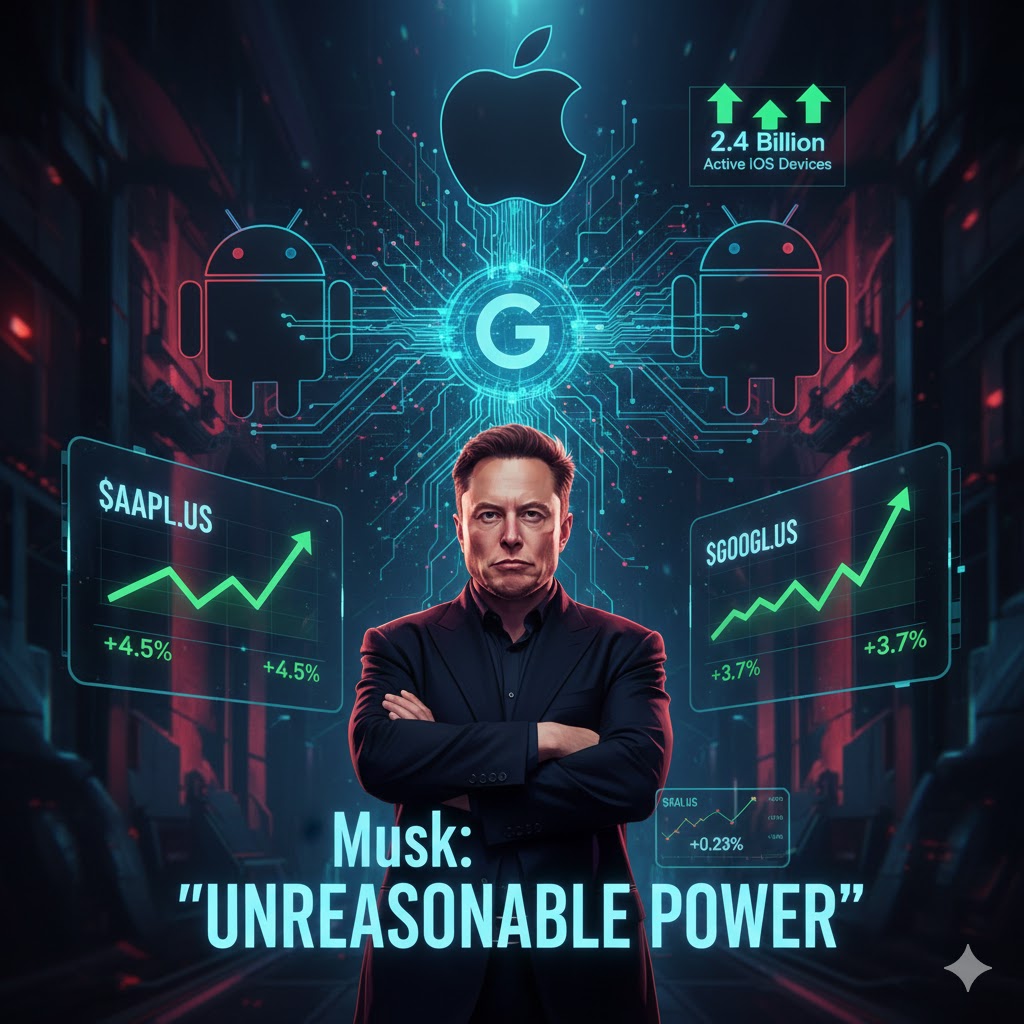
Elon Musk, the world’s wealthiest person, launched a scathing critique on Monday against the new partnership between Apple (AAPL) and Alphabet (GOOGL), claiming it grants the latter an “unreasonable concentration of power.”

Google and Apple announced a new multi-year cooperation agreement on Monday, though specific financial terms were not disclosed.

Under the agreement, Apple will utilize Google’s Gemini model to power a new version of Siri, set to launch later this year. This collaboration deepens the alliance between the two tech giants in the AI era and further solidifies Google’s position in its competition against OpenAI.

In a joint statement, the two companies said: “After a thorough evaluation, Apple determined that Google’s AI technology provides the most capable underlying support for Apple Foundation Models and is excited about the new innovative experiences this will unlock for Apple users.”

Musk responded on his social media platform X, stating: “Given that Google also controls Android and Chrome, this looks like an unreasonable concentration of power.”

Musk founded his own AI company, xAI, to compete with major industry players like OpenAI.

In contrast to Musk’s criticism, Dan Ives, an analyst at Wedbush Securities, believes the deal is a “positive win” for both Apple and Google. He noted that for Google, the partnership serves as a major validation of its status as a top-tier foundation model provider. For Apple, it represents a significant step in accelerating its AI strategy toward 2026 and beyond.

Apple had previously considered partnering with OpenAI or Anthropic to have ChatGPT or Claude power the new Siri but ultimately selected Google’s Gemini. Last November, Google launched its Gemini 3 model, which received widespread acclaim for its performance.

The latest agreement builds upon years of existing collaboration, as Google has long been the default search engine on Apple devices. This partnership not only drives massive traffic to Google but also generates tens of billions of dollars in annual revenue for Apple.

Apple currently has approximately 2.4 billion active iOS devices and 1.5 billion iPhones in use, representing one of the largest installed bases among consumer electronics companies.

“Magnificent Seven” Group Strategy Fails: Wall Street Says It’s Time to “Pick and Choose” Best Stock in 2026

In recent years, many investors followed a simple recipe to beat the market: heavy concentration in U.S. mega-cap tech stocks.

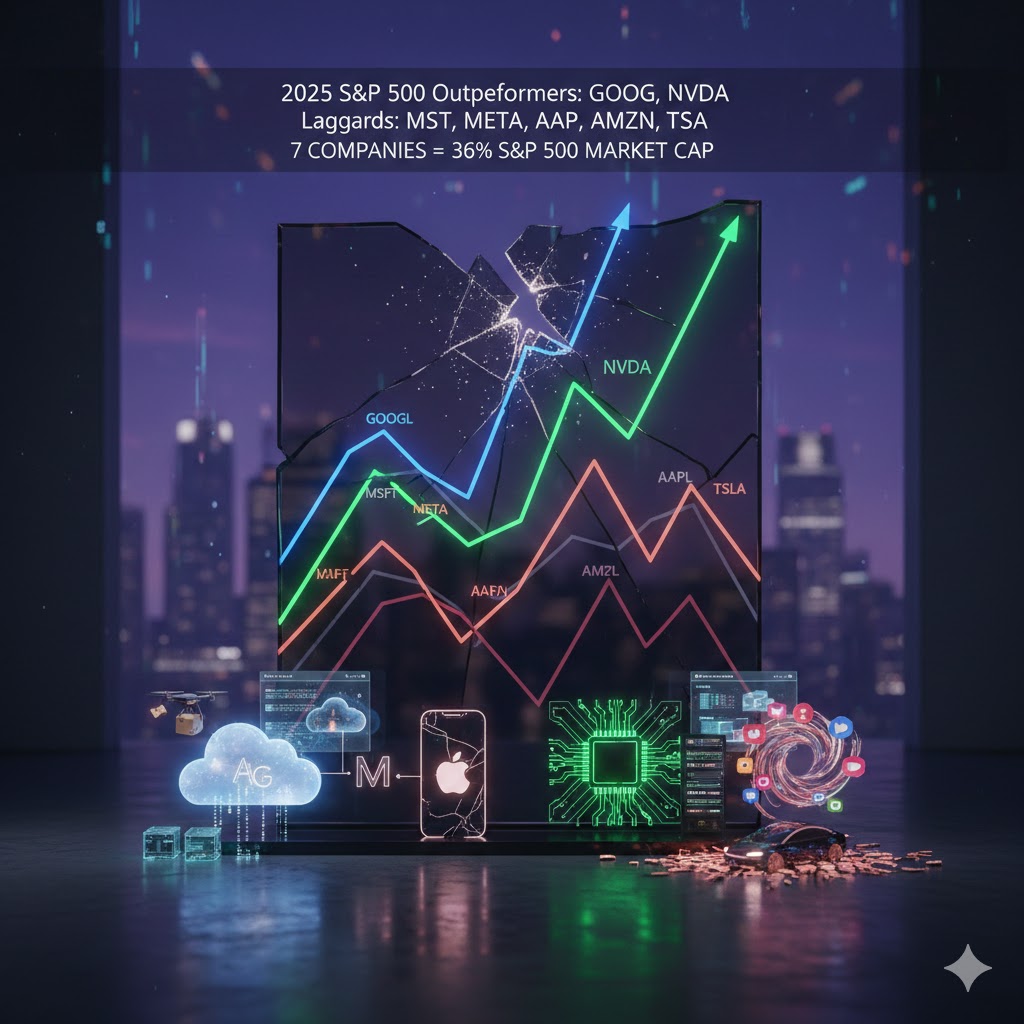
While this strategy yielded handsome rewards for a long time, it lost its luster in 2025. For the first time since the Federal Reserve began its rate-hiking cycle in 2022, the majority of the “Big Tech” firms underperformed the S&P 500 (SPX). Although an index tracking the “Magnificent Seven” rose 25% in 2025—outpacing the S&P 500’s 16%—this gain relied entirely on the explosive performance of Alphabet (GOOGL) and Nvidia (NVDA).

Many Wall Street professionals expect this divergence to persist through 2026 as earnings growth for tech giants slows and skepticism grows regarding the returns on massive Artificial Intelligence (AI) investments. Early 2026 data supports this view: the Magnificent Seven index is up only 0.5%, while the S&P 500 has climbed 1.8%. In this environment, selective stock picking within the group has become critical.

“The market is no longer a ‘one-size-fits-all’ trade,” said Jack Janasiewicz, Lead Portfolio Strategist at Natixis Investment Managers Solutions, which manages $1.4 trillion. “If you just blindly buy the whole basket, the laggards are likely to cancel out the winners.”

Cooling Enthusiasm and Narrowing Growth Gaps

This three-year bull market has been spearheaded by tech titans. Since the bull run began in October 2022, just four companies—Nvidia, Alphabet, Microsoft (MSFT), and Apple (AAPL)—have accounted for over one-third of the S&P 500’s total gains. However, as capital begins to rotate into other S&P 500 constituents, enthusiasm for Big Tech is cooling.

With earnings growth slowing, investors are no longer satisfied with the “AI will make us rich” narrative; they want tangible financial results. Data indicates that earnings growth for the Magnificent Seven is projected to be around 18% in 2026—the slowest since 2022. This narrows their lead significantly over the other 493 S&P 500 companies, which are expected to see a 13% increase.

“We are seeing the breadth of corporate earnings growth expanding, and that trend will continue,” noted David Lefkowitz, Head of U.S. Equities at UBS Global Wealth Management. “Tech is no longer the only game in town.”

One silver lining for the group is that valuations have moderated. The Magnificent Seven index currently trades at 29 times forward earnings, well below the highs of over 40 times seen at the start of the decade. By comparison, the S&P 500 trades at 22 times, and the Nasdaq 100 at 25 times.


Outlook for the Magnificent Seven in 2026:

Nvidia

The dominant AI chipmaker is under pressure from rising competition and concerns over the sustainability of capital expenditure from its largest customers. While the stock has soared roughly 1,100% since late 2022, it has retreated 8% since hitting an all-time high on October 29 last year.

Rival AMD (AMD) has secured data center chip orders from OpenAI and Oracle (ORCL), while major customers like Google are accelerating the deployment of in-house custom chips. Nevertheless, Nvidia’s revenue continues to grow rapidly as chip demand still outstrips supply. Wall Street remains bullish: 76 out of 82 analysts rate it a “Buy,” with an average price target implying 39% upside—the highest among the Seven.

Microsoft

2025 marked the second consecutive year Microsoft underperformed the S&P 500. As a major spender in the AI race, Microsoft is expected to see capital expenditures approach $100 billion for the fiscal year ending June 2026, with analysts predicting a further climb to $116 billion the following year.

While data center expansion has boosted cloud revenue growth, the company has struggled to convince customers to pay significantly more for AI-integrated software. Brian Mulberry, Client Portfolio Manager at Zacks Investment Management, notes that investors are waiting for these massive investments to translate into real bottom-line results.

Apple

Apple took the most conservative approach to AI among the group, a strategy that weighed on its stock in early 2025, with shares falling nearly 20% by August. However, Apple subsequently became an “Anti-AI play,” attracting investors wary of high-cost AI risks, and surged 34% by the end of 2025. Strong iPhone sales have reassured investors that core demand remains robust.

The key for 2026 is accelerating growth. While the company narrowly avoided its longest losing streak since 1991 last week, momentum has slowed. Markets expect revenue to grow 9% in the fiscal year ending September 2026—the fastest since 2021. With a forward P/E of 31x (second only to Tesla), Apple’s performance must dazzle to sustain its valuation.

Alphabet (Google)

A year ago, investors feared Google was falling behind OpenAI. Today, Google is a consensus “darling,” leading the AI field on multiple fronts. Its Gemini AI model has received widespread acclaim, and its in-house TPUs are seen as a major revenue driver that could even challenge Nvidia’s dominance.

In 2025, Google was the best performer of the Seven, rising over 65%. However, with its market cap nearing $4 trillion and a P/E of 28x (well above its five-year average of 20x), analysts expect more modest gains of about 3.9% in 2026.

Amazon

After seven consecutive years as the laggard of the group, Amazon (AMZN) has staged a strong comeback in early 2026. Optimism centers on its cloud business, AWS, which recently posted its fastest growth in years. Investors expect efficiency gains from warehouse automation and robotics to pay off soon. Clayton Allison, Portfolio Manager at Prime Capital Financial, believes the market has yet to fully price in this value, drawing parallels to Google’s turnaround last year.

Meta

Meta Platforms (META.) most clearly reflects investor skepticism regarding “AI overspending.” CEO Mark Zuckerberg has spent billions on acquisitions and talent, including a $14 billion investment in Scale AI. However, after Meta raised its 2025 capex to $72 billion and forecasted “significantly higher” spending for 2026, the stock tumbled. Since its August 2025 high, the stock has dropped 17%. Meta’s primary task in 2026 is proving these investments drive profit growth.

Tesla

Tesla (TSLA) flipped from laggard to leader in the second half of 2025 as Elon Musk pivoted focus from lackluster EV sales to autonomous vehicles and robotics, sending shares up over 40%. This rally pushed Tesla’s forward P/E to a staggering 200x. While revenue is expected to return to 12% growth in 2026 after a stagnant period, Wall Street analysts remain pessimistic about the stock price, with an average target predicting a 9.1% decline over the next 12 months.

Key Takeaways from Goldman Sachs’ 2026 Tech Industry Predictions: Apple’s “Foldable” Rescue, the Rise of ASICs, and a Trillion-Dollar Optical Feast

Goldman Sachs’ top ten trends for the tech industry in 2026 focus on core sectors such as AI servers, optical communications, Apple’s foldable screens, semiconductors, intelligent driving, and satellite communications, revealing structural investment opportunities driven by technological innovation and supply chain shifts.

In a recent report, Goldman Sachs’ analyst team led by Allen Chang pointed out that AI server shipments will experience explosive growth in 2026. The penetration rate of ASIC chips is expected to rise to 40%, driving a year-over-year surge of more than 200% in 800G/1.6T optical module shipments. The accelerated penetration of specialized ASIC chips will propel the AI server and optical communications industries to new trillion-dollar heights.

In consumer electronics, $Apple (AAPL)$’s upcoming foldable iPhone is expected to be a powerful catalyst for the smartphone market and a central focus for investors. Meanwhile, the PC market continues to face severe challenges, though leading players remain resilient.

Goldman Sachs emphasized that demand for AI-related technology and high-end hardware will continue to drive earnings growth across China’s semiconductor, optical communication, and PCB (printed circuit board) supply chains. Simultaneously, emerging sectors such as intelligent driving, AI software, and Low Earth Orbit (LEO) satellites are accelerating their commercialization due to policy support and technological breakthroughs, providing diversified opportunities for investors.

AI Servers: The Strong Rise of ASICs and Connectivity Upgrades

The AI server market is undergoing a structural adjustment. Goldman Sachs expects rack-level AI server shipments to surge from 19,000 units in 2025 to 50,000 units in 2026.

A key trend is the diversification of platforms and enhanced network connectivity. Due to their energy efficiency advantages in specific AI workloads, ASIC chips are expected to reach a 40% penetration rate in 2026 and further rise to 45% in 2027.

This trend will make customers more dependent on top-tier suppliers with strong design and manufacturing capabilities, such as Hon Hai and $Foxconn Industrial Internet (601138.SH)$.

Optical Communications: Explosion of 800G/1.6T Optical Modules

The optical communications sector will directly benefit from the expansion of AI infrastructure. As data center networks upgrade from 400G to 800G/1.6T, and the application of Silicon Photonics and CPO (Co-Packaged Optics) technologies increases, demand for optical transceivers will see explosive growth.

Goldman Sachs highlighted that the rising penetration of ASIC chips will further support optical module demand, as ASICs rely more heavily on networking capabilities to execute AI workloads.

Thermal Management: Accelerated Penetration of Liquid Cooling

As computing density increases, thermal management technology is reaching an upgrade inflection point. Goldman Sachs noted that the penetration of liquid cooling technology will rise significantly, particularly in the ASIC AI server domain. To handle the thermal design power (TDP) challenges brought by higher computing power, the supply chain will accelerate its migration toward liquid cooling solutions, benefiting thermal component suppliers like AVC and Auras.

ODM Manufacturers: U.S. Capacity Layout as the Competitive Edge

In the ODM (Original Design Manufacturer) sector, geopolitics and supply chain resilience have become critical considerations. Goldman Sachs believes that manufacturers with firm commitments or capacity plans in the United States will outperform the market. ODMs with strong R&D capabilities, vertical integration advantages, and exposure to comprehensive chipset platforms—such as Hon Hai, Wistron, and Wiwynn—will be preferred by the market.

PCs: Severe Market Challenges, But Leaders Remain Resilient

The PC market faces multiple headwinds in 2026. Goldman Sachs analysis suggests that the Windows 10 replacement cycle is nearing its end, growth expectations for AI PCs have already been priced in by the market, and rising memory costs may lead to lower product specifications or higher prices. In this context, only global market leaders (such as Lenovo) are expected to remain resilient, thanks to stronger supply chain bargaining power and exposure to high-end products.

Smartphones: Will the Foldable iPhone Stand Alone?

The report indicates that Apple will launch a foldable iPhone in 2026, with estimated shipments between 11 million and 35 million units, serving as a powerful catalyst for the smartphone market. The rising penetration of high-end foldable models will drive earnings growth for related component companies.

Goldman Sachs noted that this change in form factor will be a core driver, as the launch of a foldable iPhone will attract consumers and support terminal demand. Although rising memory costs pose a potential risk, high-end branding and new features like foldable screens will reduce consumer price sensitivity.

PCBs: High-End Capacity Shortage Leading to Price and Volume Gains

Despite market disagreements over long-term supply and demand dynamics, Goldman Sachs believes PCB demand remains solid.

Specifically, high-end CCL (Copper Clad Laminate) and PCB suppliers will face a favorable supply-demand landscape, benefiting from increased AI server shipments and ASIC penetration. As CCL grades upgrade to M8+ and M9, the average selling price (ASP) of high-end products is expected to grow by 20-30% annually in 2026 and 2027.

China Semiconductors: AI Driving a New Round of Expansion

The Chinese semiconductor industry will continue its growth momentum. Goldman Sachs is optimistic about the expansion plans of local leaders (such as $SMIC (00981.HK)$ and Hon Hai) in advanced processes, as well as the rise of domestic GPU suppliers.

AI technological innovation and new demand for edge devices (such as AI glasses) will be major drivers. Furthermore, the semiconductor equipment and materials sectors will benefit from the localization trend within the supply chain.

L4 Chips and Robotaxis: Continuous Upgrades in Autonomous Driving

The intelligent driving trend will continue to deepen in 2026. Goldman Sachs expects the popularization of urban NOA (Navigate on Autopilot) and Robotaxis to drive growth for chipset, software, and sensor suppliers. Solutions from companies like Horizon Robotics are being adopted by more vehicle models, while the commercialization process for Robotaxi operators like $Pony.ai (PONY)$ is accelerating, creating new growth poles for the supply chain.

LEO Satellites: Accelerated Launches and Specification Upgrades

The Low Earth Orbit (LEO) satellite industry is entering an acceleration phase. Goldman Sachs pointed out that with the increase in rocket carrying capacity and the reduction in launch costs, satellite launches will speed up significantly.

Meanwhile, satellite specifications are being upgraded, with bandwidth evolving from single-band to multi-band (Ka, E, V, W). Considering the 5-6 year lifecycle of satellites, replacement demand could start as early as 2026, driving the construction of constellation network infrastructure.