Tag Archives: INTC

Market Surge: AI Storage Demand Ignites Record Highs While Intel and Moderna Soar on Strategic Breakthroughs

The global storage market is entering a powerful new “super-cycle” driven by surging demand for AI chips and supply shortages. On Wednesday, the U.S. storage sector erupted once again. SanDisk Corp (SNDK) skyrocketed 10.63% in a single day, hitting a new all-time high. Micron Technology (MU) rose 6.61%, also refreshing its historical record. Shares of Western Digital (WDC) and Seagate Technology (STX.) followed suit, surging 8.49% and 5.6%, respectively. Analysts pointed out that while HDDs are slower than SSDs, the massive capacity requirements of AI infrastructure are benefiting the entire storage field.
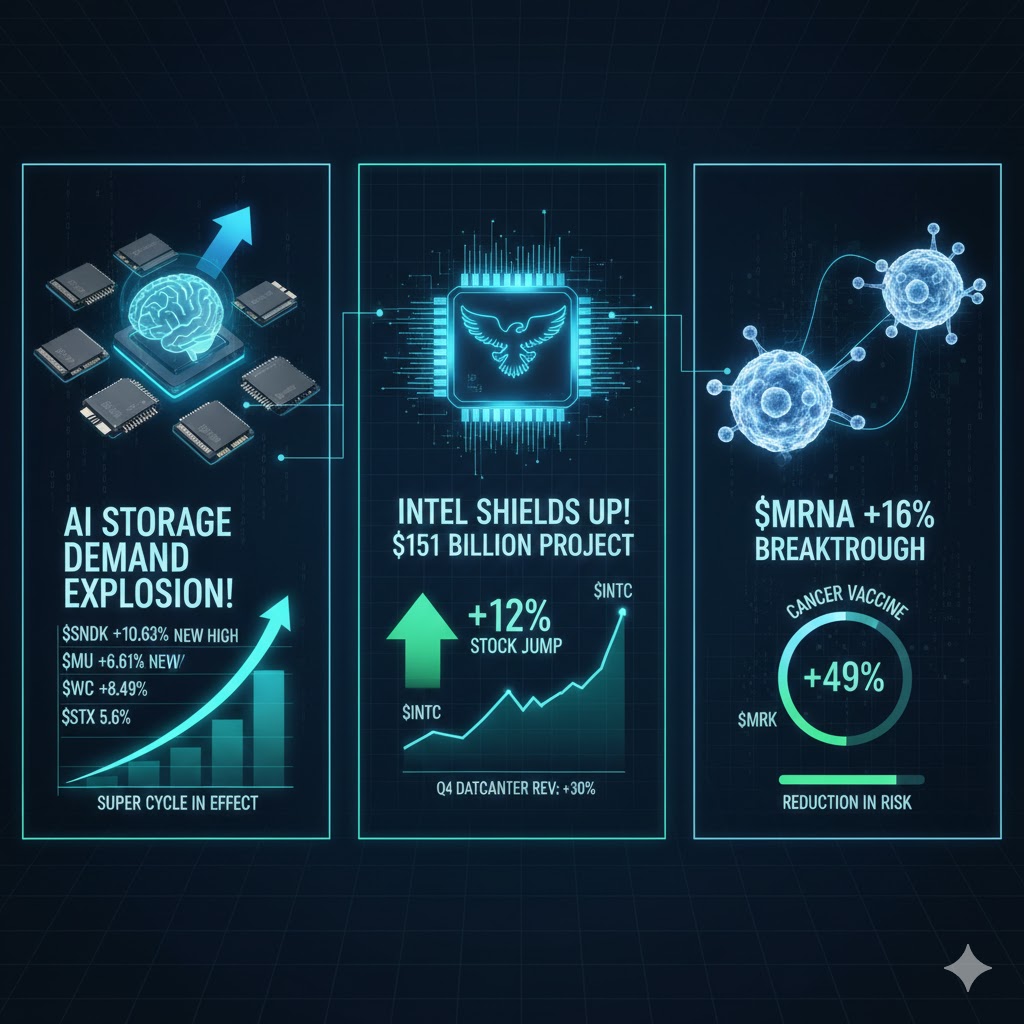
The core driver of this rally stems from Wall Street’s recalibration of valuations for storage giants. Several brokerages raised price targets for SanDisk and Micron, citing robust demand for enterprise-grade SSDs and tight NAND flash supply as key factors driving up product prices. Analysts generally believe that the hunger for high-performance storage in AI infrastructure, combined with the “production-cut-to-support-prices” strategy of major manufacturers, has led to a fundamental reversal in market supply and demand. As chip giants reduce output to maximize profits and spot prices see multi-fold increases, investors are betting that the industry is shifting from traditional cyclical volatility toward a “high-margin, stable-price” foundry-like model. Under a severe supply gap, the upward trend in storage chip prices is widely expected to intensify throughout 2026.

BofA Securities believes the memory chip industry is undergoing a profound transformation, exhibiting “foundry-like” characteristics with reduced cyclicity and improved margins. Supported by strong guidance from upstream players like TSMC and consistent growth in South Korean semiconductor export data, the market consensus is that the storage industry has entered a margin-centric “super-cycle.” Despite the short-term risk of high valuations, the long-term process of value re-rating continues.


Winning a Major U.S. Military Contract! Intel (INTC) Jumps Nearly 12% to Highest Level Since May 2021 Ahead of Q4 Earnings

On January 20, as reported by wccftech, Intel’s new Vice President of Government Technology, James Chew, announced that the company is now a participant in the “Scalable Homeland Innovation Enterprise Layered Defense” (SHIELD) program. Intel will serve as a chip supplier under an Indefinite Delivery/Indefinite Quantity (IDIQ) contract. The project, valued at up to $151 billion, is considered one of the most ambitious initiatives of the U.S. Department of War.

Additionally, Intel is scheduled to release its Q4 2025 earnings after the market closes on January 22. Investor optimism regarding the report has reached a multi-quarter peak, with bets that CEO Lip-Bu Tan’s promised transformation plan is yielding results. Meanwhile, large-scale data center expansions are driving strong demand for Intel’s traditional server chips. According to data compiled by LSEG, Intel’s fourth-quarter data center revenue is expected to surge by over 30%, reaching $4.43 billion.

Fuelled by this optimism, several investment banks recently raised their price targets for Intel. Citigroup upgraded the stock from “Sell” to “Neutral” and raised its target from $29 to $50. Barclays increased its target from $35 to $45, while Susquehanna raised its target from $40 to $45.


Breakthrough Clinical Data for mRNA Cancer Vaccine: Moderna (MRNA) Surges Nearly 16% as Death Risk Halves

Moderna (MRNA) and Merck & Co. (MRK) released median five-year follow-up data from the Phase 2b KEYNOTE-942/mRNA-4157-P201 study. The study evaluates the efficacy and safety of the investigational mRNA individualized neoantigen therapy, intismeran autogene (mRNA-4157 or V940), in combination with the PD-1 inhibitor Keytruda (pembrolizumab) in patients with high-risk melanoma (Stage III/IV) following complete surgical resection. The analysis showed that at the five-year median follow-up, the combination therapy reduced the risk of recurrence or death by nearly half compared to Keytruda alone. According to the press release, eight Phase 2 and Phase 3 clinical trials are currently underway for this combination therapy across various tumor types, including melanoma, non-small cell lung cancer (NSCLC), bladder cancer, and renal cell carcinoma.

In this pre-specified analysis, the combination therapy showed durable and clinically meaningful improvement in the primary endpoint of recurrence-free survival (RFS), reducing the risk of recurrence or death by 49%. The safety profile remained consistent with earlier reports. Moderna and Merck plan to present further data from the follow-up analysis at an upcoming medical conference.

Intismeran autogene is an individualized neoantigen therapy (INT) consisting of a single synthetic mRNA molecule encoding up to 34 neoantigens. These neoantigens are designed using an algorithm based on the unique DNA sequence mutational signature of each patient’s tumor. Once injected, the mRNA sequences are translated into proteins that stimulate a T-cell anti-tumor response through antigen presentation. Based on the KEYNOTE-942 data, the U.S. FDA and the European Medicines Agency (EMA) granted the combination Breakthrough Therapy Designation (BTD) and PRIME status, respectively, for the adjuvant treatment of patients with high-risk melanoma following complete resection.

Currently, the mRNA-4157 indications for melanoma and NSCLC have advanced to Phase 3 clinical trials, putting it on track to potentially become the first marketed mRNA cancer vaccine.
South Korea’s Semiconductor Exports Surge Over 70%! Philadelphia Semiconductor Index Hits Record High as Global “Chip War” Escalates

The semiconductor industry is flashing a major signal.

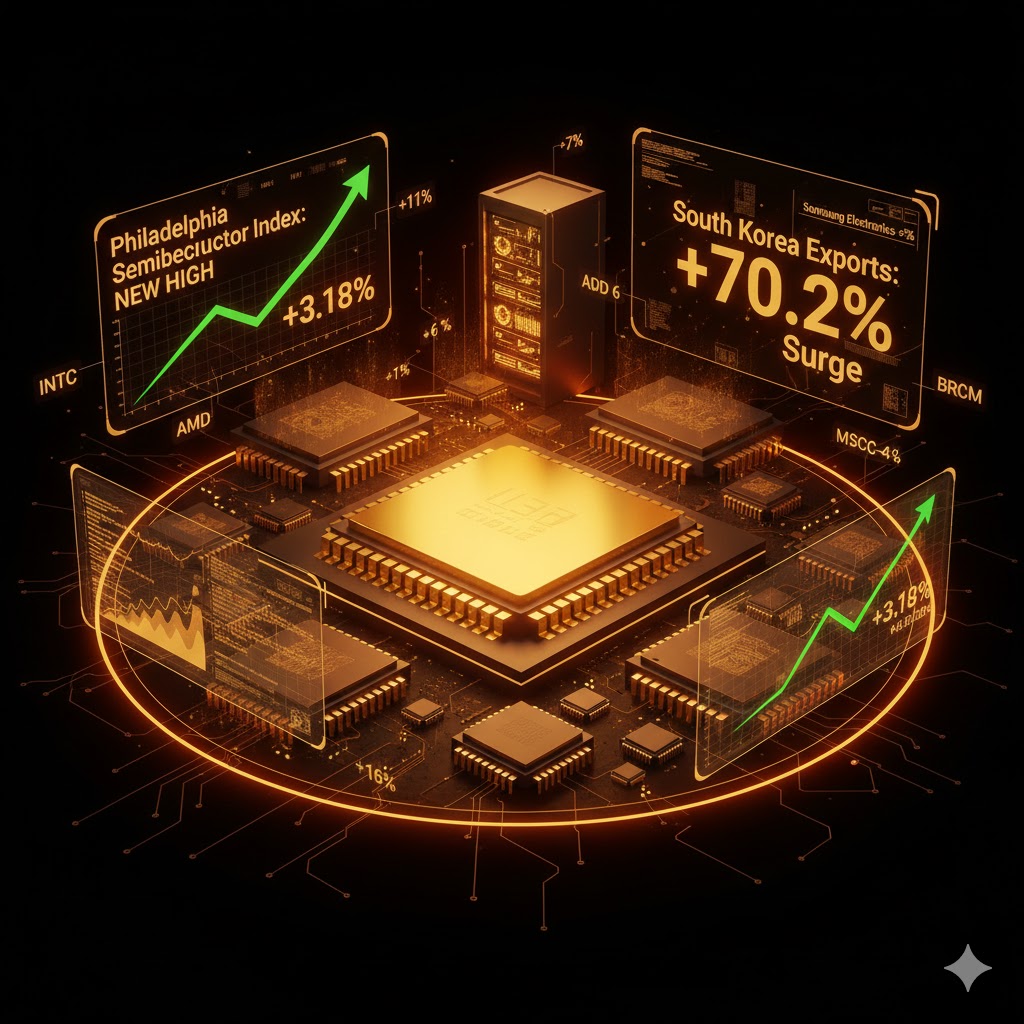
According to the latest data, during the first 20 days of this year, semiconductor exports from South Korea—often called the “canary in the coal mine” for the global economy—totaled $10.73 billion (approximately 74.7 billion RMB), representing a massive year-over-year surge of over 70%. This indicates that global demand for semiconductors remains exceptionally robust amidst the AI (Artificial Intelligence) wave. Following the news, shares of memory chip giant Samsung Electronics spiked, rising more than 3% during intraday trading on the 21st.

Chip stocks rallied broadly on the 21st. The Philadelphia Semiconductor Index rose 3.18%, hitting a new all-time high. Intel (NASDAQ:INTC, ) surged over 11%, Advanced Micro Devices (NASDAQ:AMD) rose more than 7%, Micron Technology (NASDAQ:MU) gained over 6%, ARM (NASDAQ:ARM) climbed over 6%, and Microchip Technology (NASDAQ:MCHP) rose over 4%, while Broadcom (NASDAQ:AVGO) fell by over 1%.

Prior to this, U.S.-listed storage chip stocks also saw a massive rally on Tuesday, with SanDisk soaring over 10% at one point. Institutional analysts pointed out that this round of price hikes in memory chips is not driven by short-term market sentiment, but by the dual factors of “limited advanced process capacity” and “rigid growth in AI server demand.” The sustainability of this trend is significantly stronger than historical cycles.

A Surge of Over 70%

On January 21, local time, data disclosed by the South Korean customs department showed that from January 1 to January 20, 2026, South Korea’s total exports reached $36.36 billion, a year-over-year increase of 14.95%. Imports totaled $36.98 billion, up 4.2%, resulting in a trade deficit of approximately $600 million.

By product category, semiconductor exports during the first 20 days of the month reached $10.73 billion, a year-over-year jump of 70.2%. This accounted for 29.5% of total exports, an increase of 9.6 percentage points compared to the same period last year.

Exports of petroleum products reached $2.46 billion (up 17.6%), and steel products totaled $2.4 billion (up 1.2%). However, automobile exports fell 10.8% to $2.87 billion, and ship exports saw a sharp decline of 18.1%.

As a major global semiconductor exporter and home to two memory giants—Samsung Electronics and SK Hynix—South Korea has become one of the biggest winners as the global AI boom drastically boosts demand for memory chips.

Driven by this demand, South Korea’s exports in December 2025 grew 13.4% year-over-year to $69.6 billion, marking the 11th consecutive month of growth.

For the full year of 2025, South Korea’s total exports reached a record high of $709.7 billion, marking the first time in history that annual exports have surpassed the $700 billion threshold.

According to the latest data from the South Korean Ministry of Science and ICT, thanks to the expansion of demand for high-value-added memory and the continuous rise in prices of general semiconductors such as DRAM, South Korea’s annual semiconductor exports in 2025 reached a record $173.48 billion, up 22.1% year-over-year. This marks the second consecutive year of double-digit growth.

Significant Upgrades

Citigroup has significantly raised the price targets for storage chip giants, most notably hiking SanDisk’s target from $280 to $490 per share—a 75% increase.

Citigroup expressed optimism regarding the strong demand for data center memory, favorable supply-demand conditions, and the company’s powerful competitive moat. SanDisk is expected to continue growing its market share in the enterprise SSD (Solid State Drive) segment.

Simultaneously, Citigroup maintained a “Buy” rating on Seagate Technology, raising its target price from $320 to $385 (an increase of about 20%). Western Digital’s target was also raised from $200 to $280 (an increase of about 40%).

The Citigroup report noted that these companies remain the primary beneficiaries of “strong demand from hyperscale data centers supporting rising storage prices.” Spending by hyperscalers “remains strong,” which will drive demand for power, storage, connectors, and fiber optics.

Divya Mathur, an emerging markets equity fund manager at ClearBridge Investments, also explicitly stated that the market is significantly undervaluing the memory chip demand driven by AI development.

Furthermore, an operations executive at Micron Technology emphasized in a recent interview that the global memory chip shortage has intensified over the past quarter and will persist beyond 2026. PC and smartphone manufacturers are also joining the “scramble” to lock in memory chip supplies for 2026 and beyond. The core reason is the explosive growth in demand for high-end semiconductors for AI infrastructure.

SK Hynix revealed that its chip production capacity for 2026 is already fully sold out, and its high-end memory products for AI are completely booked.

TrendForce also noted in its latest report that the current price increases in storage chips are not driven by temporary market sentiment. Instead, they result from the combined effects of “limited capacity in advanced processes” and “rigidly growing demand for AI servers,” making this cycle notably more durable than previous ones.

Data shows that capital expenditures by the world’s eight leading cloud providers are expected to grow by approximately 65% year-over-year in 2025. Annual reports from IDC and Gartner confirm that AI servers have become the fastest-growing segment in data center IT investment, with storage systems as critical infrastructure set to benefit significantly from this trend.