Tag Archives: TSLA

Tesla’s Valuation Anchor: Cybercab Mass Production in April—How Will Robotaxi and FSD Deliver on the Hype?

Tesla’s(TSLA) current high valuation relies heavily on the visionary potential of its Robotaxi and Full Self-Driving (FSD) technology. Based on the latest operational updates and product roadmaps, the core investment logic is summarized below:

Robotaxi Status: Competitive Pricing and Expanding Range, but Scale Remains Limited

More Affordable than Waymo According to DriveTesla and Robotracker, Tesla’s Robotaxi initially launched with a flat fare of $4.20 per trip, later adjusting to $6.90 as coverage expanded. The service has now largely transitioned to dynamic pricing, averaging approximately $1.50 per mile. In comparison, Waymo’s pricing in San Francisco and Phoenix averages around $2.50 per mile—rising above $3.00 during peak hours—giving Tesla a clear price advantage.
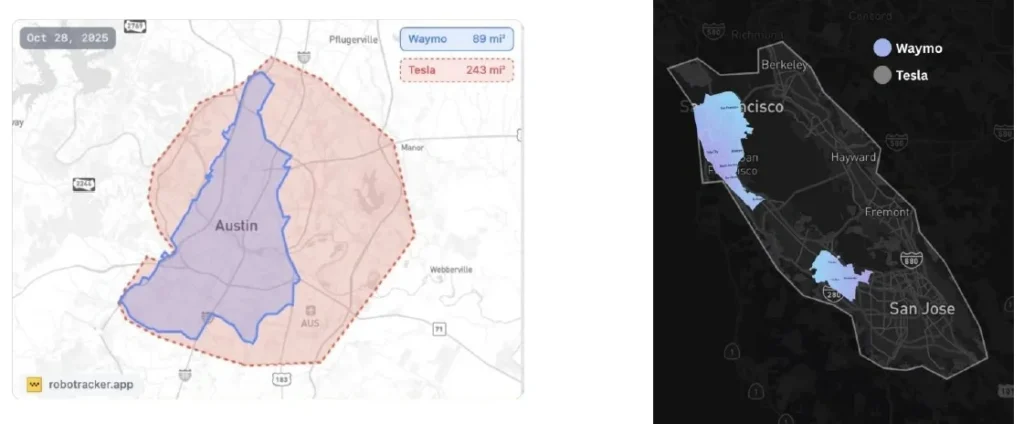
Steady Geographic Expansion While currently only operational in two core hubs—Austin, Texas, and the San Francisco Bay Area—Tesla’s coverage area already exceeds that of Waymo. By 2026, the company plans to expand to multiple states, with a confirmed list of cities including Miami, Las Vegas, Houston, and Dallas.

Key Bottlenecks Persist The primary challenge remains fleet size, which leads to prolonged wait times. As of December 2025, approximately 1,655 Robotaxis were registered in California, but only 132 were in active operation; Austin’s fleet stood at just 40 vehicles. Consequently, Robotaxi has yet to contribute significant revenue and remains in the early stages of commercial validation.

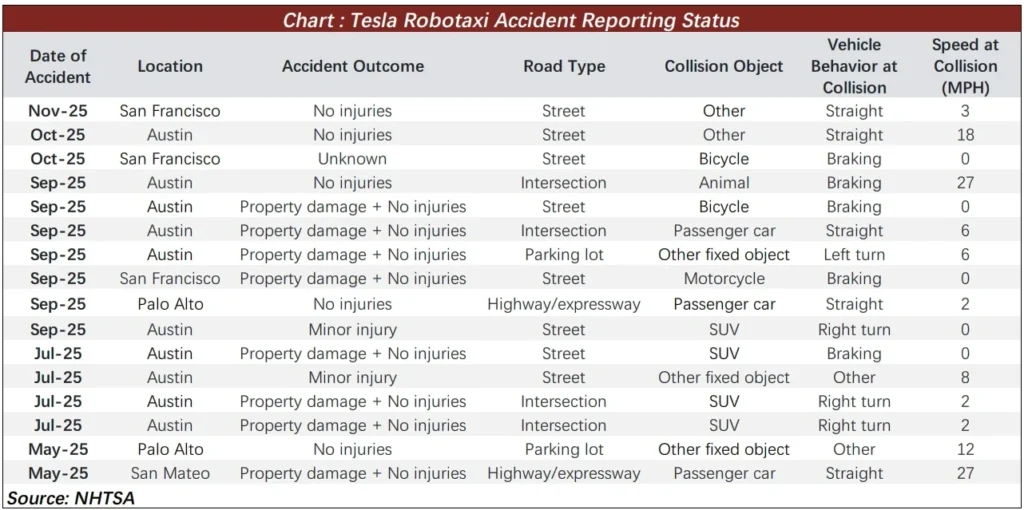
Robust Safety Performance The safety record has been stable since launch with no severe accidents reported. Of the 16 incidents reported to the NHTSA (National Highway Traffic Safety Administration) since May 2025, only two involved airbag deployment—both caused by other vehicles. Tesla’s vehicles sustained no structural damage in these cases, and the majority of incidents resulted in no injuries, indicating a high level of overall safety.
FSD: Rising Penetration and “Grok” Integration—China as the Critical Variable

While Robotaxi may not drive significant revenue in the short term, it serves as a powerful catalyst for FSD adoption:

Technical Iteration and Surging Subscription Rates FSD V14 utilizes a unified system compatible with both consumer vehicles and Robotaxis, with only minor functional differences (e.g., consumer cars retain Autopark, which is unnecessary for Robotaxis). V14 features more conservative driving logic and, following an architectural upgrade, may integrate a streamlined version of the Grok AI system, which is expected to further increase MPI (Miles Per Intervention).

The FSD subscription “take rate” has surged from single digits to between 13% and 19% as of September 2025. By the end of 2025, with Tesla’s cumulative production reaching approximately 9 million vehicles, the estimated number of FSD subscribers sits around 1 million. Since subscribers are concentrated in the U.S. (which accounts for roughly 50% of Tesla’s recent sales), the U.S. penetration rate likely exceeds 20%.

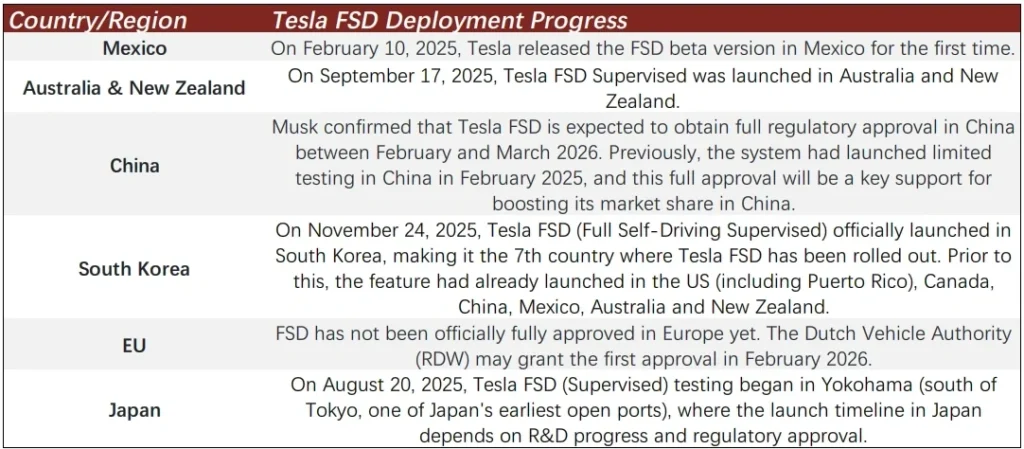
2026 Global Acceleration: Focus on the China Market Following the Grok integration and subsequent performance boosts, the market expects the launch of “unsupervised” Robotaxi operations and a driverless version of FSD. By 2026, commercialization is expected to move into Europe, Southeast Asia, and other regions.

As Tesla’s second-largest market, China remains a crucial growth lever. Currently, FSD is limited to a one-time purchase of 64,000 RMB (~$9,000) with a penetration rate under 5%. If full regulatory approval is granted and Tesla switches to a monthly subscription model, the lower entry barrier is expected to significantly drive adoption in the region.
Cybercab: Mass Production Slated for 2026 with a 2-Million Unit Target

Tesla has already begun testing the Cybercab production system. Elon Musk previously indicated that mass production is scheduled to begin in April 2026. Multiple Cybercab prototypes have been spotted during road tests in Austin. Notably, these test vehicles are equipped with temporary steering wheels and mirrors to satisfy current safety and regulatory requirements.

Tesla envisions the Cybercab as the “highest-volume vehicle in history,” targeting an annual capacity of 2 million units. However, given the realities of automotive manufacturing, achieving this goal in the short term remains a formidable challenge.

Summary: 2026—The Year of Scalability and Execution

Compared to the expectations set in early 2025, many of Tesla’s Robotaxi milestones have already been achieved: accident rates are low, and an unsupervised version is in testing. The core watchpoints for the future are twofold:

  1. Fleet Scaling: Current wait times of 30–40 minutes and the continued need for human supervision mean the service is not yet “fully commercialized.”
  2. Cybercab Production: The pace of the production ramp-up will directly determine whether Tesla’s valuation logic can be realized.
“Magnificent Seven” Group Strategy Fails: Wall Street Says It’s Time to “Pick and Choose” Best Stock in 2026

In recent years, many investors followed a simple recipe to beat the market: heavy concentration in U.S. mega-cap tech stocks.

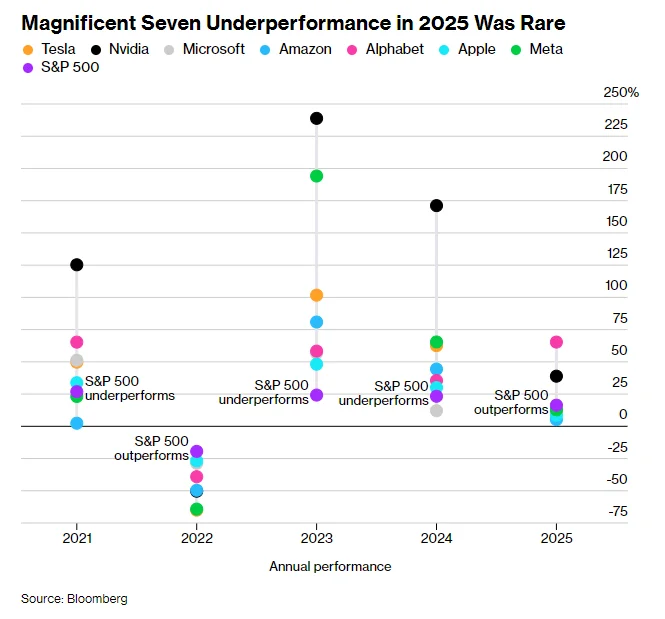
While this strategy yielded handsome rewards for a long time, it lost its luster in 2025. For the first time since the Federal Reserve began its rate-hiking cycle in 2022, the majority of the “Big Tech” firms underperformed the S&P 500 (SPX). Although an index tracking the “Magnificent Seven” rose 25% in 2025—outpacing the S&P 500’s 16%—this gain relied entirely on the explosive performance of Alphabet (GOOGL) and Nvidia (NVDA).

Many Wall Street professionals expect this divergence to persist through 2026 as earnings growth for tech giants slows and skepticism grows regarding the returns on massive Artificial Intelligence (AI) investments. Early 2026 data supports this view: the Magnificent Seven index is up only 0.5%, while the S&P 500 has climbed 1.8%. In this environment, selective stock picking within the group has become critical.

“The market is no longer a ‘one-size-fits-all’ trade,” said Jack Janasiewicz, Lead Portfolio Strategist at Natixis Investment Managers Solutions, which manages $1.4 trillion. “If you just blindly buy the whole basket, the laggards are likely to cancel out the winners.”

Cooling Enthusiasm and Narrowing Growth Gaps

This three-year bull market has been spearheaded by tech titans. Since the bull run began in October 2022, just four companies—Nvidia, Alphabet, Microsoft (MSFT), and Apple (AAPL)—have accounted for over one-third of the S&P 500’s total gains. However, as capital begins to rotate into other S&P 500 constituents, enthusiasm for Big Tech is cooling.

With earnings growth slowing, investors are no longer satisfied with the “AI will make us rich” narrative; they want tangible financial results. Data indicates that earnings growth for the Magnificent Seven is projected to be around 18% in 2026—the slowest since 2022. This narrows their lead significantly over the other 493 S&P 500 companies, which are expected to see a 13% increase.

“We are seeing the breadth of corporate earnings growth expanding, and that trend will continue,” noted David Lefkowitz, Head of U.S. Equities at UBS Global Wealth Management. “Tech is no longer the only game in town.”

One silver lining for the group is that valuations have moderated. The Magnificent Seven index currently trades at 29 times forward earnings, well below the highs of over 40 times seen at the start of the decade. By comparison, the S&P 500 trades at 22 times, and the Nasdaq 100 at 25 times.


Outlook for the Magnificent Seven in 2026:

Nvidia

The dominant AI chipmaker is under pressure from rising competition and concerns over the sustainability of capital expenditure from its largest customers. While the stock has soared roughly 1,100% since late 2022, it has retreated 8% since hitting an all-time high on October 29 last year.

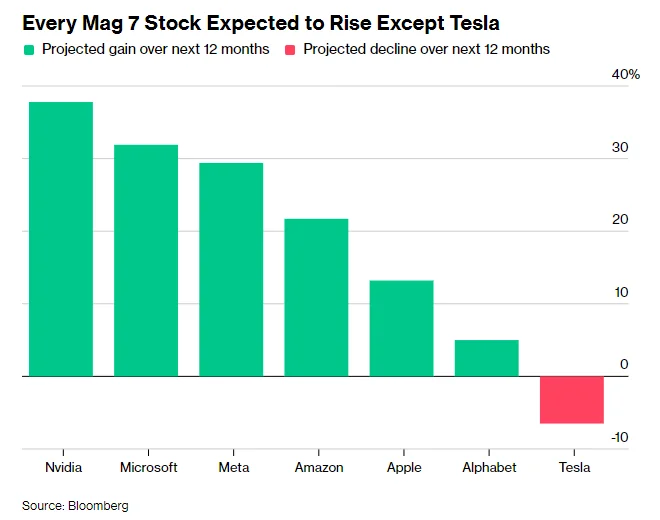
Rival AMD (AMD) has secured data center chip orders from OpenAI and Oracle (ORCL), while major customers like Google are accelerating the deployment of in-house custom chips. Nevertheless, Nvidia’s revenue continues to grow rapidly as chip demand still outstrips supply. Wall Street remains bullish: 76 out of 82 analysts rate it a “Buy,” with an average price target implying 39% upside—the highest among the Seven.

Microsoft

2025 marked the second consecutive year Microsoft underperformed the S&P 500. As a major spender in the AI race, Microsoft is expected to see capital expenditures approach $100 billion for the fiscal year ending June 2026, with analysts predicting a further climb to $116 billion the following year.

While data center expansion has boosted cloud revenue growth, the company has struggled to convince customers to pay significantly more for AI-integrated software. Brian Mulberry, Client Portfolio Manager at Zacks Investment Management, notes that investors are waiting for these massive investments to translate into real bottom-line results.

Apple

Apple took the most conservative approach to AI among the group, a strategy that weighed on its stock in early 2025, with shares falling nearly 20% by August. However, Apple subsequently became an “Anti-AI play,” attracting investors wary of high-cost AI risks, and surged 34% by the end of 2025. Strong iPhone sales have reassured investors that core demand remains robust.

The key for 2026 is accelerating growth. While the company narrowly avoided its longest losing streak since 1991 last week, momentum has slowed. Markets expect revenue to grow 9% in the fiscal year ending September 2026—the fastest since 2021. With a forward P/E of 31x (second only to Tesla), Apple’s performance must dazzle to sustain its valuation.

Alphabet (Google)

A year ago, investors feared Google was falling behind OpenAI. Today, Google is a consensus “darling,” leading the AI field on multiple fronts. Its Gemini AI model has received widespread acclaim, and its in-house TPUs are seen as a major revenue driver that could even challenge Nvidia’s dominance.

In 2025, Google was the best performer of the Seven, rising over 65%. However, with its market cap nearing $4 trillion and a P/E of 28x (well above its five-year average of 20x), analysts expect more modest gains of about 3.9% in 2026.

Amazon

After seven consecutive years as the laggard of the group, Amazon (AMZN) has staged a strong comeback in early 2026. Optimism centers on its cloud business, AWS, which recently posted its fastest growth in years. Investors expect efficiency gains from warehouse automation and robotics to pay off soon. Clayton Allison, Portfolio Manager at Prime Capital Financial, believes the market has yet to fully price in this value, drawing parallels to Google’s turnaround last year.

Meta

Meta Platforms (META.) most clearly reflects investor skepticism regarding “AI overspending.” CEO Mark Zuckerberg has spent billions on acquisitions and talent, including a $14 billion investment in Scale AI. However, after Meta raised its 2025 capex to $72 billion and forecasted “significantly higher” spending for 2026, the stock tumbled. Since its August 2025 high, the stock has dropped 17%. Meta’s primary task in 2026 is proving these investments drive profit growth.

Tesla

Tesla (TSLA) flipped from laggard to leader in the second half of 2025 as Elon Musk pivoted focus from lackluster EV sales to autonomous vehicles and robotics, sending shares up over 40%. This rally pushed Tesla’s forward P/E to a staggering 200x. While revenue is expected to return to 12% growth in 2026 after a stagnant period, Wall Street analysts remain pessimistic about the stock price, with an average target predicting a 9.1% decline over the next 12 months.

Musk’s “Optimus” Robot: Still Dependent on Remote Control, Facing Dexterity Challenges, and Internal Doubts Over Practicality

Elon Musk has staked the future of $Tesla (TSLA) and his personal fortune on the grand vision of the “Optimus” humanoid robot, claiming the product will generate “infinite” revenue and become “the biggest product ever.”

However, according to The Wall Street Journal, a massive gap remains between current reality and the societal transformation Musk describes. In public appearances, Optimus often relies on remote operation by engineers and faces severe technical hurdles in mimicking human hand dexterity.

During recent high-profile demonstrations, the robot’s performance was not entirely autonomous. Reports indicate that at the October 2024 event at the Warner Bros. studio, while some robots performed programmed dances, those interacting with guests and serving drinks were actually being remotely controlled by engineers behind the scenes wearing motion-capture suits and VR headsets. This “human-in-the-loop” reality suggests a significant technological chasm remains before Optimus can achieve Musk’s goal of fully replacing human labor.

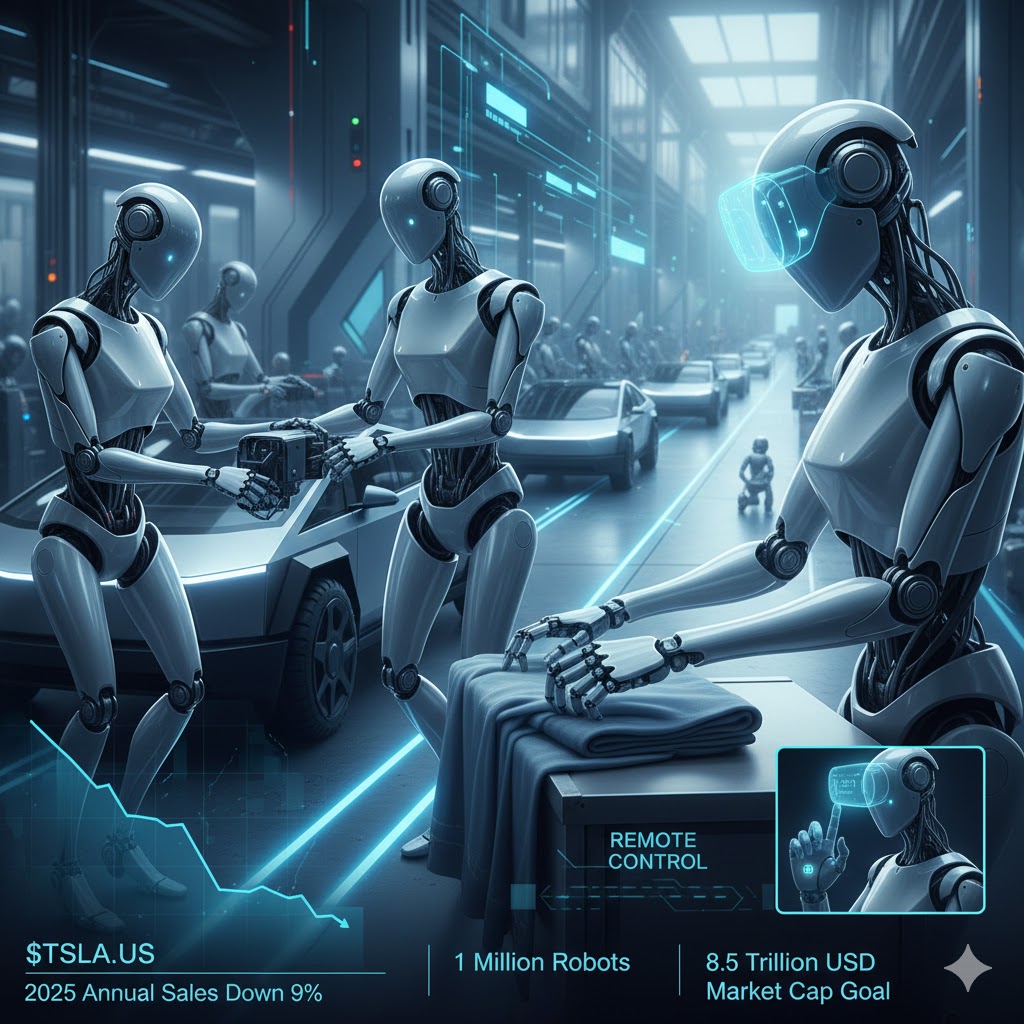
This strategic pivot comes as Tesla’s core business faces mounting pressure. On Friday, the company reported a 9% decline in vehicle sales for the full year of 2025, with a 16% drop in the fourth quarter, trailing China’s BYD in annual volume. Amid slowing EV sales, Musk is attempting to revive investor confidence by shifting focus toward Robotaxis and humanoid robots. Musk’s new compensation package sets a target for Tesla to reach a $8.5 trillion market capitalization within 10 years and sell at least one million robots.

While capital markets remain focused on the long-term prospects of the robotics industry, internal voices at Tesla and industry experts are divided over the practicality of Optimus. On one hand, engineers have hit bottlenecks in creating mechanical hands with human-like sensing and dexterity; on the other, some employees question whether a humanoid form is truly more efficient than purpose-built automation for routine factory tasks.

Remote Control and the “Behind-the-Scenes” Reality

Although Optimus has become a regular at Tesla events—even appearing at the Hollywood premiere of Tron: Ares—the project remains in a development stage heavily reliant on manual assistance behind the polished demonstrations.

Sources told The Wall Street Journal that during last year’s event, every robot interacting with people required real-time monitoring and operation by multiple engineers: one wearing equipment for remote control, one monitoring via laptop, and others on-site to ensure the robot’s physical stability. At Tesla’s engineering headquarters in Palo Alto, while robots frequently walk through offices to collect navigation data, former employees describe instances where engineers had to use hoists to lift the robots back up after they fell.

While this “remote-control” mode showcases future possibilities, it also exposes the limitations of current autonomous capabilities. Ken Goldberg, a robotics expert at UC Berkeley, noted that while Musk is right that building mechanical hands is a challenge, the difficulty lies not just in the hand’s structure, but in control systems, environmental perception, and the ability to compensate for uncertainty. Enabling a robot to perform truly “useful” tasks remains the frontier of current research.

The Dexterity Bottleneck and Internal Practicality Debates

Inside Tesla’s labs, Optimus is practicing mechanical tasks like sorting LEGO bricks and folding laundry. However, granting a robot the dexterity and environmental understanding required to perform tasks like clearing a dinner table remains fraught with difficulty.

Beyond technical challenges, there are dissenting voices within Tesla regarding the commercial logic of humanoid robots. According to former manufacturing engineers, while Optimus may be capable of simple hauling, non-humanoid robots designed for specific tasks are likely more efficient in most factory scenarios.

Evan Beard, CEO of competitor Standard Bots, pointed out that for factories, warehouses, or agriculture, “wheels” are often more practical than “legs.” He argues that wheeled robots are more stable and safer, whereas bipedal robots are inherently unstable when powered down, posing a risk of collapsing and injuring people. Nevertheless, Musk insists on the humanoid design, believing it allows robots to adapt to environments built for humans.

Market Valuation and Analyst Caution

Musk has painted an incredibly ambitious blueprint for Tesla, aiming to shed its label as a mere EV manufacturer through its robotics business. Morgan Stanley analyst Adam Jonas believes cars are to Tesla what books were to Amazon—merely a springboard into other sectors. Jonas predicts that by 2050, the global humanoid robot industry could generate $7.5 trillion in annual revenue; if Tesla can capture a share, it would drastically scale its income.

However, given the industry’s infancy, some analysts have excluded Optimus from their valuation models. Even ARK Invest, a long-term Tesla bull that predicts the stock could reach $2,600, has not included Optimus in its 2029 financial model, citing the likelihood that the product will take longer to reach commercial maturity. Tasha Keeney, a director at ARK Invest, stated that the tasks early versions of the robot can perform may be very limited.

Currently, Tesla has pushed back the preliminary timeline for deploying Optimus commercially in its own factories and is developing a third-generation robot. Although Musk’s marketing positions Optimus as a “home butler” capable of handling chores—likening it to C-3PO or R2-D2 from Star Wars—Tesla still needs a substantial breakthrough in eliminating manual control and improving engineering practicality to turn this “biggest product ever” into a reality and a profit-maker.