Monthly Archives: February 2026

Optical Communication Giant Lumentum Hits Record High! Morgan Stanley Comments on Earnings Report: Explosive Gross Margin and CPO Secures Major Orders!

Lumentum has revealed that it has secured a multi-million-dollar CPO expansion order, expected to ship in the second half of 2027. Meanwhile, the company’s OCS business has backlog orders exceeding $400 million, with expectations to reach $100 million in quarterly revenue two quarters ahead of schedule. Morgan Stanley raised Lumentum’s target price from $350 to $420 but maintained an “Equal-weight” rating. Analysts noted that while the company’s fundamentals are strong, the stock price has already reflected the optimistic expectations of $20 per share earnings for the calendar year 2027, and the current 25x price-to-earnings valuation seems fairly priced.

Lumentum, the optical communication giant (NASDAQ:LITE), delivered a “blowout” Q2 earnings report, surpassing expectations across traditional metrics and providing solid guidance on critical AI infrastructure technologies, securing multi-million-dollar orders. The company is meeting the expectations of Wall Street bulls, though its valuation now reflects these optimistic forecasts.

In early trading today, Lumentum rose more than 10%, reaching a new all-time high.

According to Wind Trading Desk, Morgan Stanley analysts Meta A. Marshall and Mary B. Lenox released a recent report stating that Lumentum’s non-GAAP gross margin for Q2 was 42.5%, exceeding analysts’ expectation of 38.6% by 385 basis points. This was mainly due to product mix optimization and price increases on EML lasers. This performance drove earnings per share to $1.67, significantly higher than the expected $1.38.

More importantly, the company made substantial progress in the emerging CPO market. Lumentum disclosed that it has secured a multi-million-dollar CPO expansion order, which is expected to ship in the second half of 2027. Additionally, its OCS (Optical Subsystems) business backlog has surpassed $400 million, and the company expects to hit $100 million in quarterly revenue two quarters ahead of expectations.

Morgan Stanley raised Lumentum’s target price from $350 to $420, but maintained an “Equal-weight” rating. Analysts noted that while the company’s fundamentals are strong, the stock price has already priced in the optimistic expectation of about $20 earnings per share for the calendar year 2027, and the current 25x price-to-earnings multiple is already quite fully valued.

Gross Margin Exceeds Expectations, Pricing Power Evident

Lumentum’s Q2 gross margin performance became the highlight. The company reported non-GAAP revenue of $665.5 million and earnings per share of $1.67, both exceeding Morgan Stanley’s expectations of $648.6 million and $1.38.

The outperformance in gross margin was primarily driven by two factors: first, product mix improvement, with higher-margin EML lasers and OCS products gaining a larger revenue share. Second, the company successfully implemented price hikes amidst persistent supply constraints. Management indicated that despite increasing capacity by 20% in Q4, supply shortages persist, which gives the company pricing power.

Non-GAAP operating margin reached 25.2%, also significantly surpassing Morgan Stanley’s expectation of 20.6%. The company demonstrated its ability to increase both revenue and margin in a strong demand environment.

As a result, Morgan Stanley raised its earnings forecast significantly. Q3 revenue and earnings per share expectations were raised from $695.3 million and $1.56 to $804.3 million and $2.24. For FY2026, full-year revenue and earnings per share expectations were raised from $2.621 billion and $5.60 to $2.915 billion and $7.63.

CPO Business Wins Major Orders, OCS Accelerates Ramp-Up

While Lumentum’s current performance is driven by EML lasers, the company’s valuation premium is entirely based on its bets on future AI network architecture—OCS and CPO. The report reveals that progress in these two businesses is accelerating faster than expected.

CPO Secures Multi-Million-Dollar Order: Previously, the market saw CPO mostly in the technical exploration stage, but Lumentum revealed that it has received an additional “multi-million-dollar” purchase order for scale-out CPO, expected to begin shipments in the second half of 2027 (CY27). This marks a key milestone in the commercialization of CPO.

OCS Backlog Orders Surge: The optical switching business (OCS) is ramping up faster than expected. The current backlog orders exceed $400 million, and the company expects to reach a $100 million quarterly revenue scale two quarters earlier than planned. This means that the demand for optical switching in AI clusters is accelerating. The majority of the backlog orders are expected to ship in Q1 and Q2 of FY2027 (the second half of 2026).

Supply Chain Status: Ongoing Shortages, EML Controls Pricing Power

Although Lumentum increased capacity by 20% in Q4, supply shortages remain a challenge. This supply-demand imbalance has created a powerful pricing moat for the company.

The 1.6T Era Benefits EML: The company observed that the majority of initial demand for 1.6T optical modules is directed towards EML lasers. This means that in the competition for next-generation high-speed modules, EML remains dominant.

Strong Pricing Power: Management explicitly stated that due to the broad demand for laser chips, components, and subsystems, supply constraints continue, which grants the company pricing power. Morgan Stanley raised its margin expectations for the future based on the assumption that price increases will be successfully passed on to customers.

Valuation Risk: High Growth Already Priced In

Given the strong fundamentals, Morgan Stanley raised its earnings forecast significantly. Analysts predict a compound annual growth rate (CAGR) of a staggering 158% for Lumentum’s earnings from FY2025 to FY2027.

Morgan Stanley raised its target price to $420, based on a 28x P/E multiple applied to an estimated earnings per share of $15 for the calendar year 2027 (CY27).
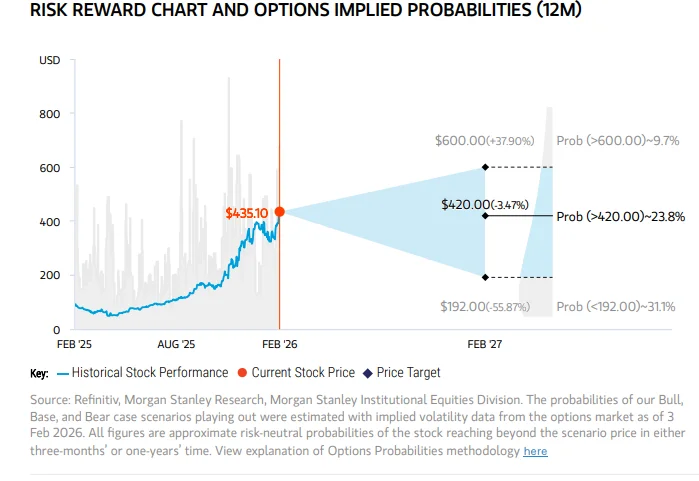
Despite the solid fundamentals, Morgan Stanley maintains an “Equal-weight” rating. The reason is that the strong rebound in the stock price following the earnings report (up 30% from its low point) has already priced in some of the expectations.

The report points out that buy-side expectations are even more aggressive than Morgan Stanley’s, already pricing in $20 earnings per share for CY27. The current stock price corresponds to a P/E multiple of nearly 25x based on the optimistic CY27 earnings per share in Morgan Stanley’s bull case scenario.
Intel Enters the GPU Market, Taking On Nvidia’s Dominance

Intel Takes On Nvidia! Announces GPU Production to Target AI Data Center Business, Hires Qualcomm Executive as Chief Architect

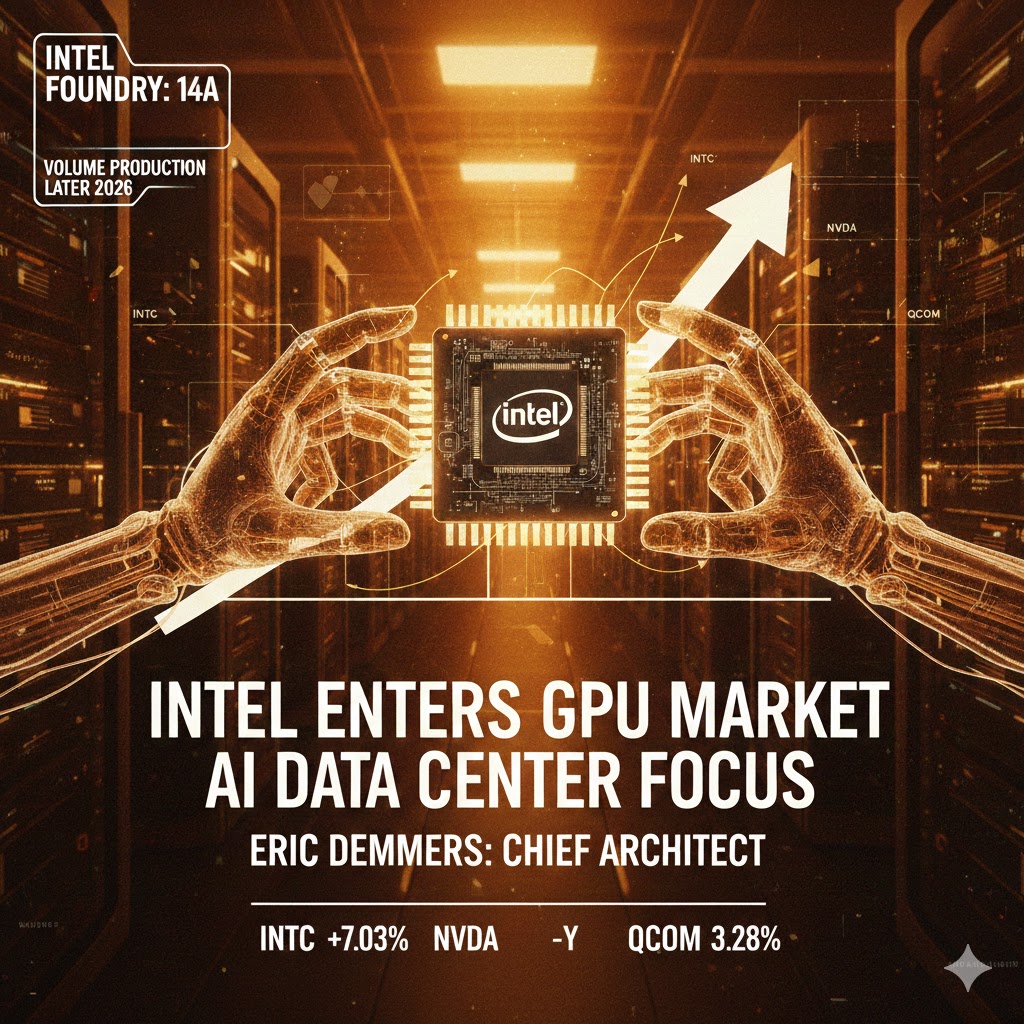
Intel (NASDAQ:INTC) has announced its entry into the graphics processing unit (GPU) market, challenging Nvidia (NASDAQ:NVDA), which currently dominates this sector. This move represents a significant strategic expansion under the leadership of Intel’s new CEO, targeting the highly profitable AI data center chip business.

According to Reuters, Intel CEO Lip-Bu Tan confirmed on Tuesday at the Cisco AI Summit that the company plans to manufacture GPUs and has hired Qualcomm (NASDAQ:QCOM) veteran Eric Demmers as its chief GPU architect.

In an interview with Reuters, Tan stated that the GPU project would focus on the data center segment and be closely integrated with Intel’s data center business. The team will first work with customers to define product requirements based on their needs.

Meanwhile, Tan also revealed that several customers are already in deep discussions with Intel Foundry, the company’s wafer fabrication business, with a focus on the 14A process. Volume production is expected to ramp up later this year.

Targeting Data Center GPUs, Directly Challenging Nvidia’s Core Strength

Reuters and TechCrunch reported that Tan has explicitly set the GPU target toward the data center market. Unlike Intel’s long-standing dominance in CPUs, GPUs are tailored for specific workloads, commonly used in gaming and training artificial intelligence models—domains where Nvidia holds a significant competitive edge.

Tan emphasized that Intel’s approach would be to first work with customers to understand their needs, which will then drive the development of the product strategy. This shows that Intel’s strategy will be demand-driven, rather than providing a fixed product roadmap upfront.

Key Personnel Appointment: Eric Demmers Joins and Reports to Kevork Kechichian

On the personnel front, Intel has made a crucial move by hiring a key figure for the GPU project. Tan stated that the company had brought on board a chief GPU architect and highly praised their capabilities.

According to TechCrunch and Reuters, Eric Demmers joined Intel in January. Prior to this, Demmers had worked at Qualcomm for over 13 years, most recently serving as Senior Vice President of Engineering.

Strategy: Defining Customer Needs First, Product Strategy to Follow

Based on Tan’s statements, Intel’s GPU plan is still in the early stages of defining strategy and customer requirements. Tan emphasized that the company plans to develop its approach based on customer needs, aligning with his earlier comments about first collaborating with customers to define product requirements.

This strategy also extends to production capacity and delivery schedules. Tan stated that for Intel to be a customer, the client would need to specify the required volume and corresponding products, so Intel can plan and allocate time to build the necessary capacity.

Intel Foundry’s Progress: 14A Technology Attracts Customers, Volume Production Expected Later This Year

Beyond GPUs, Tan also signaled progress in Intel’s foundry business. According to Reuters, Tan mentioned that several customers are deeply engaged with Intel Foundry, with a particular interest in the 14A manufacturing process, and volume production could ramp up later this year.

For the market, this statement ties together Intel’s two main business lines: entering the data center market with GPUs while leveraging 14A process technology to attract foundry customers. The key market focus now is whether Intel can simultaneously deliver GPU productization and foundry volume production in response to customer demand.

Intel CEO: Memory Chip Manufacturers Tell Me the Supply Shortage Won’t Ease Until 2028

Intel(INTC) CEO Pat Gelsinger has warned that the memory chip shortage in the computer industry will continue for at least another two years.

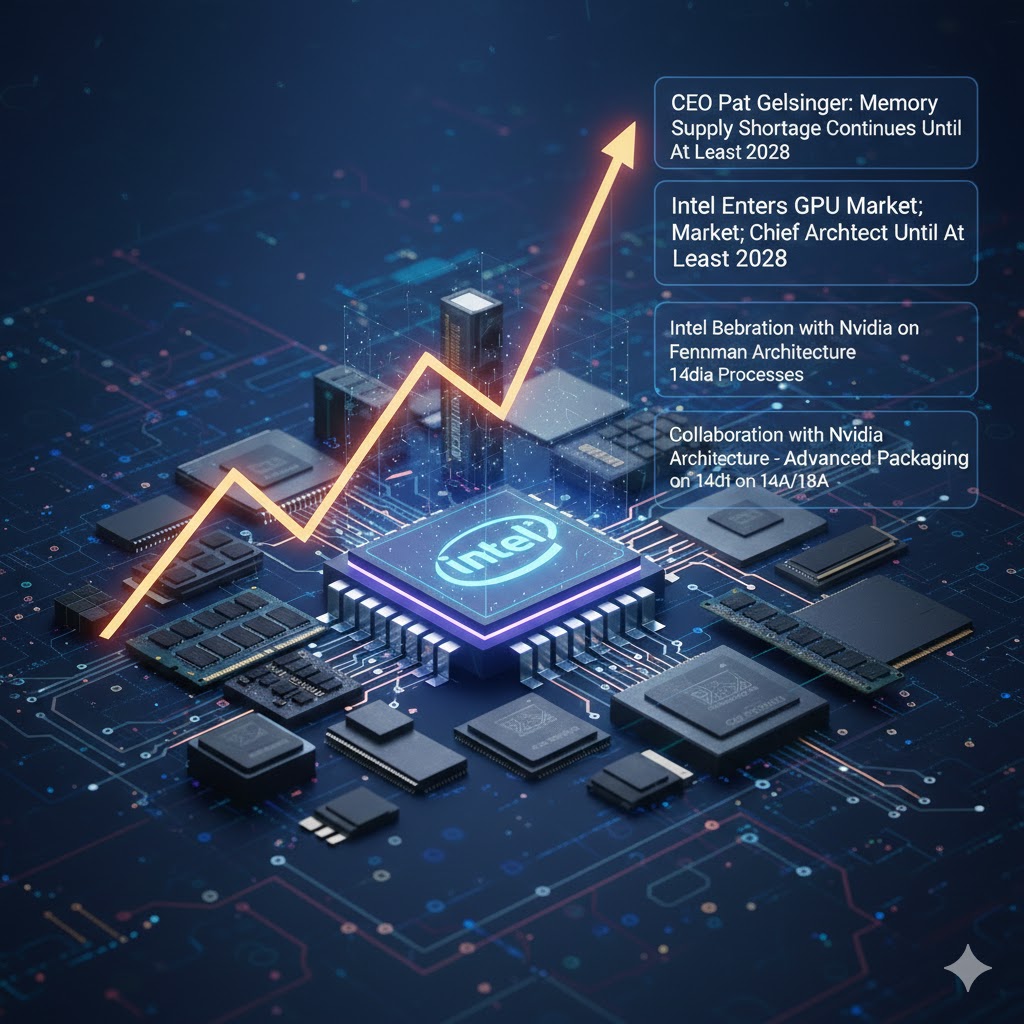
On Tuesday, February 3, Gelsinger stated at a Cisco Systems conference that he had communicated with two major memory manufacturers, who clearly told him that “the shortage won’t ease until at least 2028.” The continued large-scale expansion of artificial intelligence infrastructure is driving up demand for memory chips, further squeezing the supply available for traditional devices.

Gelsinger pointed out that Nvidia, a leading supplier of AI processors, will further increase memory demand with its latest Rubin platform and next-generation products. He said that artificial intelligence would “absorb a large amount of memory.”

At the same time, Gelsinger revealed that Intel plans to enter the GPU market and has hired a Chief GPU Architect. This business will be closely integrated with the company’s data center chip division and foundry services. On Tuesday, Intel’s stock opened higher but closed up by 0.9%.

Intel’s Entry into the GPU Market

During the conference, Gelsinger announced that Intel plans to manufacture graphics processing units (GPUs), a product widely promoted by Nvidia.

Gelsinger said that hiring the Chief GPU Architect had been a significant effort, adding:

“I just hired a fantastic Chief GPU Architect. I’m thrilled that he’s joined my team.”

Reports indicate that Qualcomm executive Eric Demmers joined Intel last month, and Demmers later confirmed this news on LinkedIn. Gelsinger mentioned in an interview that the GPU project is being supervised by Intel’s data center chip head, Kevork Kechichian.

Gelsinger also stated:

“This is closely related to data centers. We are working with customers to determine what they need.”

Foundry Business Draws Customer Attention

Gelsinger also mentioned at the conference that:

“Several customers are engaging deeply with Intel’s foundry business.”

Earlier, in an interview with the media, he revealed that these customers’ interests are focused on Intel’s 14A manufacturing technology, and mass production could accelerate later this year. Gelsinger explained:

“To secure customers, they need to tell us the quantities and types of products, so we can plan and spend time building the capacity.”

Earlier, Wall Street reports mentioned that after Nvidia announced a $5 billion investment in Intel in September 2025, the latest plan is for Intel to collaborate with Nvidia on the next-generation successor of the Rubin series, the Feynman architecture chips. Intel will be responsible for advanced packaging requirements for the GPU section.

According to supply chain sources, the GPU core chips are still being outsourced to TSMC, while some I/O chips will be manufactured using Intel’s 18A process or the 14A process, which is expected to enter mass production by 2028. The specific choice depends on the yield production status of the 14A process.

I/O chips, which include memory controllers and handle inter-chip connections, have lower performance requirements than the GPU compute chips but still require advanced manufacturing processes.