Intel(INTC) CEO Pat Gelsinger has warned that the memory chip shortage in the computer industry will continue for at least another two years.
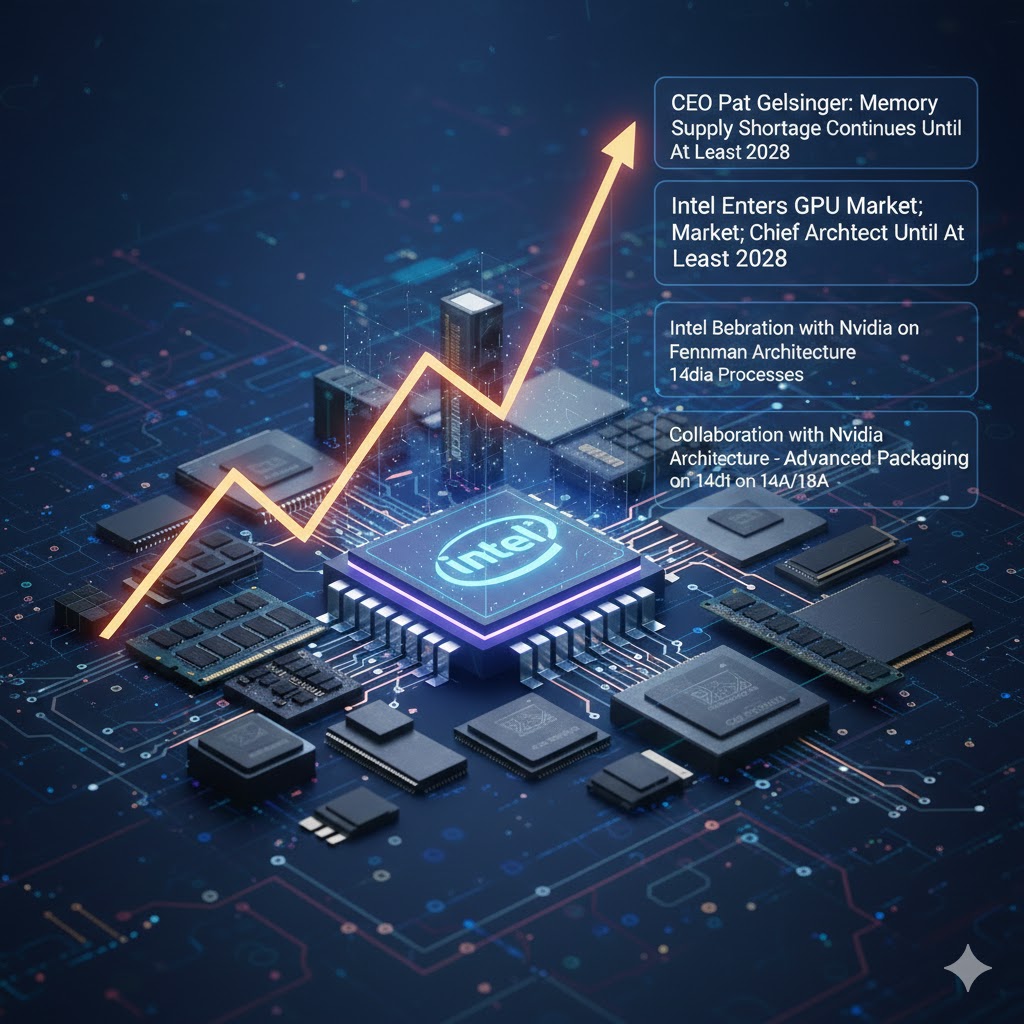
On Tuesday, February 3, Gelsinger stated at a Cisco Systems conference that he had communicated with two major memory manufacturers, who clearly told him that “the shortage won’t ease until at least 2028.” The continued large-scale expansion of artificial intelligence infrastructure is driving up demand for memory chips, further squeezing the supply available for traditional devices.
Gelsinger pointed out that Nvidia, a leading supplier of AI processors, will further increase memory demand with its latest Rubin platform and next-generation products. He said that artificial intelligence would “absorb a large amount of memory.”
At the same time, Gelsinger revealed that Intel plans to enter the GPU market and has hired a Chief GPU Architect. This business will be closely integrated with the company’s data center chip division and foundry services. On Tuesday, Intel’s stock opened higher but closed up by 0.9%.
Intel’s Entry into the GPU Market
During the conference, Gelsinger announced that Intel plans to manufacture graphics processing units (GPUs), a product widely promoted by Nvidia.
Gelsinger said that hiring the Chief GPU Architect had been a significant effort, adding:
“I just hired a fantastic Chief GPU Architect. I’m thrilled that he’s joined my team.”
Reports indicate that Qualcomm executive Eric Demmers joined Intel last month, and Demmers later confirmed this news on LinkedIn. Gelsinger mentioned in an interview that the GPU project is being supervised by Intel’s data center chip head, Kevork Kechichian.
Gelsinger also stated:
“This is closely related to data centers. We are working with customers to determine what they need.”
Foundry Business Draws Customer Attention
Gelsinger also mentioned at the conference that:
“Several customers are engaging deeply with Intel’s foundry business.”
Earlier, in an interview with the media, he revealed that these customers’ interests are focused on Intel’s 14A manufacturing technology, and mass production could accelerate later this year. Gelsinger explained:
“To secure customers, they need to tell us the quantities and types of products, so we can plan and spend time building the capacity.”
Earlier, Wall Street reports mentioned that after Nvidia announced a $5 billion investment in Intel in September 2025, the latest plan is for Intel to collaborate with Nvidia on the next-generation successor of the Rubin series, the Feynman architecture chips. Intel will be responsible for advanced packaging requirements for the GPU section.
According to supply chain sources, the GPU core chips are still being outsourced to TSMC, while some I/O chips will be manufactured using Intel’s 18A process or the 14A process, which is expected to enter mass production by 2028. The specific choice depends on the yield production status of the 14A process.
I/O chips, which include memory controllers and handle inter-chip connections, have lower performance requirements than the GPU compute chips but still require advanced manufacturing processes.