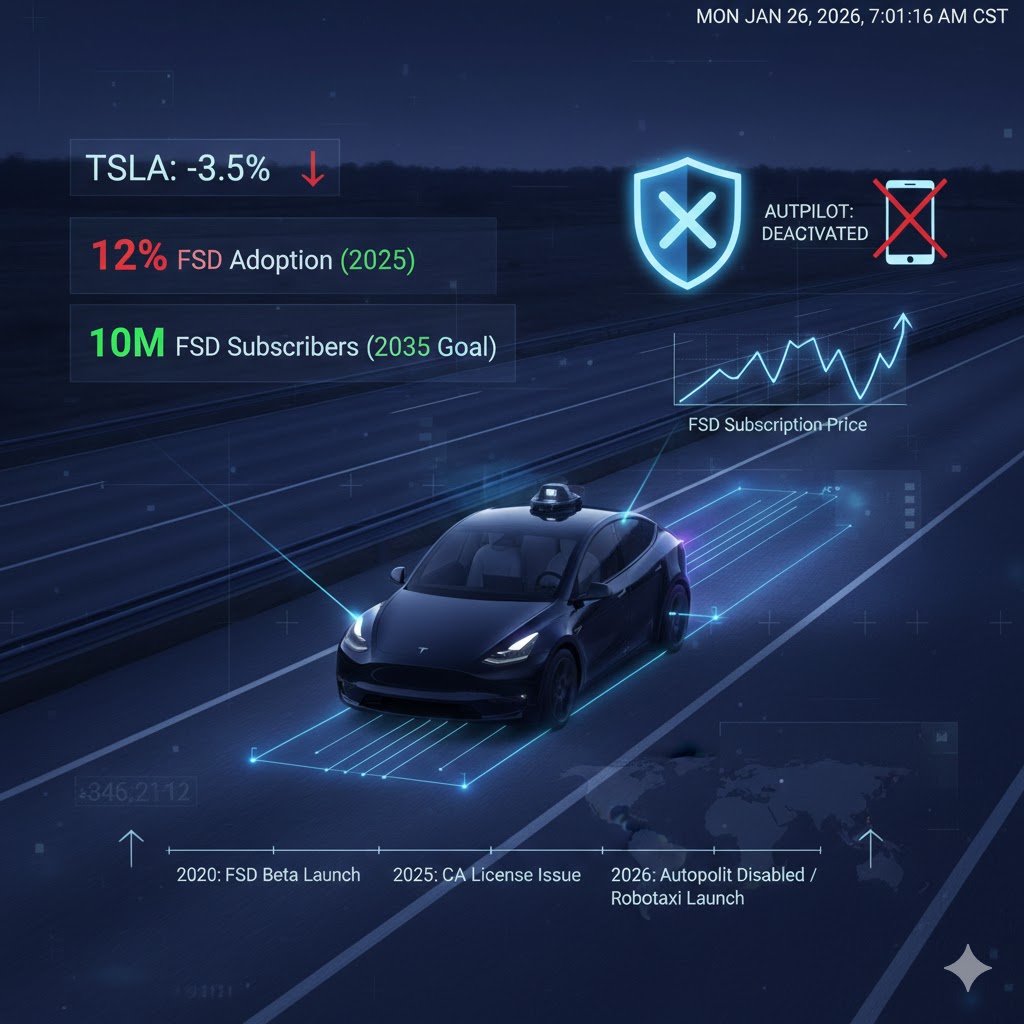
Tesla(TSLA) has officially discontinued its basic driver-assistance system, Autopilot, in a move designed to accelerate the adoption of its more advanced Full Self-Driving (Supervised) software.
The decision comes as Tesla faces a 30-day suspension of its manufacturing and dealer licenses in California—its largest U.S. market. In December, a court ruled that Tesla had engaged in years of deceptive marketing by exaggerating the actual performance of Autopilot and Full Self-Driving (FSD) features. The California Department of Motor Vehicles, which initiated the case and holds licensing authority, has granted a 60-day stay of the suspension to allow Tesla time for rectification, specifically requiring the company to stop using “Autopilot” as a functional name.
Autopilot consists of two primary features: Traffic-Aware Cruise Control, which maintains a set speed and a safe distance from the vehicle ahead, and Autosteer, which assists in steering the vehicle within its lane and navigating curves.
Tesla’s official vehicle configuration page now indicates that new cars will only come standard with Traffic-Aware Cruise Control. It remains unclear whether existing owners will be affected by this change.
Just a week before this decision, Tesla announced that starting February 14, it will eliminate the $8,000 one-time purchase option for its Full Self-Driving software. From then on, consumers will only be able to access the feature via a $99 monthly subscription. However, CEO Elon Musk noted in a post on Thursday that subscription prices will rise as software capabilities continue to improve.
Musk claimed that future Tesla models will possess “unsupervised” autonomous capabilities. With FSD software installed, he suggested drivers could “spend the whole trip on their phones or even sleep.” Last December, he stated that the latest version of FSD could already achieve the former, though it is important to note that texting while driving remains illegal in nearly every U.S. state.
On Thursday, Tesla launched its first fleet of Model Y robotaxis in Austin, Texas, operating without human safety drivers on board. These taxis are equipped with Tesla’s more advanced autonomous software, though they are still shadowed by Tesla-operated monitoring vehicles during operation.
Tesla first launched the beta version of its FSD software in late 2020, but adoption rates have consistently fallen short of expectations held by Musk and other executives. In October 2025, Tesla CFO Vaibhav Taneja revealed that only 12% of Tesla owners had paid for the software. Reaching Musk’s new $1 trillion compensation package milestones requires meeting a core “product goal”: achieving 10 million active FSD subscriptions by 2035.
Tesla originally introduced Autopilot in the early 2010s. Musk had previously negotiated with Google to use technology from the search giant’s then-fledgling self-driving division, but talks eventually collapsed (that division later became the autonomous vehicle company Waymo). In April 2019, Tesla announced that Autopilot would become a standard feature on all its models.
In the decade since Autopilot’s debut, Tesla has struggled to clearly and accurately communicate the actual performance boundaries of the software. The company has frequently used hyperbolic claims, leading consumers to believe the technology is far more capable than it truly is. This has resulted in some drivers over-relying on the system; data from the National Highway Traffic Safety Administration (NHTSA) indicates that this has contributed to hundreds of accidents and at least 13 fatalities.