ARK Invest Tracker: Cathie Wood Buys 30K+ Broadcom Shares, Sweeps Up eVTOL Leaders Joby and Archer

On Thursday, U.S. time, the three major stock indices closed mixed. While tech giants like Nvidia pulled back, the defense sector saw a broad rally fueled by President Trump’s proposal to increase military spending.

Against this backdrop, Cathie Wood is executing a clear sector rotation: doubling down on the “low-altitude economy” and AI hardware, while locking in profits or trimming positions in the recently red-hot defense and space sectors.

Accumulation: Bullish on the “Low-Altitude Economy,” Buying Broadcom on the Dip

The most striking moves in ARK’s latest buy list are the massive bets on the eVTOL (Electric Vertical Take-off and Landing) sector, purchasing over 160,000 shares of Joby Aviation (JOBY) and over 70,000 shares of Archer Aviation (ACHR).

As we enter 2026, the market widely regards this as the “Year of Commercialization” for eVTOLs. Wood’s heavy investment in these two industry leaders sends a strong signal: she believes the tipping point for regulatory approval (such as FAA certification) and commercial operations has arrived. Rather than waiting for a distant future, she is positioning for the imminent launch of “air taxi” services—a bet not just on technology, but on the transformation of urban mobility.

In the AI hardware space, ARK added 31,600 shares of Broadcom (AVGO). As the leader in networking chips and custom ASIC solutions, Broadcom plays an indispensable role in AI data center construction. This move suggests Wood remains confident in the sustained demand for AI infrastructure. Compared to some overvalued AI stocks, Broadcom is viewed as a more resilient core AI asset due to its robust cash flow and monopoly in Ethernet switching.

Divestment: Trimming Defense and Space Stocks

In sharp contrast to her purchases of “civilian” aircraft, Wood hit the sell button on the military and space sectors.

  • Palantir (PLTR): Reduced by 58,700 shares. As a leader in AI and defense data analytics, this move is likely profit-taking or valuation-driven portfolio management.
  • Rocket Lab (RKLB): Sold 24,900 shares. ARK chose to reduce exposure to this commercial space newcomer amid recent volatility.
  • Kratos Defense (KTOS) & AeroVironment (AVAV): Trimmed by 20,100 and 2,017 shares, respectively. Both are major players in the military drone space.

This creates a fascinating “hedge”: selling military drones to buy civilian eVTOLs. It suggests Wood may judge that defense sector premiums have become overextended in the short term, whereas the growth potential and value proposition of the civilian low-altitude economy are currently more attractive.

Musk Announces X Will Open-Source All Algorithms Within 7 Days, Including Recommendation Engine; Updates to Follow Every Four Weeks

Elon Musk has recently pledged to open-source the platform’s new algorithms to the public within the next seven days, marking a radical step forward in transparency for the social media giant.

In a post on X this Saturday, Musk stated that this open-source initiative is not a one-time event but will become a regular mechanism. He noted that X will repeat the algorithm disclosure process every four weeks, accompanied by detailed developer notes designed to help external parties clearly understand specific changes.

The announcement comes at a time of mounting friction between X and global regulators over content moderation and recommendation mechanisms. By regularly disclosing its algorithms, X may be attempting to alleviate external concerns regarding its opaque operations while addressing user criticism over the quality of feed recommendations. However, Musk did not explicitly state the specific motivation behind this sudden decision to open-source.

This move could have profound implications for the digital advertising market and social media operating models. If the core recommendation logic becomes fully transparent, it will not only shift strategies for content creators but also allow advertisers to more intuitively understand how their content reaches audiences. Simultaneously, it provides regulators with direct evidence to scrutinize the platform for potential bias or manipulation.

Transition to AI-Driven Recommendation

X is currently focused on deepening the application of artificial intelligence within its recommendation algorithms. Last October, Musk stated that improvements in user feeds resulted not from manual adjustments to heuristic rules, but from an increased reliance on Grok and other AI tools.

According to Musk’s previous disclosures, the company aims to make X’s recommendation engine “purely AI-driven.” The plan involves utilizing Grok, Musk’s AI chatbot, to evaluate the more than 100 million posts published on X daily. After being filtered by Grok, the system pushes content most likely to interest individual users. Musk has asserted that this mechanism will “profoundly improve the quality of the feed.”

In September of last year, Musk proposed an even more frequent open-source schedule, claiming the platform would share its algorithms every two weeks. Although the frequency has been adjusted to every four weeks, it still indicates the company’s intent to fully integrate AI into its core operational architecture.

While Musk has made multiple promises to open parts of X’s algorithm in recent years, actual execution has been inconsistent. Prior to this announcement, some X users complained about seeing fewer posts from people they follow due to platform changes.

Addressing this issue last October, Musk confirmed that the company had discovered a “major bug” in the “For You” algorithm and promised a fix. The announcement of full open-sourcing and periodic updates may be a further step toward repairing trust and technical vulnerabilities.

Intensifying Global Regulatory Pressure

Musk’s announcement comes as X faces increasingly stringent scrutiny from global regulators, primarily focused on the spread of misinformation, inadequate content moderation, and a lack of transparency.

European regulators, in particular, have stepped up their focus. In an investigation last July, France requested that X share its algorithms to investigate allegations of bias and manipulation. At the time, X refused the request, dismissing the investigation as politically motivated.

Furthermore, Grok’s image generation feature has recently come under fire for producing a large volume of sexualized AI-generated images of women and children. UK Prime Minister Keir Starmer has demanded “urgent rectification” from X this week, while UK Technology Secretary Liz Kendall warned that access to the service could be blocked in the UK if it fails to comply with the law. Indonesia has already blocked Grok over concerns regarding the generation of sexual content. As of Friday, Grok informed X users that image generation and editing features will transition to a paid subscription service, removing the initial free allowance.

Brent Crude Surges 5% to Two-Week High Amid Venezuela Unrest and Supply Concerns

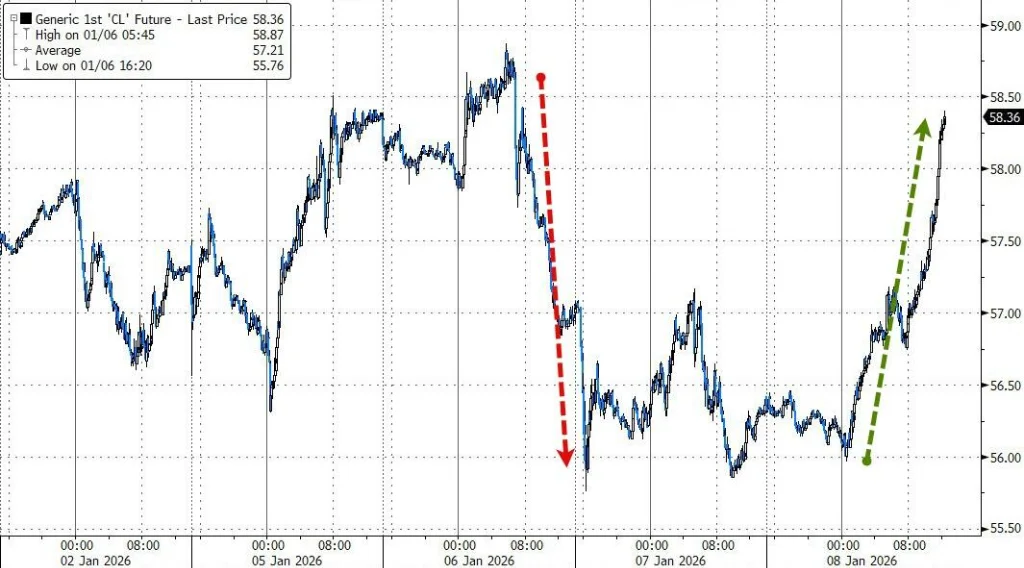
International oil prices rebounded on Thursday after two consecutive days of declines, with Brent crude jumping as much as 5% to hit a two-week high.

Despite U.S. plans to sell up to 50 million barrels of Venezuelan crude to domestic refiners and a rise in U.S. gasoline and distillate inventories, oil prices were driven higher by investor assessments of the developing situation in Venezuela and mounting concerns over supply disruptions in Russia, Iraq, and Iran.

On Wednesday, U.S. Energy Secretary Chris Wright stated in a media interview that Chevron is expected to rapidly expand its operations in Venezuela, with ConocoPhillips and ExxonMobil also seeking constructive roles. However, energy consultancy Ritterbusch and Associates noted:

“It could take years for significant volumes of Venezuelan crude to reach the U.S. Gulf Coast region.”

The market is simultaneously monitoring supply risks from other major producers. Reports emerged of a drone attack on a tanker bound for Russia in the Black Sea. Meanwhile, Iraq is moving forward with the nationalization of the West Qurna 2 oil field following U.S. sanctions on Russia’s Lukoil. In Iran, nationwide protests fueled by economic hardship have led to a widespread internet shutdown.

Closing Prices

On Thursday, Brent crude futures settled up $2.03, or 3.4%, at $61.99 per barrel, marking its highest close since December 24 of last year. WTI crude futures rose $1.77, or 3.2%, to settle at $57.76 per barrel.