According to Bloomberg, Coinbase (COIN) is escalating its pressure on U.S. lawmakers to ensure it can continue offering “rewards” or “yield” to customers holding stablecoins. The company warns that restrictive clauses currently under discussion for a major cryptocurrency bill, set to be unveiled Monday, could jeopardize this business line.
Sources familiar with the matter indicate that the largest U.S. crypto exchange may reconsider its support for the Digital Asset Market Structure Bill if the text includes restrictions beyond “enhanced disclosure requirements” for rewards. The bill is scheduled for a committee markup in the Senate this Thursday. Coinbase has not responded to requests for comment.
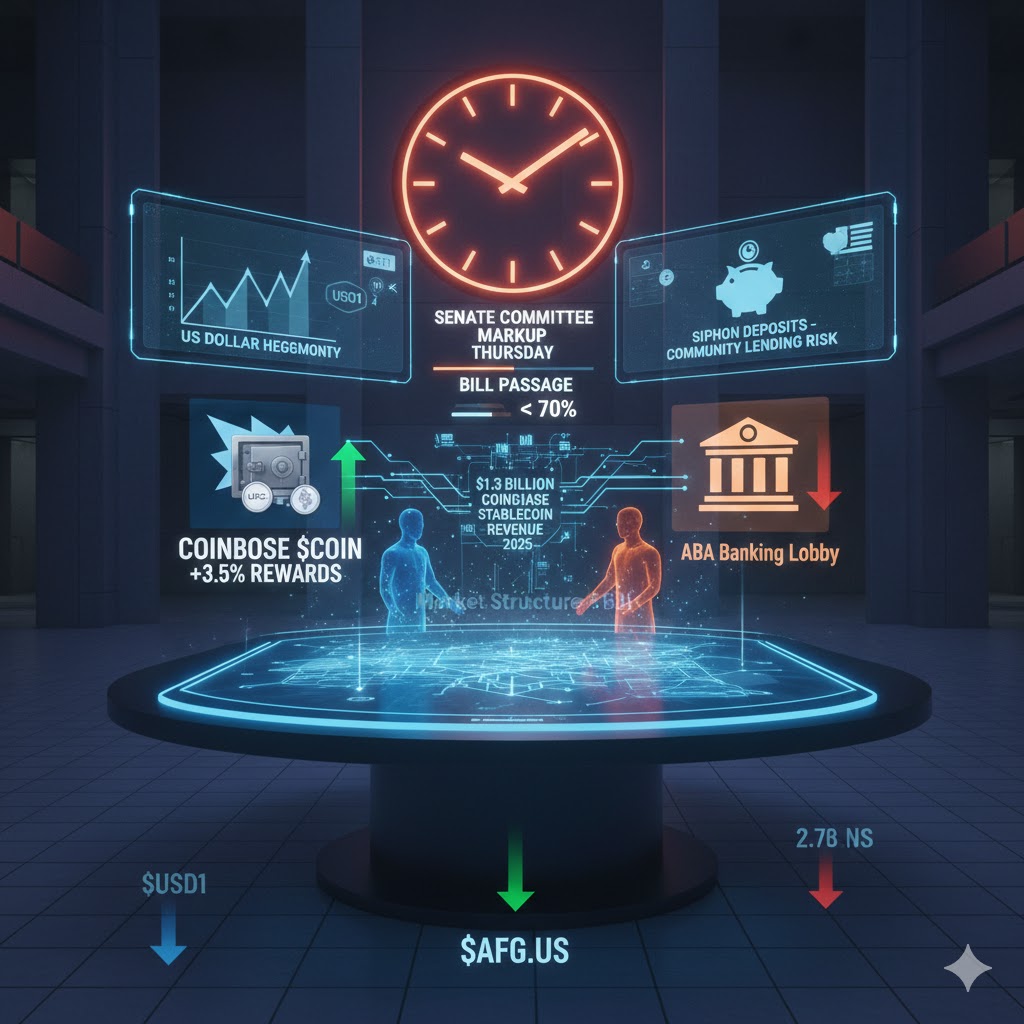
The Battle Between Banking and Crypto Interests
Industry insiders report that one proposal under consideration would restrict the eligibility to offer rewards solely to regulated financial institutions. This move has gained support from some in the banking sector who argue that interest-bearing stablecoin accounts could siphon deposits away from traditional banks.
Coinbase has already applied for a National Trust Charter, which could eventually allow it to offer such rewards under those rules. However, native crypto firms are fighting to ensure that exchange-based reward models are recognized as a viable business model even without a banking license. They warn that broader restrictions could upend the industry’s competitive landscape.
Political Leverage and Financial Impact
Coinbase’s threat to withdraw support carries significant weight. In the 2023–2024 election cycle, the crypto industry emerged as a top corporate political donor, pouring massive funds into supported candidates. Under CEO Brian Armstrong, Coinbase donated $1 million to Donald Trump’s presidential inauguration and was among the corporate sponsors for the proposed White House ballroom project.
For Coinbase, stablecoin rewards are a core issue. The exchange shares interest income generated from reserves of the USDC stablecoin, which is issued by Circle (CRCL). USDC parked on Coinbase provides a steady revenue stream that has proven crucial during bear markets. Coinbase also holds a minority stake in Circle, currently the largest issuer of stablecoins compliant with the laws passed last July.
Currently, Coinbase encourages users to hold USDC on its platform by offering rewards—such as 3.5% for Coinbase One balances. If the Market Structure Bill bans these incentives, the number of users holding stablecoins on exchanges could plummet. According to Bloomberg data, Coinbase’s total stablecoin revenue is estimated to have reached $1.3 billion in 2025, a figure that now faces significant downside risk.
The Devil in the Details
While the exact impact remains unclear until the final bill text is released, sources confirm that provisions regarding rewards will certainly be included.
The GENIUS Act and Regulatory Background
The second Trump administration has moved quickly to deliver victories for the digital asset industry, including the passage of the GENIUS Act last July—the first federal regulatory framework for stablecoin issuers. Its signing triggered a wave of entries into the stablecoin space, ranging from retailers to traditional financial institutions. Even the Trump family became involved prior to the bill’s passage through World Liberty Financial, which launched its own stablecoin, USD1.
Despite the administration’s push for rapid legislation, the rewards controversy has eroded the bipartisan base for the Market Structure Bill. Coinbase’s warning marks an escalation in tensions that could delay the bill’s review, potentially pushing completion beyond this year. Nathan Dean, an analyst at Bloomberg Intelligence, noted that without bipartisan support during the markup, the probability of the bill passing in the first half of the year has dropped below 70%.
The GENIUS Act prohibits stablecoin issuers from paying interest or yield solely for “holding the token,” but it does not explicitly prevent third-party partners like Coinbase from offering rewards based on customer balances.
The banking industry has expressed fierce opposition to exchanges paying rewards, viewing it as a drain on the banking system that weakens community lending. The American Bankers Association (ABA) stated in a recent letter: “If billions are diverted from community bank lending, small businesses, farmers, students, and homebuyers in towns like ours will suffer. Crypto exchanges… are not designed to fill this lending gap, nor do they offer FDIC-insured products—a point they omit in their aggressive advertising.”
Dollar Hegemony and Potential Compromises
In contrast, the crypto industry describes the banking sector’s efforts as an attempt to undermine the established gains of the GENIUS Act. Coinbase Chief Policy Officer Faryar Shirzad recently posted on X (formerly Twitter) that maintaining reward mechanisms tied to stablecoins is essential for preserving U.S. dollar hegemony, noting China’s plans to begin paying interest on its central bank digital currency (e-CNY).
This tension leaves Senators in a dilemma: under pressure from the administration to pass further legislation, they are forced to decide on an issue where compromise is difficult.
Sources suggest a potential middle ground could be allowing only entities with bank licenses or financial institutions to provide rewards on stablecoin balances. Recently, five crypto firms received conditional approval from the OCC to become national trust banks. These approvals were also met with fierce opposition from bank lobbyists, who argue that crypto firms are overextending the use of restrictive trust charters, posing a threat to the stability of the U.S. financial system (AFG).
Without clear restrictions, some industry players believe the situation will devolve into a game of “whack-a-mole,” where crypto firms continuously find new ways to reward users. As William Gaybrick, President of Technology and Business at Stripe, noted in a 2025 interview: “In a world where you hold a stablecoin in an app, that app will always find some way to give you something back for it.”