Tag Archives: GOOGL

Tech Stocks Surge Amid Strong Market Demand and Increased Price Expectations

SanDisk (NASDAQ:SNDK) surges over 15% as DRAM price forecasts skyrocket to new highs!

In a report released on February 2, Goldman Sachs revealed that despite fluctuations in the spot market, contract prices for DRAM are not only holding steady but are projected to rise sharply. Goldman Sachs has significantly revised its DRAM price forecast for Q1 2026, now expecting a quarter-over-quarter increase of 90-95%, far exceeding previous market and the firm’s own expectations.

For mobile NAND (eMMC/UFS), Q1 2026 contract prices are also expected to rise by 55-65%, aligning with Goldman Sachs’ earlier projection of a 45-70% increase for overall NAND pricing. Despite a seasonal decline in consumer electronics demand, strong demand for enterprise SSDs (eSSD) and AI-related storage has led to limited supply for smartphone and PC customers, further driving up prices in these segments.

The server market is also facing a supply shortage. While some suppliers have shifted production capacity from PCs and smartphones to servers, demand from North American and Chinese cloud service providers (CSPs) continues to outpace supply, maintaining the pricing power of suppliers. TrendForce has revised its server DRAM price forecast for Q1 2026, now predicting a quarter-over-quarter increase of 88-93%, slightly higher than Goldman Sachs’ prior forecast of 75-80%. Notably, the premium for DDR5 over DDR4 is shrinking, with the price difference for 64GB DDR5 modules in January dropping to just 9% compared to DDR4 of the same specifications.

Robotaxi industry enters the race for mass adoption! Google (NASDAQ:GOOGL) hits a new all-time high with a nearly 2% increase, as its autonomous driving arm Waymo secures $16 billion in funding for global expansion.

Google’s autonomous driving division, Waymo, has successfully raised $16 billion in funding, reaching a post-money valuation of $126 billion. This funding round highlights the company’s rapid growth as a leader in the robotaxi industry.

In a statement on Monday, Waymo announced that this round of funding was led by new investors Sequoia Capital, DST Global, and Dragoneer Investment Group. Other investors included Andreessen Horowitz, Mubadala Capital, Silver Lake Capital, and Bessemer Venture Partners.

Waymo has established a clear lead in the commercialization of autonomous taxis, operating fully driverless services in about six U.S. cities, charging passengers for the service. The company provides services in San Francisco and Los Angeles through its own app, and in Austin and Atlanta in partnership with Uber. Waymo plans to rapidly expand across the U.S. and enter the UK market this year.

Strong earnings performance leads to a 4% rise for Texas Instruments (NASDAQ:TXN), as the data center end market revenue continues to grow for the seventh consecutive quarter.

Texas Instruments recently released its fiscal report for 2025, showing strong performance in the data center end market. The company’s data center-related revenue reached $1.5 billion in 2025, a 64% increase from the previous year, accounting for 9% of its total revenue. This growth is attributed to sustained demand in areas such as data center computing, networking, power, and cooling.

In the earnings call, the company’s management revealed that revenue from the data center end market has been growing for seven consecutive quarters. Texas Instruments believes that the accelerated global digital transformation and high demand for data center construction and upgrades will continue to provide significant growth opportunities for this sector. If investment in data centers remains strong, the company’s related business is likely to maintain its growth momentum.

For Q1 2026, Texas Instruments has provided revenue guidance, estimating revenues to fluctuate around $4.5 billion, with a variance of $180 million. This forecast reflects the company’s cautious assessment of market demand while maintaining confidence in its business development. As the global semiconductor market gradually recovers, Texas Instruments is expected to strengthen its industry position through technological innovation and market expansion.
Musk Slams Apple-Google Partnership, Alleging “Unreasonable Concentration of Power”

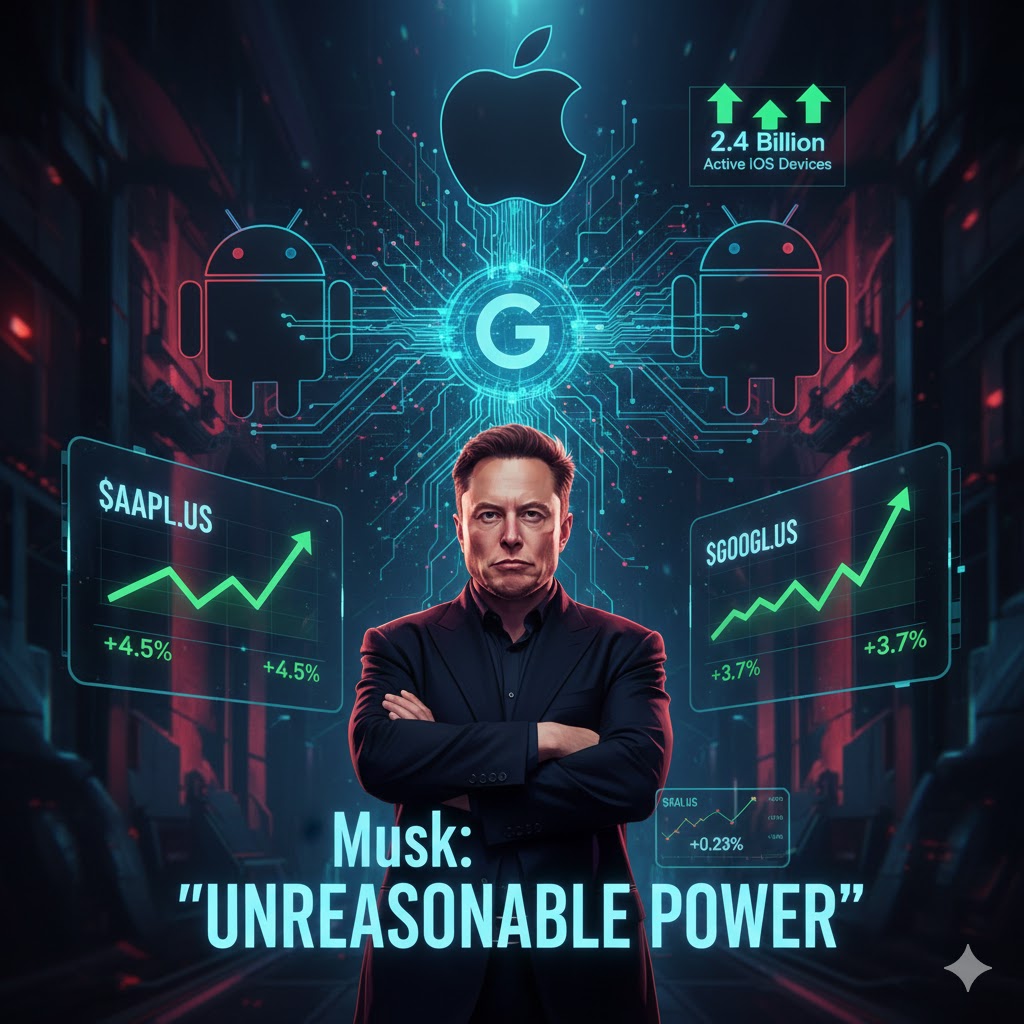
Elon Musk, the world’s wealthiest person, launched a scathing critique on Monday against the new partnership between Apple (AAPL) and Alphabet (GOOGL), claiming it grants the latter an “unreasonable concentration of power.”

Google and Apple announced a new multi-year cooperation agreement on Monday, though specific financial terms were not disclosed.

Under the agreement, Apple will utilize Google’s Gemini model to power a new version of Siri, set to launch later this year. This collaboration deepens the alliance between the two tech giants in the AI era and further solidifies Google’s position in its competition against OpenAI.

In a joint statement, the two companies said: “After a thorough evaluation, Apple determined that Google’s AI technology provides the most capable underlying support for Apple Foundation Models and is excited about the new innovative experiences this will unlock for Apple users.”

Musk responded on his social media platform X, stating: “Given that Google also controls Android and Chrome, this looks like an unreasonable concentration of power.”

Musk founded his own AI company, xAI, to compete with major industry players like OpenAI.

In contrast to Musk’s criticism, Dan Ives, an analyst at Wedbush Securities, believes the deal is a “positive win” for both Apple and Google. He noted that for Google, the partnership serves as a major validation of its status as a top-tier foundation model provider. For Apple, it represents a significant step in accelerating its AI strategy toward 2026 and beyond.

Apple had previously considered partnering with OpenAI or Anthropic to have ChatGPT or Claude power the new Siri but ultimately selected Google’s Gemini. Last November, Google launched its Gemini 3 model, which received widespread acclaim for its performance.

The latest agreement builds upon years of existing collaboration, as Google has long been the default search engine on Apple devices. This partnership not only drives massive traffic to Google but also generates tens of billions of dollars in annual revenue for Apple.

Apple currently has approximately 2.4 billion active iOS devices and 1.5 billion iPhones in use, representing one of the largest installed bases among consumer electronics companies.

The Highly Anticipated “AI Business Model”: Google Takes the Lead by Integrating Ads into Gemini

Alphabet (GOOGL) is introducing new personalized advertising features within its AI shopping tools, marking a pivotal step forward for tech giants in the race to monetize artificial intelligence.

On Sunday, Google announced that advertisers will now be able to offer exclusive deals to consumers preparing to purchase items through Google’s “AI Mode,” which is powered by its Gemini model. This move represents a significant evolution of Google’s traditional advertising paradigm.

“This is a new concept that moves beyond our traditional search advertising model,” said Vidhya Srinivasan, Vice President of Google Ads and Commerce. She noted that it enables retailers to provide value to AI-assisted shoppers at the most critical moments “to close the deal.” Google’s AI will determine precisely when to display these offers based on user shopping behavior and purchase probability.

The move comes as AI chatbots pose a potential threat to Google’s traditional “sponsored” ad placements, which generate tens of billions of dollars in annual revenue. Simultaneously, Google seeks to capitalize on the momentum of its latest large language model, Gemini 3, which has gained significant ground in its competition against OpenAI’s GPT-5.

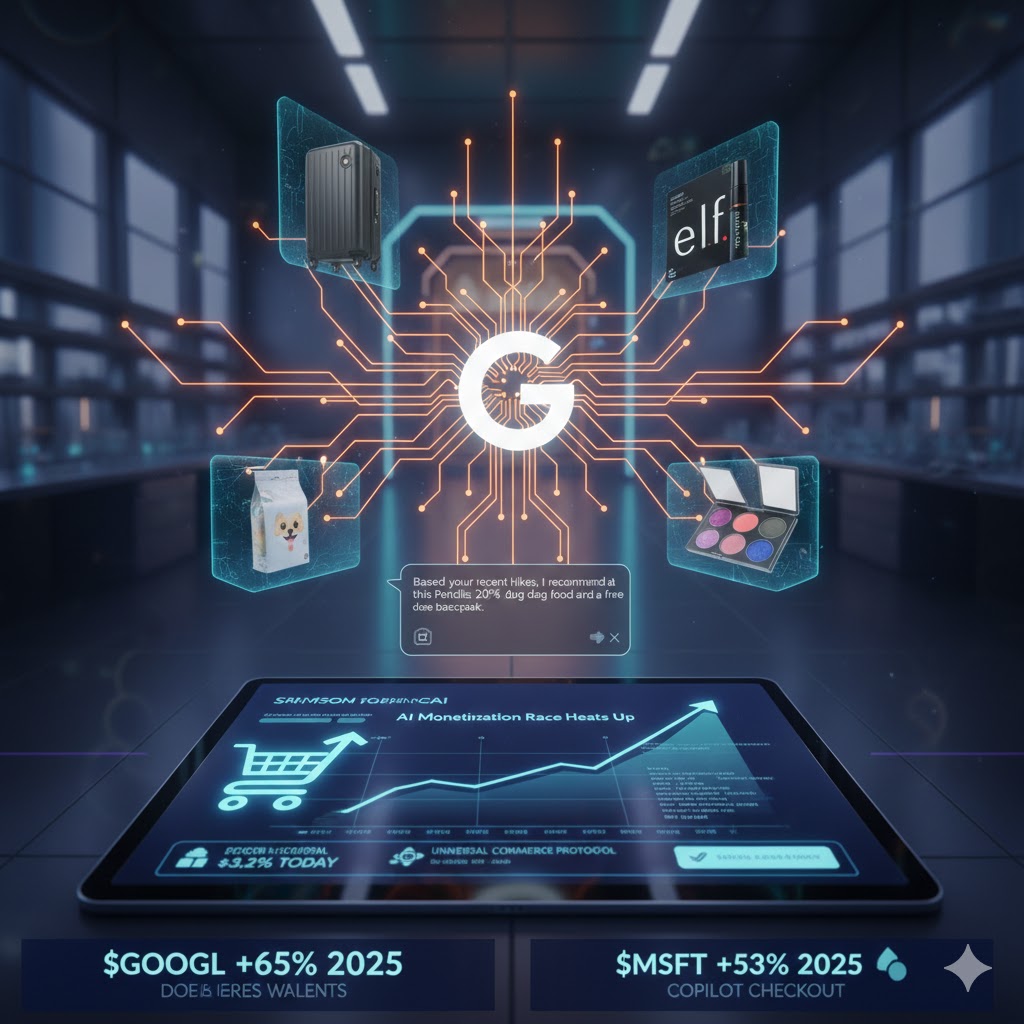
Google also unveiled a “Universal Commerce Protocol,” allowing shopping agents to research products and complete purchases directly within its platform. The protocol was co-developed with major retailers and marketplaces, including Walmart, Target, and Shopify.

Beyond the Traditional Search Ad Model

The new advertising capabilities from Alphabet (GOOGL) allow brands to provide highly personalized ads—such as discount codes—through its chatbot, giving it an edge over AI rivals. This feature leverages contextual information from the user’s conversation with the chatbot and triggers offers based on relevant products the user has clicked on.

Retailers define the offers they wish to provide, while Google’s AI determines the optimal timing to present these deals to potential customers. Existing partners in Google Shopping include pet brand Petco, e.l.f. Cosmetics, and luggage manufacturer Samsonite.

Srinivasan indicated that while the initial pilot focuses on discounts, it will expand to support offers with other attributes. This will help shoppers prioritize value beyond just price, such as bundled deals and free shipping.

The AI Monetization Race Heats Up

Alphabet (GOOGL) is leveraging its massive market share in online search to expose its AI models to billions of users through the “AI Mode” added to search pages last year. Its standalone chatbot, Gemini, currently still trails ChatGPT in terms of popularity.

Last month, OpenAI suspended internal discussions regarding advertising products after CEO Sam Altman declared a “Code Red” to improve ChatGPT. This shift stemmed from concerns that competitors were narrowing OpenAI’s early lead in cutting-edge technology development.

Over the past year, AI firms including OpenAI, Microsoft, and Perplexity have raced to launch e-commerce features within their chatbots to find new ways to generate revenue from their popular but expensive AI products. As first reported by the Financial Times, OpenAI has been rolling out its own checkout feature, where the AI startup takes a commission on sales made via ChatGPT.

Tech Giants Bet on AI Shopping

On Thursday, Microsoft (MSFT) launched “Copilot Checkout,” which also offers recommendations and checkout services to users within its AI chat. Microsoft stated that users shopping through Copilot were 53% more likely to make a purchase within 30 minutes of interaction compared to those not using the feature.

At the National Retail Federation’s annual show in New York, Google CEO Sundar Pichai stated, “We need to work together. I think if we do it well, this will be an extraordinary moment of expansion.”

The “Universal Commerce Protocol” launched by Alphabet (GOOGL) will enable shopping agents to research and purchase products without leaving the platform, further solidifying the partnership between AI and major retailers like Walmart, Target, and Shopify.