Elon Musk has staked the future of $Tesla (TSLA) and his personal fortune on the grand vision of the “Optimus” humanoid robot, claiming the product will generate “infinite” revenue and become “the biggest product ever.”
However, according to The Wall Street Journal, a massive gap remains between current reality and the societal transformation Musk describes. In public appearances, Optimus often relies on remote operation by engineers and faces severe technical hurdles in mimicking human hand dexterity.
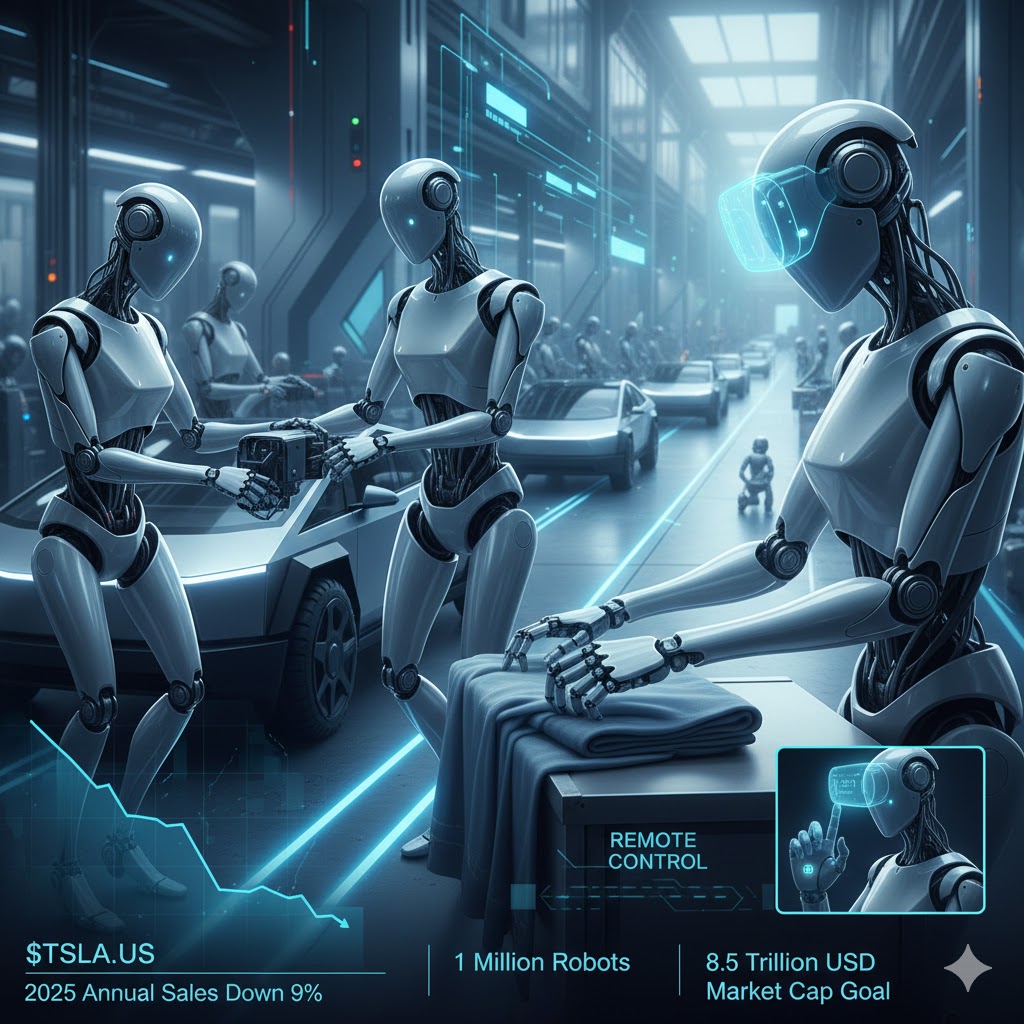
During recent high-profile demonstrations, the robot’s performance was not entirely autonomous. Reports indicate that at the October 2024 event at the Warner Bros. studio, while some robots performed programmed dances, those interacting with guests and serving drinks were actually being remotely controlled by engineers behind the scenes wearing motion-capture suits and VR headsets. This “human-in-the-loop” reality suggests a significant technological chasm remains before Optimus can achieve Musk’s goal of fully replacing human labor.
This strategic pivot comes as Tesla’s core business faces mounting pressure. On Friday, the company reported a 9% decline in vehicle sales for the full year of 2025, with a 16% drop in the fourth quarter, trailing China’s BYD in annual volume. Amid slowing EV sales, Musk is attempting to revive investor confidence by shifting focus toward Robotaxis and humanoid robots. Musk’s new compensation package sets a target for Tesla to reach a $8.5 trillion market capitalization within 10 years and sell at least one million robots.
While capital markets remain focused on the long-term prospects of the robotics industry, internal voices at Tesla and industry experts are divided over the practicality of Optimus. On one hand, engineers have hit bottlenecks in creating mechanical hands with human-like sensing and dexterity; on the other, some employees question whether a humanoid form is truly more efficient than purpose-built automation for routine factory tasks.
Remote Control and the “Behind-the-Scenes” Reality
Although Optimus has become a regular at Tesla events—even appearing at the Hollywood premiere of Tron: Ares—the project remains in a development stage heavily reliant on manual assistance behind the polished demonstrations.
Sources told The Wall Street Journal that during last year’s event, every robot interacting with people required real-time monitoring and operation by multiple engineers: one wearing equipment for remote control, one monitoring via laptop, and others on-site to ensure the robot’s physical stability. At Tesla’s engineering headquarters in Palo Alto, while robots frequently walk through offices to collect navigation data, former employees describe instances where engineers had to use hoists to lift the robots back up after they fell.
While this “remote-control” mode showcases future possibilities, it also exposes the limitations of current autonomous capabilities. Ken Goldberg, a robotics expert at UC Berkeley, noted that while Musk is right that building mechanical hands is a challenge, the difficulty lies not just in the hand’s structure, but in control systems, environmental perception, and the ability to compensate for uncertainty. Enabling a robot to perform truly “useful” tasks remains the frontier of current research.
The Dexterity Bottleneck and Internal Practicality Debates
Inside Tesla’s labs, Optimus is practicing mechanical tasks like sorting LEGO bricks and folding laundry. However, granting a robot the dexterity and environmental understanding required to perform tasks like clearing a dinner table remains fraught with difficulty.
Beyond technical challenges, there are dissenting voices within Tesla regarding the commercial logic of humanoid robots. According to former manufacturing engineers, while Optimus may be capable of simple hauling, non-humanoid robots designed for specific tasks are likely more efficient in most factory scenarios.
Evan Beard, CEO of competitor Standard Bots, pointed out that for factories, warehouses, or agriculture, “wheels” are often more practical than “legs.” He argues that wheeled robots are more stable and safer, whereas bipedal robots are inherently unstable when powered down, posing a risk of collapsing and injuring people. Nevertheless, Musk insists on the humanoid design, believing it allows robots to adapt to environments built for humans.
Market Valuation and Analyst Caution
Musk has painted an incredibly ambitious blueprint for Tesla, aiming to shed its label as a mere EV manufacturer through its robotics business. Morgan Stanley analyst Adam Jonas believes cars are to Tesla what books were to Amazon—merely a springboard into other sectors. Jonas predicts that by 2050, the global humanoid robot industry could generate $7.5 trillion in annual revenue; if Tesla can capture a share, it would drastically scale its income.
However, given the industry’s infancy, some analysts have excluded Optimus from their valuation models. Even ARK Invest, a long-term Tesla bull that predicts the stock could reach $2,600, has not included Optimus in its 2029 financial model, citing the likelihood that the product will take longer to reach commercial maturity. Tasha Keeney, a director at ARK Invest, stated that the tasks early versions of the robot can perform may be very limited.
Currently, Tesla has pushed back the preliminary timeline for deploying Optimus commercially in its own factories and is developing a third-generation robot. Although Musk’s marketing positions Optimus as a “home butler” capable of handling chores—likening it to C-3PO or R2-D2 from Star Wars—Tesla still needs a substantial breakthrough in eliminating manual control and improving engineering practicality to turn this “biggest product ever” into a reality and a profit-maker.