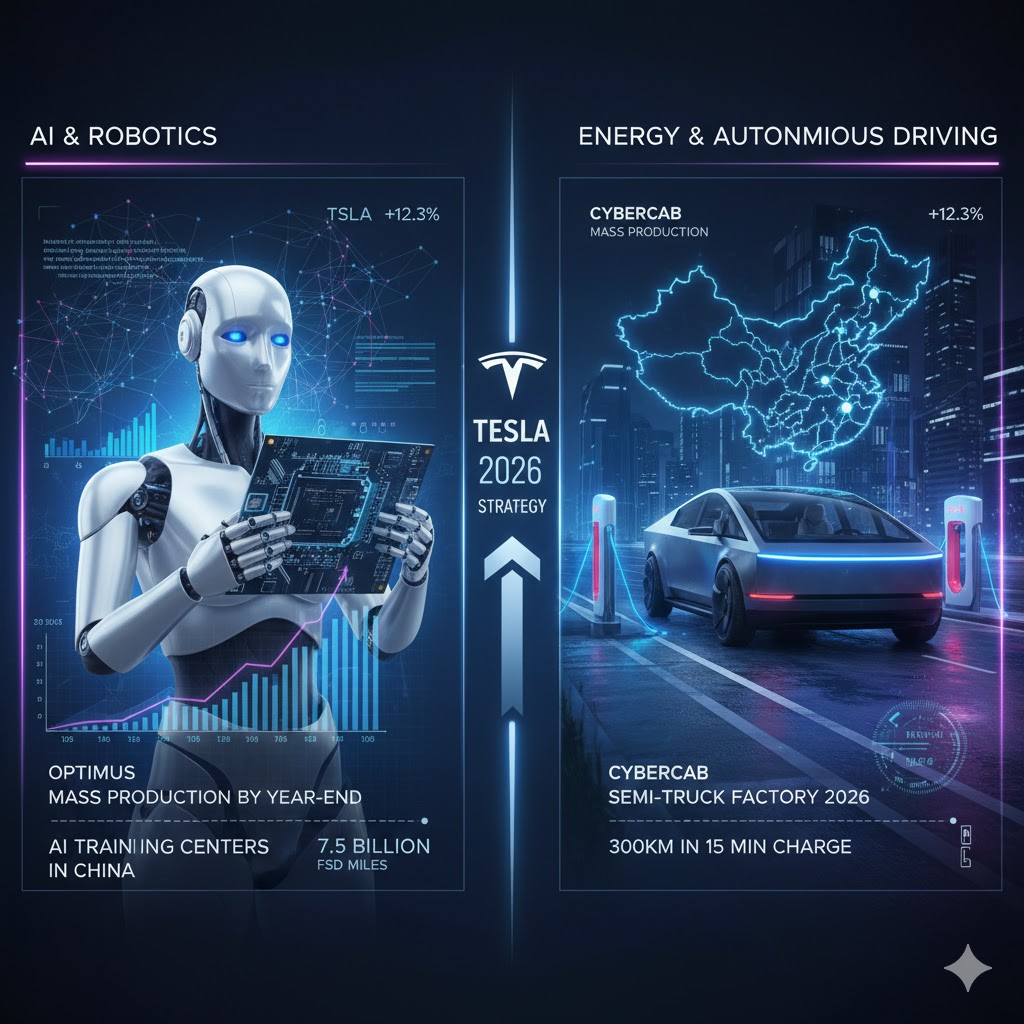
On February 6, Tao Lin, Vice President of Tesla (NASDAQ:TSLA), held a symposium in Beijing where she discussed the company’s 2026 strategic plans and business layout. These plans cover key areas including capital expenditure, investment priorities, autonomous driving in China, energy storage expansion, humanoid robot mass production, and Tesla’s positioning in the Chinese market.
For Tesla, 2025 is a year of significant challenges. According to Tesla’s Q4 2025 financial report, the company saw declines and fluctuations in both revenue and sales, along with some business adjustments. CEO Elon Musk stated during the earnings call that production of the Model S and Model X will cease in Q2 2026.
Tao Lin responded, explaining that the sales fluctuation in 2025 was mainly due to production capacity impacts caused by product transitions, rather than a loss of competitiveness. She emphasized that Tesla’s core focus over the next 3-5 years will clearly be on cutting-edge fields such as AI, autonomous driving, and robotics.
“2026 is a significant year for Tesla,” Tao Lin said. “We are undergoing a transformative shift driven by AI and energy.”
During the symposium, Tao Lin shared further updates and plans regarding Tesla’s core business areas. Key points are as follows:
- There is no clear timeline for the rollout of Tesla’s Full Self-Driving (FSD) in China. Musk’s earlier mention of “February” mainly referred to markets like Europe, with China following later.
- Tesla’s driver assistance data does not need to be sent abroad. The computing power and training are done locally in China, strictly complying with data regulations.
- Tesla has already established its own AI training center in China to deploy localized training capabilities, preparing for larger-scale applications.
- Tesla expects Robotaxi to roll out in China within five years, but it will not rush to pursue city coverage or order volume.
- The key bottleneck for Optimus humanoid robot capability enhancement is not the training data, but whether the hardware has the basic capabilities for training, especially in terms of dexterous hands and joint coordination.
Regarding the “parameter race” involving 800V and 5C fast charging, Tesla remains calm. The overall user experience is more important than focusing on individual metrics. Currently, 15 minutes of charging provides about 300 kilometers, which meets most usage scenarios.
Below are some of Tao Lin’s Q&A highlights, adjusted without changing the original meaning:
01. Tesla’s Investment Priorities for 2026
Q: Recently, Musk’s team visited China to inspect the supply chain. Is this related to Tesla?
Tao Lin: That report probably wasn’t about Tesla; it might be related to SpaceX or another project.
Regarding the supply chain, we follow a global procurement strategy. As long as a supply chain in a region meets cost, stability, delivery speed, and other criteria, we will choose to source from there.
Q: Tesla’s 2026 capital expenditure is expected to exceed $20 billion. How will this be allocated, and how will Tesla balance short-term returns with long-term planning?
Tao Lin: We haven’t yet broken down the allocation of this $20 billion to individual projects, but the overall direction is clear and will be focused on six areas:
- Cybercab mass production. The core production lines at the U.S. factory are nearly complete, with most early investments made in 2025. We will continue to invest in 2026 to ensure Cybercab achieves large-scale production.
- AI computing power center construction, which is the most critical investment. The training center in Texas, USA, has already received over $10 billion in investments, and additional investments will be made in 2026. This center will support all of Tesla’s AI-related applications, including autonomous driving and robot model training, serving global markets, including China.
- Robot factory upgrades. We’ve started upgrading the Model S/X production lines, and in 2026, we will carry out larger-scale renovations aimed at enabling mass production of Optimus robots by year-end.
- Energy storage business expansion. We will continue to invest in energy storage manufacturing to increase capacity and delivery ability to meet the rapidly growing global energy demand.
- Global manufacturing system upgrade. The focus here is on improving both hardware automation and software capabilities to make the manufacturing system more efficient, intelligent, and scalable.
- Ongoing construction and opening of the charging network. We will continue to expand the coverage of the charging network and gradually open it to more automakers. In the future, the charging network will not only be a refueling facility but also an important part of a new energy network.
Overall, these investments demonstrate Tesla’s firm commitment to transitioning to “AI + energy infrastructure.” Before large-scale applications of AI explode, foundational infrastructure such as computing power, manufacturing, and energy must be laid out in advance, which is key to long-term competitiveness.
Q: How much of this $20 billion capital expenditure will be invested in China?
Tao Lin: This investment will include some funds for the Chinese market, but the specific proportion has not been disclosed yet. The relevant plans are still being developed.
In general, we will continue to increase our investment in China, and the direction aligns with our global strategy, with a focus on energy and AI, including continuous construction and upgrades of hardware and software capabilities.
Currently, we have deployed localized training capabilities in China to support autonomous driving and various AI applications in the Chinese market. Although the AI user base in China is still in the early stages, we have already laid the groundwork for future large-scale applications.
02. Progress of FSD’s Rollout in China
Q: Is there any plan to introduce a cheaper version of the Model 3 in China?
Tao Lin: There are currently no such plans. Our focus is not on this at the moment.
Q: How do you view the competitive environment in the Chinese automotive industry?
Tao Lin: China is one of the most dynamic and innovative automotive markets globally.
Both consumers and the industrial ecosystem display tremendous creativity. Many new Chinese carmakers are willing to invest in this highly challenging industry. Many founders who have already achieved stable success are still choosing to enter this high-risk field, and such courage deserves respect.
Tesla’s value is, on one hand, to prove that this path is feasible, and on the other, to push forward technological progress, accelerating the development of the entire industry. As long as we continue to develop in China, we will keep increasing our investments and place important goals on achieving them in China.
Q: How is FSD progressing in China? Musk previously mentioned a “February” rollout—does that apply to China?
Tao Lin: We are actively participating in the development of autonomous driving in China.
In the U.S., FSD development is progressing rapidly, with a large user base and driving mileage as proof of its reliability. The official website is updated daily, and the accumulated driving mileage has exceeded 7.5 billion miles, or approximately 12.1 billion kilometers.
As for the specific timeline, we cannot provide a clear answer at this time. Musk’s mention of “February” primarily refers to Europe, with China following later. However, this does not mean that China will also roll out in February. All work is actively progressing, but there is no published timeline yet.
Q: In China, L3 (autonomous driving assistance) is moving quickly, with many automakers pushing for regional trials in cooperation with local governments. Will this accelerate Tesla’s actions?
Tao Lin: Tesla will actively participate in the development of autonomous driving in China. Although we have not officially launched it yet, we have been conducting training and adaptation for the Chinese market. Once ready, it will be in the best possible state.
In fact, all driver assistance systems in the market are still in the early stages, and it’s difficult to clearly distinguish their strengths and weaknesses. It may take a year or two for the advantages to become clearer.
Q: The Chinese government recently introduced restrictions on data export. Will this affect FSD?
Tao Lin: This is not related to driver assistance. Our driver assistance does not require data to be exported, as our computing power centers and training are all conducted locally.
Q: Will FSD be opened to other carmakers in the future?
Tao Lin: Tesla has always adhered to an open philosophy. Just like how our charging network is already open to other brands, we are also open to the possibility of sharing FSD capabilities with more automakers in the future. However, this would require collaboration and development. Currently, our focus is on improving our own system, but this is a clear long-term direction.
We believe that in the future, every car should be capable of autonomous driving. However, not every automaker has the capability to develop a complete system from scratch. This requires massive funding, large teams, and vast amounts of data.
Tesla’s “world model” can be more efficiently adapted to different vehicles, helping the entire industry enter the autonomous driving era faster. FSD’s entry into China may have a similar impact on the new energy vehicle industry as the Shanghai Gigafactory did.
Q: In 2026, it seems that Tesla is shifting from car sales to AI and robotics. What are the core directions for the next 3–5 years?
Tao Lin: The fluctuations in global sales in 2025 are mainly due to the impact of product transitions, such as the switch to the refreshed Model Y.
Tesla has always operated with a “zero inventory” model, where production capacity largely determines sales. Sales peaked in 2023 because the product was stable and the production line was running at full capacity. Therefore, sales fluctuations do not necessarily indicate a decline in product competitiveness but are more a result of
supply changes caused by production pace adjustments.
Looking further ahead, our focus is continually extending toward AI, autonomous driving, and robotics, which will be the company’s core development paths in the coming years.
03. Competition in Robotaxi
Q: What is the timeline and business model for Robotaxi in China?
Tao Lin: We currently do not have a clear timeline to share. Once we have progress, we will communicate it promptly. As for the business model, whether it operates independently or in partnership is also yet to be determined.
Q: Given the current progress, how long will it take for Robotaxi to be deployed in China?
Tao Lin: Technologically, Robotaxi is already operating in some parts of the U.S., even in unsupervised mode. So, from a technical standpoint, Robotaxi is already capable of serving the public in the U.S.
However, in China, this is not only a technical issue but also involves legal, regulatory, and insurance factors. I personally expect it will be achieved within five years. In the U.S., Robotaxi is currently operating in limited regions, such as certain parts of Austin and Silicon Valley, where users can hail unsupervised Robotaxis. This will be a gradual process.
Q: Waymo is already operating in six cities with 400,000 trips per week, while Tesla’s progress seems slower. Why?
Tao Lin: We could expand to many cities, but we are taking a more cautious approach. We are testing rigorously in each location and making adjustments to ensure absolute safety before scaling up.
It’s like a child learning to walk. Whether they walk at 10 months or 11 months doesn’t matter. It’s not about having more cities or more orders right now; what matters is ensuring that the technology is mature and safe.
Once the technology is fully mature, expansion will be very rapid. Just like a child who can walk anywhere once they’ve mastered it, we’ll scale up quickly once we’ve validated all scenarios.
Q: How do you view competition from companies like Baidu in the Robotaxi field?
Tao Lin: At this stage, the number of cities covered is not the most important metric. While this progress may provide some first-mover advantage, we don’t focus on it.
The more important point is that we don’t view this as a zero-sum competition. The automotive and mobility markets are still far from saturated, and there’s a huge potential.
It’s like people learning to drive at different driving schools. As long as everyone can drive safely, there’s no need to have only one company doing it. Similarly, as long as more vehicles can drive safely, we don’t think that every car must come from Tesla.
Looking globally, no company’s vehicle fleet currently exceeds a few million, while the total number of cars worldwide is immense. At this stage, the industry needs to jointly push for technological maturity and safe deployment, rather than early competition for market share.
So, it’s too early to talk about who has more or who wins or loses right now.
Q: He Xiaopeng recently stated that autonomous driving has leapfrogged from L2 to “near L4.” How do you view this jump from L3 to L4?
Tao Lin: The definitions of L3 and L4 are actually quite vague, while L2 has a clear definition. We prefer to differentiate based on “supervised” vs. “unsupervised.” When supervised, the responsibility remains with the driver; when unsupervised, the responsibility lies more with the car company. The specific level names are not as important as the responsibility division and technical capability.
04. Optimus Robot’s Technical Challenges and Mass Production Plans
Q: Tesla plans to upgrade Model S/X factories for robot production and aims for 1 million units of Optimus by 2027. How will this be achieved?
Tao Lin: At this stage, the key to humanoid robots is not mass production scale, but whether the product itself is truly mature.
If we compare it to human growth, the industry is still in its “embryonic stage,” with a clear gap before large-scale applications. The key breakthroughs are mainly in two areas:
- Dexterity. Over 70% of human work relies on hand usage, and dexterity is key to humanoid robots. Some robots on the market can perform simple movements, but they still fall short in high-precision tasks like threading needles.
- Sensitivity and coordination of the joints. Only when all joints approach human-like flexibility can robots enter mass production. Our third-generation Optimus will show significant improvements over the second generation. Once the functionality is mature, mass production will not be the biggest challenge.
From a global demand perspective, 1 million units is not a particularly large number. The real key is whether the robot can effectively replace humans in performing tasks.
We are developing a general-purpose humanoid robot, which doesn’t need to differentiate between industrial or domestic scenarios. The same robot can switch between different tasks through training, with a unified hardware system.
Q: How will Optimus collaborate with China’s robot产业链? What is the domestic production rate?
Tao Lin: Currently, Optimus is mainly based on an in-house development system, with key components sourced globally. The exact domestic production rate will only become clearer once the product enters stable mass production.
Our principle is clear: we prioritize regions with comprehensive advantages in cost, stability, and supply capacity. If the Chinese supply chain performs best in these areas, we will certainly choose the Chinese solution.
Looking at the broader picture, the robot industry is still in its “initial building” phase, similar to the early stages of the automotive industry. There was no mature, complete supply system at that time, and gradual integration and improvement were needed.
Once humanoid robots achieve large-scale production, it will mark a significant milestone in the global robotics industry, indicating that the full supply chain is beginning to form and will support more robot products’ continued development.
05. Tesla Builds AI Computing Power Center in China
Q: Does Tesla have its own AI training capabilities in China? How is local data training handled?
Tao Lin: Tesla has already set up an AI training center in China, where we conduct local training for Tesla’s AI applications in the Chinese market.
Q: How large is the computing power at the China training center?
Tao Lin: We don’t measure it in terms of specific computing cards, but the center can meet our training needs in China. The chips used are not exactly the same as those in the U.S., so direct comparisons aren’t possible.
Q: Is the training center self-built or rented?
Tao Lin: It is fully self-built; there’s no need to rent. We built it ourselves in the U.S. as well.
Q: What is the data source for the computing power center?
Tao Lin: We don’t collect owner data. Everything related to data is strictly compliant with China’s laws and regulations. We collect data only when allowed by law, and we don’t collect it if not allowed. Regardless, we can conduct local training.
Q: Will Tesla consider using Chinese data for overseas model training or joint training?
Tao Lin: We haven’t started these functions yet, as there’s not much need at the moment. Our model is already world-class, and in China, we only need to make some localized adjustments. Many of these adjustments do not necessarily require actual road data from China, such as traffic signs or turning rules—these are already available in existing资料.
Q: Is training completely dependent on video clips sourced from the internet?
Tao Lin: We use a variety of data sources, but we don’t necessarily need大量采集 road data. We ensure the effectiveness of training.
06. Semi Truck and Cybertruck Plans
Q: What are the plans for Semi truck construction and mass production?
Tao Lin: The Semi factory will officially begin construction in 2026. Semi is not just a new commercial vehicle but an important product symbolizing Tesla’s advancement in electrification and autonomous driving.
Q: Why is Tesla prioritizing Semi over other potential products?
Tao Lin: Resources are always limited, so we must proceed step by step, solving key issues one at a time.
While there are many directions we could explore, the truly important projects are those that have the most strategic value and long-term impact. Based on this, the combination of electric freight and autonomous driving that Semi represents clearly has a high priority.
Q: Does the Semi truck have autonomous driving capabilities from the start?
Tao Lin: Semi was designed with autonomous driving in mind from the beginning.
Unlike passenger vehicles, freight operations have standardized routes, usage scenarios, and business models, making them one of the most suitable areas for the initial large-scale deployment of autonomous driving technology.
Q: Will Cybertruck include features like automated logistics delivery?
Tao Lin: These plans are mainly targeted at the U.S. market and are focused on maximizing Cybertruck’s cargo capacity. We have a Cybertruck at our Shanghai factory, and we frequently use it for hauling goods—it’s very useful.
Q: Is Cybertruck designed for cargo hauling?
Tao Lin: Yes, while it doesn’t carry as much as the Semi truck, for a small pickup truck in the U.S., it has a very good cargo capacity.
Q: Will Cybertruck enter the Chinese market?
Tao Lin: It’s too early to discuss that, but we certainly hope it will enter the Chinese market. We’ll make a decision after it officially enters mass production in the U.S. and runs for some time. There is still significant space in China’s truck market.
07. Charging Technology and Battery System Plans
*Q: What do you think about the 5C fast charging and 800V high-voltage platforms already
deployed by domestic carmakers? What are Tesla’s plans?*
Tao Lin: These technologies will continue to evolve. A significant portion of our capital expenditure will be used to improve infrastructure capabilities, including the continued construction of the charging system.
For example, with the 800V platform, we have conducted thorough internal evaluations. Even if vehicles support 800V, if the charging network is not fully compatible, the ultimate user experience will still depend on the amount of energy that can be charged in a given time.
Currently, with our Supercharger network, Tesla vehicles can charge around 300 kilometers in 15 minutes, which satisfies most real-world usage scenarios. Therefore, there is not an urgent need for higher voltage platforms.
On the technology front, we maintain cutting-edge explorations. For example, the 48V low-voltage system used in the Cybertruck is a groundbreaking design. However, whether a technology is truly implemented depends on whether it enhances the user experience in specific market environments.
Our core principle is not to pursue leadership in a single parameter but to ensure that the entire system is optimized for real-world use.
If a vehicle has an 800V architecture but the charging network cannot support it, users are essentially paying for an unusable capability.
Ultimately, the user experience is determined by the speed, stability, reliability, network coverage, and management capabilities of the entire system—not just a single technical parameter.