Author Archives: admin

Elevated U.S. Stock Valuations Spark Concern; BofA Names Healthcare and Real Estate as Top Picks for 2026

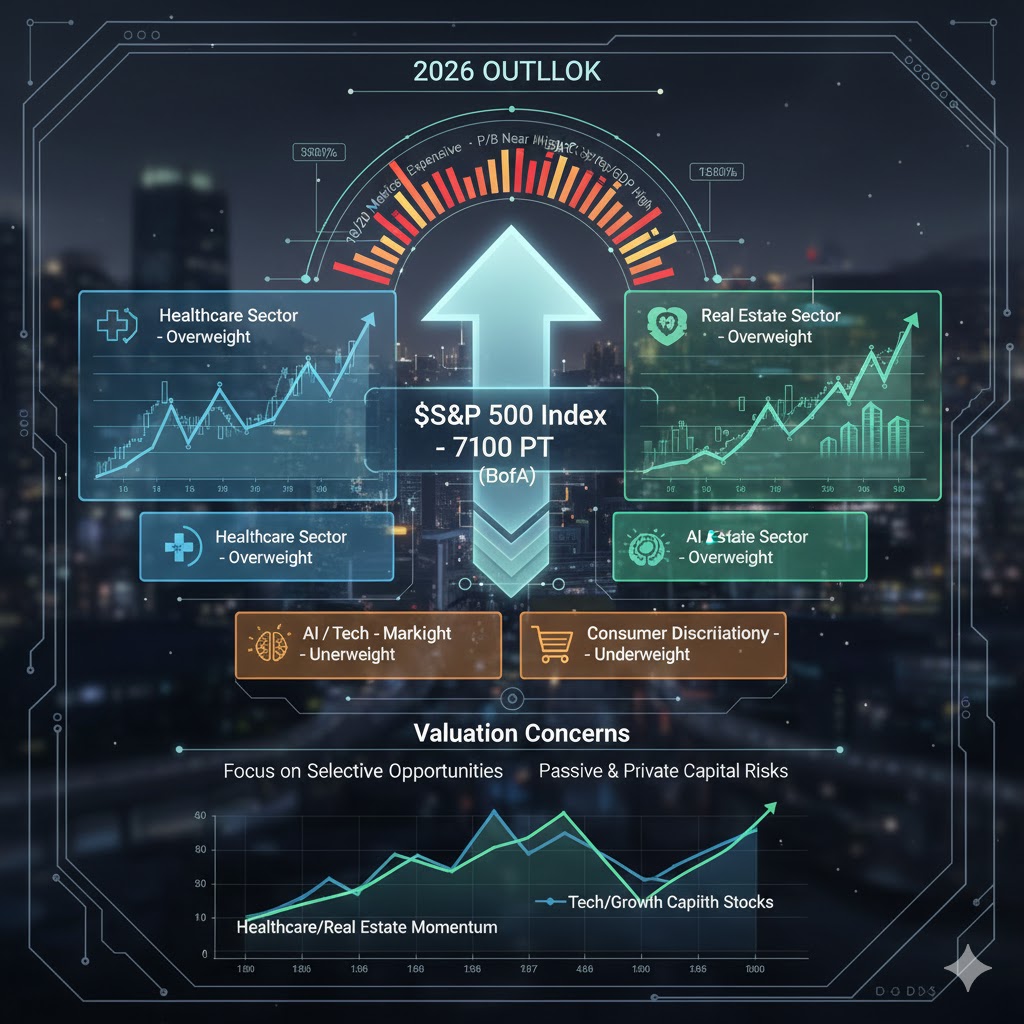
As the U.S. stock market enters 2026 trading at elevated valuation levels, Bank of America Securities strategist Savita Subramanian is advising investors to look beyond the aggregate market and focus on selective sector opportunities—specifically Healthcare and Real Estate.

In a strategy report released on December 31 titled “Lifelines Beyond AI,” Subramanian noted that the S&P 500 appears expensive across nearly every major valuation metric, though structural differences make direct historical comparisons not entirely precise.

Out of the 20 valuation metrics tracked by the institution, the index shows expensive levels in 18 of them. Key indicators such as Market Cap-to-GDP, Price-to-Book (P/B), Price-to-Operating Cash Flow, and Enterprise Value-to-Sales are all hovering near historical highs. In nine of these metrics, current valuations have already surpassed the levels seen during the peak of the dot-com bubble in March 2000.

While today’s index composition reflects higher-quality, asset-light, and lower-leverage companies compared to previous cycles, Subramanian stated that risk remains high at the index level. Bank of America has set a year-end 2026 target for the S&P 500 at 7,100 points, which is below the general market consensus.

“A bull market always exists somewhere,” the report stated, advocating that investors should focus on industrial sectors rather than simply holding the index.

Healthcare and Real Estate Stand Out

Bank of America’s short-term momentum and valuation models currently rank the Healthcare sector as the most attractive industry, with Real Estate ranking third. For investors with an approximately 12-month horizon, the bank maintains an “Overweight” rating on both sectors in its U.S. equity strategy.

The strategist noted that these two sectors are not only cheap relative to historical market valuations but are also benefiting from upward revisions in earnings estimates and a period of sustained relative outperformance. This combination suggests “true value” rather than just being statistically cheap.

The Tech sector ranked second in the model, but Bank of America maintains a “Market Weight” stance on it, citing increasing uncertainty over how the proliferation of AI will interact with broader economic dynamics in 2026.

AI and the Consumer: A Growing Tension

Subramanian highlighted a potential conflict between the two forces that have driven earnings growth for the $S&P 500 Index (.SPX)$ in recent years: the rise of Artificial Intelligence and the resilience of the U.S. consumer.

Since the 1980s, professional service workers have been the largest contributors to consumption growth. However, recent hiring trends and corporate commentary suggest that AI may reduce the demand for such roles. In turn, if the jobs created by AI do not materialize quickly, it could drag down the consumer-driven economy.

The strategist remarked that it remains unclear what types of new jobs this wave of AI investment will catalyze, prompting the bank to maintain an “Underweight” stance on the Consumer Discretionary and Communication Services sectors.

Passive and Private Capital Heighten Market Risks

Beyond valuation concerns, the report emphasized structural risks stemming from asset allocation trends among U.S. institutional investors. Many pensions and asset owners have leaned toward a “barbell strategy,” simultaneously allocating to passive S&P 500 exposure and private equity or private credit holdings.

Passive funds now account for the vast majority of the S&P 500’s float market capitalization. Subramanian warned that if pressure in the private credit sector persists, or if interest rates fail to return to a “lower for longer” environment, some asset owners might be forced to sell liquid equity positions to manage portfolio valuations.

Whether this pressure manifests gradually or through a sharp wave of forced selling remains uncertain, but the report argues that either scenario reinforces the case for a more selective strategy for U.S. equities in 2026.

Decreased Short-term Appeal for the Staples Sector

Although Bank of America remains strategically Overweight on the Consumer Staples sector, it is currently underperforming in the tactical model. Subramanian described Consumer Staples as a potential “value trap,” noting that its recent cheapness reflects falling prices rather than improving earnings expectations.

By contrast, Healthcare and Real Estate combine attractive valuations with improving fundamentals, making them the preferred areas for investors amidst an expensive market and a changing economic backdrop.

Trump Administration Pressures Oil Giants: Massive Investment in Venezuela Required to Recover Debts!

According to information disclosed by the U.S. side on January 3, local time, the White House has requested major American oil companies to invest heavily in Venezuela to repair the country’s crude oil extraction infrastructure.

Reportedly, officials have told oil executives in recent weeks that if they “hope to receive compensation for drilling rigs, pipelines, and other property seized by the Venezuelan government, they must be prepared to return to Venezuela now and invest on a large scale to revitalize its battered oil industry.”

At the beginning of this century, the late Venezuelan President Hugo Chávez demanded that international oil companies cede more operational control to the state-owned Petróleos de Venezuela (PDVSA). Some companies refused, leading the Chávez government to forcibly expropriate their assets.

At the time, U.S. oil giant $Chevron (CVX) managed to stay in Venezuela through negotiations, forming joint ventures with PDVSA. In contrast, its competitors $Exxon Mobil (XOM) and $ConocoPhillips (COP) chose to exit the country and filed for international arbitration to seek damages for their losses.

In recent discussions with oil executives, the U.S. government has made it clear that American oil companies must first commit their own funds to rebuild Venezuela’s oil industry. This investment will be a prerequisite for eventually recovering the debts related to the expropriated assets.

Sources familiar with the matter stated that for companies like ConocoPhillips, this investment would be extremely costly. For years, ConocoPhillips has been attempting to recover approximately $12 billion in losses resulting from the nationalization of assets during the Chávez era. ExxonMobil has similarly pursued international arbitration to recover $1.65 billion.

Caution Within the Oil Industry

Oil industry insiders are maintaining a cautious stance regarding the Trump administration’s demand for investment in Venezuela. They are concerned about the uncertain prospects of rebuilding Venezuela’s dilapidated oil fields and the political instability that may persist in the country for some time.

Sources say that whether these companies ultimately return to Venezuela will depend on how executives, boards of directors, and shareholders assess the risks of re-investment.

A spokesperson for ConocoPhillips responded recently, stating: “ConocoPhillips is closely monitoring developments in Venezuela and their potential impact on global energy supply and stability. At this time, it is premature to speculate on possible future business activities or investments.”

On January 3, during a press conference at Mar-a-Lago in Florida, President Trump stated that major U.S. oil companies would be heading to Venezuela. He claimed he would have America’s massive oil firms invest billions of dollars to repair Venezuela’s severely deteriorated oil infrastructure and begin “generating revenue” for the United States.

Trump’s assertion that U.S. oil companies were preparing to return to Venezuela came just hours after U.S. forces captured Venezuelan President Nicolás Maduro.

Even if oil companies agree to return, it could take years for the country’s oil production to see a significant recovery. Despite possessing some of the world’s largest proven oil reserves, Venezuela’s production has plummeted over the past few decades due to a combination of mismanagement, lack of investment, and U.S. sanctions.

Analysts point out that companies interested in returning face not only uncertainties regarding local oil contract frameworks but also security risks, backward infrastructure, and legal controversies surrounding the U.S. capture of Maduro—all alongside the risk of prolonged political upheaval.

As a founding member of the Organization of the Petroleum Exporting Countries (OPEC), Venezuela produced as much as 3.5 million barrels of oil per day in the 1970s, accounting for over 7% of total global production at the time. By the 2010s, daily production fell below 2 million barrels; last year, average daily production was only about 1.1 million barrels, dropping its share of global production to just 1%.

Musk’s “Optimus” Robot: Still Dependent on Remote Control, Facing Dexterity Challenges, and Internal Doubts Over Practicality

Elon Musk has staked the future of $Tesla (TSLA) and his personal fortune on the grand vision of the “Optimus” humanoid robot, claiming the product will generate “infinite” revenue and become “the biggest product ever.”

However, according to The Wall Street Journal, a massive gap remains between current reality and the societal transformation Musk describes. In public appearances, Optimus often relies on remote operation by engineers and faces severe technical hurdles in mimicking human hand dexterity.

During recent high-profile demonstrations, the robot’s performance was not entirely autonomous. Reports indicate that at the October 2024 event at the Warner Bros. studio, while some robots performed programmed dances, those interacting with guests and serving drinks were actually being remotely controlled by engineers behind the scenes wearing motion-capture suits and VR headsets. This “human-in-the-loop” reality suggests a significant technological chasm remains before Optimus can achieve Musk’s goal of fully replacing human labor.

This strategic pivot comes as Tesla’s core business faces mounting pressure. On Friday, the company reported a 9% decline in vehicle sales for the full year of 2025, with a 16% drop in the fourth quarter, trailing China’s BYD in annual volume. Amid slowing EV sales, Musk is attempting to revive investor confidence by shifting focus toward Robotaxis and humanoid robots. Musk’s new compensation package sets a target for Tesla to reach a $8.5 trillion market capitalization within 10 years and sell at least one million robots.

While capital markets remain focused on the long-term prospects of the robotics industry, internal voices at Tesla and industry experts are divided over the practicality of Optimus. On one hand, engineers have hit bottlenecks in creating mechanical hands with human-like sensing and dexterity; on the other, some employees question whether a humanoid form is truly more efficient than purpose-built automation for routine factory tasks.

Remote Control and the “Behind-the-Scenes” Reality

Although Optimus has become a regular at Tesla events—even appearing at the Hollywood premiere of Tron: Ares—the project remains in a development stage heavily reliant on manual assistance behind the polished demonstrations.

Sources told The Wall Street Journal that during last year’s event, every robot interacting with people required real-time monitoring and operation by multiple engineers: one wearing equipment for remote control, one monitoring via laptop, and others on-site to ensure the robot’s physical stability. At Tesla’s engineering headquarters in Palo Alto, while robots frequently walk through offices to collect navigation data, former employees describe instances where engineers had to use hoists to lift the robots back up after they fell.

While this “remote-control” mode showcases future possibilities, it also exposes the limitations of current autonomous capabilities. Ken Goldberg, a robotics expert at UC Berkeley, noted that while Musk is right that building mechanical hands is a challenge, the difficulty lies not just in the hand’s structure, but in control systems, environmental perception, and the ability to compensate for uncertainty. Enabling a robot to perform truly “useful” tasks remains the frontier of current research.

The Dexterity Bottleneck and Internal Practicality Debates

Inside Tesla’s labs, Optimus is practicing mechanical tasks like sorting LEGO bricks and folding laundry. However, granting a robot the dexterity and environmental understanding required to perform tasks like clearing a dinner table remains fraught with difficulty.

Beyond technical challenges, there are dissenting voices within Tesla regarding the commercial logic of humanoid robots. According to former manufacturing engineers, while Optimus may be capable of simple hauling, non-humanoid robots designed for specific tasks are likely more efficient in most factory scenarios.

Evan Beard, CEO of competitor Standard Bots, pointed out that for factories, warehouses, or agriculture, “wheels” are often more practical than “legs.” He argues that wheeled robots are more stable and safer, whereas bipedal robots are inherently unstable when powered down, posing a risk of collapsing and injuring people. Nevertheless, Musk insists on the humanoid design, believing it allows robots to adapt to environments built for humans.

Market Valuation and Analyst Caution

Musk has painted an incredibly ambitious blueprint for Tesla, aiming to shed its label as a mere EV manufacturer through its robotics business. Morgan Stanley analyst Adam Jonas believes cars are to Tesla what books were to Amazon—merely a springboard into other sectors. Jonas predicts that by 2050, the global humanoid robot industry could generate $7.5 trillion in annual revenue; if Tesla can capture a share, it would drastically scale its income.

However, given the industry’s infancy, some analysts have excluded Optimus from their valuation models. Even ARK Invest, a long-term Tesla bull that predicts the stock could reach $2,600, has not included Optimus in its 2029 financial model, citing the likelihood that the product will take longer to reach commercial maturity. Tasha Keeney, a director at ARK Invest, stated that the tasks early versions of the robot can perform may be very limited.

Currently, Tesla has pushed back the preliminary timeline for deploying Optimus commercially in its own factories and is developing a third-generation robot. Although Musk’s marketing positions Optimus as a “home butler” capable of handling chores—likening it to C-3PO or R2-D2 from Star Wars—Tesla still needs a substantial breakthrough in eliminating manual control and improving engineering practicality to turn this “biggest product ever” into a reality and a profit-maker.