On Monday, $Amazon (AMZN)$ officially launched a dedicated website for Alexa+, Alexa.com, allowing select users to interact with the assistant via a web browser. This move signals a more direct competition between Amazon and OpenAI’s flagship product, ChatGPT.
The Alexa.com website is currently accessible only to Alexa+ users. As a next-generation AI assistant launched by Amazon last February, Alexa+ is still in its early preview phase. To gain access, users must either join a waitlist or purchase newer compatible devices.
Amazon stated that through Alexa.com, consumers can “get quick answers, dive deep into complex topics, create content, plan travel itineraries, and receive assistance with homework.” The company also noted that users can manage their smart home devices directly within the Alexa+ chat window.
Amazon’s primary motivation for launching a web-based version of Alexa is to ensure that users can interact with the AI assistant seamlessly across different terminal interfaces. Previously, Alexa+ was only accessible via mobile applications or select Amazon Echo smart speakers.
Furthermore, the launch of this website brings Amazon’s service closer to the usage models of other popular AI chatbots. Competitors like OpenAI, Google, Anthropic, and Perplexity all primarily support direct user access through web browsers.
With the successful deployment of generative AI products like ChatGPT and Google Gemini, Amazon has faced increasing pressure to upgrade its hardware and software ecosystems to keep pace with the current technological wave.
Since its launch last year, Alexa+ has been gradually rolled out to the public. Amazon revealed that over one million users currently have access to the service.
In fact, when Amazon first announced Alexa+ last year, it teased the upcoming launch of the Alexa.com website, stating it would go live within months. In July of the same year, the company told The Washington Post that the feature would be available to early preview users during the summer.
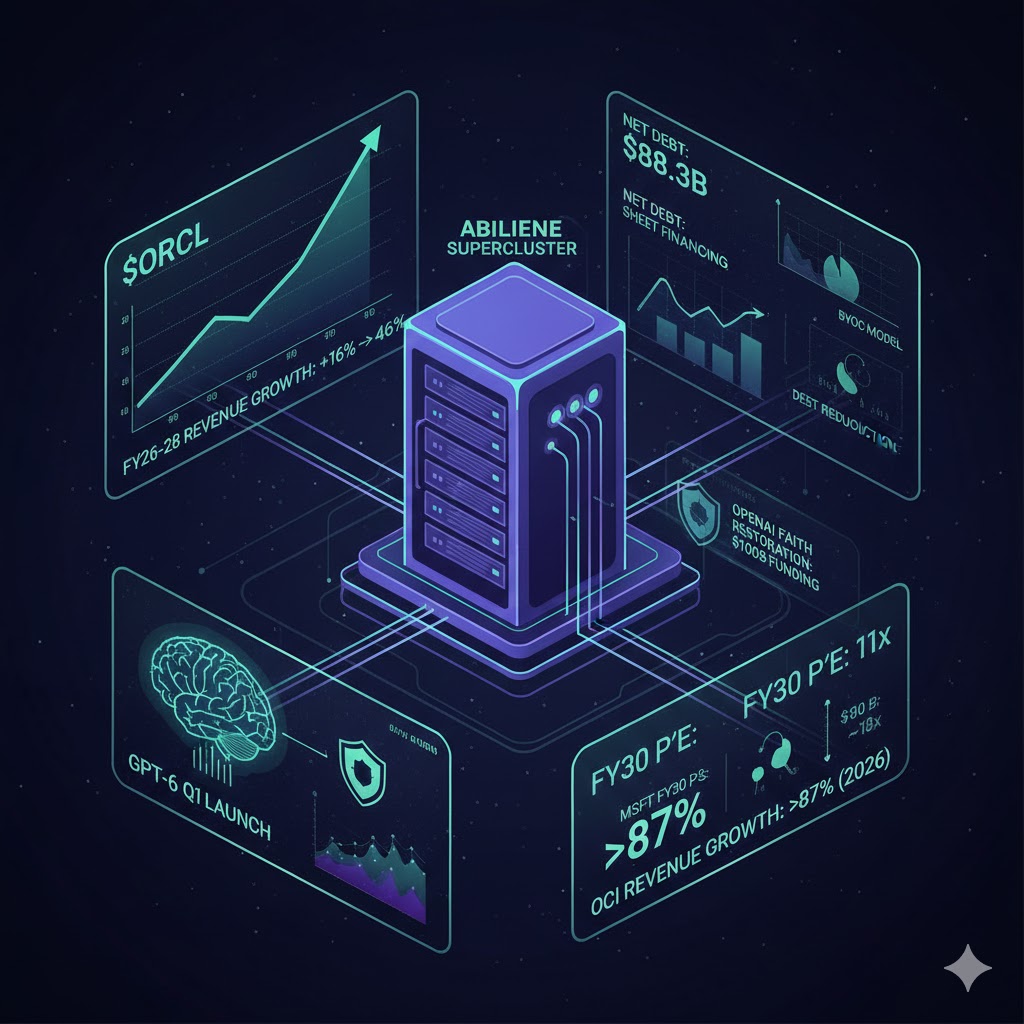
Since its mid-September peak, Oracle’s stock(ORCL) has undergone a severe correction of -41%. This is more than just a technical retracement; it is a direct reflection of crumbling confidence in the “OpenAI Complex.” Investors are currently fraught with anxiety: Can OpenAI deliver on its trillion-dollar promises? Will Oracle’s staggering $88 billion in net debt crush its balance sheet?
According to the latest report from UBS on January 4, the firm offers a distinct contrarian view, reiterating a “Buy” rating. UBS believes the market has over-priced OpenAI’s default risk and Oracle’s financing pressure. If OpenAI completes its new funding round, GPT-6 launches in Q1 as expected, and Oracle utilizes “off-balance sheet” financing to alleviate CAPEX pressure, the market narrative is poised for a fundamental reversal in the first half of 2026.
For investors, Oracle is currently trading at 29x its projected 2026 earnings and only 11x its 2030 projected earnings, offering a highly attractive risk-reward profile.
OpenAI “Faith Restoration”: Funding In-Place and the Redemption of GPT-6
The plunge in Oracle’s share price was not driven entirely by its own operations, but rather by its role as a key “arms dealer” for OpenAI’s computing power. Markets fear OpenAI cannot fulfill its commitments to suppliers. UBS notes that restoring this faith requires only two catalysts: capital and technology.
Completion of Billion-Dollar Funding: Media reports indicate OpenAI is raising $100 billion at an $830 billion valuation. SoftBank has reportedly fully funded its $40 billion commitment, and Amazon is in talks for a $10 billion investment. Once this capital is secured, the counterparty risk for Oracle vanishes instantly.
GPT-6 on the Horizon: While ChatGPT user growth is slowing, OpenAI’s CEO has hinted at a major model update (GPT-6) in Q1. If the new model proves that massive compute investment leads to a qualitative leap, it will directly crush competition anxiety from Google’s Gemini and end the “AI bubble” panic.
The Moat Holds: OpenAI Remains the Enterprise King, Gemini Threat Overblown
The release of Google Gemini 3 triggered a “Code Red” crisis within OpenAI and led investors to fear that OpenAI’s growth in the consumer market had peaked. However, UBS’s latest Enterprise AI survey suggests this concern is misplaced in the B2B sector.
Rising Adoption Rates: Production-grade adoption of Enterprise AI projects rose from 14% in March 2025 to 17% in December. While the pace is steady rather than explosive, the trend is upward.
OpenAI’s Dominance: Among enterprise users, OpenAI models occupy three of the top five spots (1st, 3rd, and 5th). Despite Gemini’s rising rank, OpenAI remains significantly ahead in terms of enterprise-grade productization.
Debt Black Hole or Financial Engineering? Off-Balance Sheet and BYOC to Save the Balance Sheet
Beyond OpenAI risk, investors are most concerned with Oracle’s own balance sheet. As of the end of the November 2025 quarter, net debt stood at $88.3 billion, with a net debt/EBITDA ratio of 2.8x (potentially reaching 4x under S&P criteria if lease liabilities are included). To maintain its investment-grade rating, Oracle must walk a tightrope between massive CAPEX and debt management.
UBS predicts Oracle’s average annual CAPEX for FY26-FY30 will reach a staggering $72 billion. To bridge the funding gap, Oracle is employing aggressive financing strategies:
Off-Balance Sheet Financing: By partnering with entities like Crusoe or Vantage to build data centers, Oracle acts only as a tenant, shifting massive infrastructure costs off its balance sheet.
Bring Your Own Chip (BYOC): Oracle is exploring a model where large customers (like OpenAI) utilize their own direct contracts with NVIDIA to purchase chips and install them in Oracle’s data centers. This would drastically reduce Oracle’s direct capital outlay. UBS estimates that if 50% of capital requirements are solved through such structures, Oracle’s direct financing needs over the next three years could drop from $80 billion to $40 billion, significantly easing credit pressure.
Infrastructure Powerhouse: Abilene Data Center on Track with 100k GB200s Deployed
Rumors of delays at Oracle’s data centers have been rampant, but UBS refutes this through field research and data analysis.
Incredible Delivery Speed: Oracle disclosed in its earnings call that its “supercluster” in Abilene, Texas, has already delivered over 96,000 NVIDIA GB200 chips as planned.
Revenue Explosion Imminent: UBS estimates that these 96,000 GPUs contributed only partial revenue in the previous quarter. As capacity ramps up to a peak of 400,000 GPUs, the Abilene project alone could generate $9.5 billion in annualized revenue. UBS expects Oracle Cloud Infrastructure (OCI) revenue growth to accelerate to over 87% in the February/May quarters of 2026.
Valuation Bottom Line: Risks Priced In, A Prime Buying Opportunity?
Despite the uncertainties, Oracle’s growth story remains the most aggressive among tech giants. Company guidance suggests revenue growth will accelerate from 16% to 46% between FY26 and FY28.
UBS conducted a stress test: even in a “disaster scenario” where OpenAI’s revenue contribution drops to zero by FY30, Oracle’s current share price would represent a P/E ratio of only 12.4x for FY30. In the base case, based on the FY30 EPS guidance of $21, the P/E is only 11x. By comparison, Microsoft’s forward P/E is approximately 18x.
UBS argues that the stock’s -36% underperformance (relative to the AI sector average) has over-reflected financing and execution risks. As long as funding lands and infrastructure is delivered as scheduled, Oracle is set for a significant valuation rerating.
Goldman Sachs’ top ten trends for the tech industry in 2026 focus on core sectors such as AI servers, optical communications, Apple’s foldable screens, semiconductors, intelligent driving, and satellite communications, revealing structural investment opportunities driven by technological innovation and supply chain shifts.
In a recent report, Goldman Sachs’ analyst team led by Allen Chang pointed out that AI server shipments will experience explosive growth in 2026. The penetration rate of ASIC chips is expected to rise to 40%, driving a year-over-year surge of more than 200% in 800G/1.6T optical module shipments. The accelerated penetration of specialized ASIC chips will propel the AI server and optical communications industries to new trillion-dollar heights.
In consumer electronics, $Apple (AAPL)$’s upcoming foldable iPhone is expected to be a powerful catalyst for the smartphone market and a central focus for investors. Meanwhile, the PC market continues to face severe challenges, though leading players remain resilient.
Goldman Sachs emphasized that demand for AI-related technology and high-end hardware will continue to drive earnings growth across China’s semiconductor, optical communication, and PCB (printed circuit board) supply chains. Simultaneously, emerging sectors such as intelligent driving, AI software, and Low Earth Orbit (LEO) satellites are accelerating their commercialization due to policy support and technological breakthroughs, providing diversified opportunities for investors.
AI Servers: The Strong Rise of ASICs and Connectivity Upgrades
The AI server market is undergoing a structural adjustment. Goldman Sachs expects rack-level AI server shipments to surge from 19,000 units in 2025 to 50,000 units in 2026.
A key trend is the diversification of platforms and enhanced network connectivity. Due to their energy efficiency advantages in specific AI workloads, ASIC chips are expected to reach a 40% penetration rate in 2026 and further rise to 45% in 2027.
This trend will make customers more dependent on top-tier suppliers with strong design and manufacturing capabilities, such as Hon Hai and $Foxconn Industrial Internet (601138.SH)$.
Optical Communications: Explosion of 800G/1.6T Optical Modules
The optical communications sector will directly benefit from the expansion of AI infrastructure. As data center networks upgrade from 400G to 800G/1.6T, and the application of Silicon Photonics and CPO (Co-Packaged Optics) technologies increases, demand for optical transceivers will see explosive growth.
Goldman Sachs highlighted that the rising penetration of ASIC chips will further support optical module demand, as ASICs rely more heavily on networking capabilities to execute AI workloads.
Thermal Management: Accelerated Penetration of Liquid Cooling
As computing density increases, thermal management technology is reaching an upgrade inflection point. Goldman Sachs noted that the penetration of liquid cooling technology will rise significantly, particularly in the ASIC AI server domain. To handle the thermal design power (TDP) challenges brought by higher computing power, the supply chain will accelerate its migration toward liquid cooling solutions, benefiting thermal component suppliers like AVC and Auras.
ODM Manufacturers: U.S. Capacity Layout as the Competitive Edge
In the ODM (Original Design Manufacturer) sector, geopolitics and supply chain resilience have become critical considerations. Goldman Sachs believes that manufacturers with firm commitments or capacity plans in the United States will outperform the market. ODMs with strong R&D capabilities, vertical integration advantages, and exposure to comprehensive chipset platforms—such as Hon Hai, Wistron, and Wiwynn—will be preferred by the market.
PCs: Severe Market Challenges, But Leaders Remain Resilient
The PC market faces multiple headwinds in 2026. Goldman Sachs analysis suggests that the Windows 10 replacement cycle is nearing its end, growth expectations for AI PCs have already been priced in by the market, and rising memory costs may lead to lower product specifications or higher prices. In this context, only global market leaders (such as Lenovo) are expected to remain resilient, thanks to stronger supply chain bargaining power and exposure to high-end products.
Smartphones: Will the Foldable iPhone Stand Alone?
The report indicates that Apple will launch a foldable iPhone in 2026, with estimated shipments between 11 million and 35 million units, serving as a powerful catalyst for the smartphone market. The rising penetration of high-end foldable models will drive earnings growth for related component companies.
Goldman Sachs noted that this change in form factor will be a core driver, as the launch of a foldable iPhone will attract consumers and support terminal demand. Although rising memory costs pose a potential risk, high-end branding and new features like foldable screens will reduce consumer price sensitivity.
PCBs: High-End Capacity Shortage Leading to Price and Volume Gains
Despite market disagreements over long-term supply and demand dynamics, Goldman Sachs believes PCB demand remains solid.
Specifically, high-end CCL (Copper Clad Laminate) and PCB suppliers will face a favorable supply-demand landscape, benefiting from increased AI server shipments and ASIC penetration. As CCL grades upgrade to M8+ and M9, the average selling price (ASP) of high-end products is expected to grow by 20-30% annually in 2026 and 2027.
China Semiconductors: AI Driving a New Round of Expansion
The Chinese semiconductor industry will continue its growth momentum. Goldman Sachs is optimistic about the expansion plans of local leaders (such as $SMIC (00981.HK)$ and Hon Hai) in advanced processes, as well as the rise of domestic GPU suppliers.
AI technological innovation and new demand for edge devices (such as AI glasses) will be major drivers. Furthermore, the semiconductor equipment and materials sectors will benefit from the localization trend within the supply chain.
L4 Chips and Robotaxis: Continuous Upgrades in Autonomous Driving
The intelligent driving trend will continue to deepen in 2026. Goldman Sachs expects the popularization of urban NOA (Navigate on Autopilot) and Robotaxis to drive growth for chipset, software, and sensor suppliers. Solutions from companies like Horizon Robotics are being adopted by more vehicle models, while the commercialization process for Robotaxi operators like $Pony.ai (PONY)$ is accelerating, creating new growth poles for the supply chain.
LEO Satellites: Accelerated Launches and Specification Upgrades
The Low Earth Orbit (LEO) satellite industry is entering an acceleration phase. Goldman Sachs pointed out that with the increase in rocket carrying capacity and the reduction in launch costs, satellite launches will speed up significantly.
Meanwhile, satellite specifications are being upgraded, with bandwidth evolving from single-band to multi-band (Ka, E, V, W). Considering the 5-6 year lifecycle of satellites, replacement demand could start as early as 2026, driving the construction of constellation network infrastructure.