Tesla’s Valuation Anchor: Cybercab Mass Production in April—How Will Robotaxi and FSD Deliver on the Hype?

Tesla’s(TSLA) current high valuation relies heavily on the visionary potential of its Robotaxi and Full Self-Driving (FSD) technology. Based on the latest operational updates and product roadmaps, the core investment logic is summarized below:

Robotaxi Status: Competitive Pricing and Expanding Range, but Scale Remains Limited

More Affordable than Waymo According to DriveTesla and Robotracker, Tesla’s Robotaxi initially launched with a flat fare of $4.20 per trip, later adjusting to $6.90 as coverage expanded. The service has now largely transitioned to dynamic pricing, averaging approximately $1.50 per mile. In comparison, Waymo’s pricing in San Francisco and Phoenix averages around $2.50 per mile—rising above $3.00 during peak hours—giving Tesla a clear price advantage.
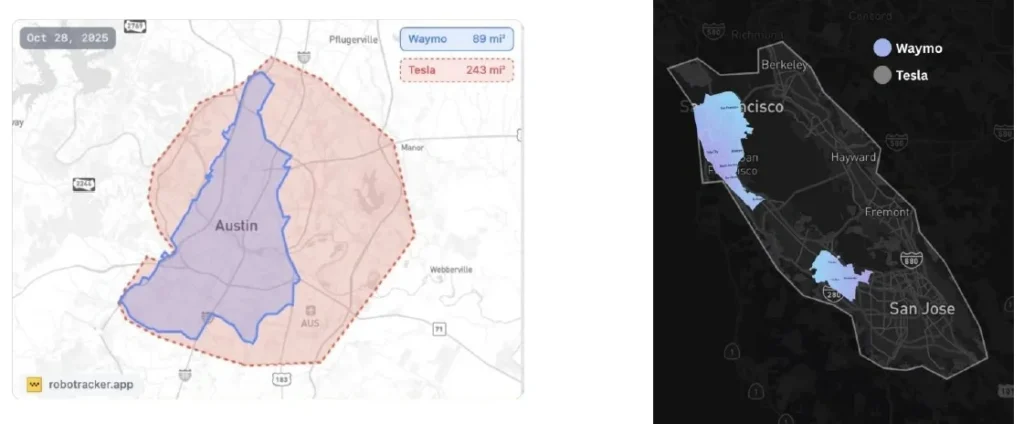
Steady Geographic Expansion While currently only operational in two core hubs—Austin, Texas, and the San Francisco Bay Area—Tesla’s coverage area already exceeds that of Waymo. By 2026, the company plans to expand to multiple states, with a confirmed list of cities including Miami, Las Vegas, Houston, and Dallas.

Key Bottlenecks Persist The primary challenge remains fleet size, which leads to prolonged wait times. As of December 2025, approximately 1,655 Robotaxis were registered in California, but only 132 were in active operation; Austin’s fleet stood at just 40 vehicles. Consequently, Robotaxi has yet to contribute significant revenue and remains in the early stages of commercial validation.

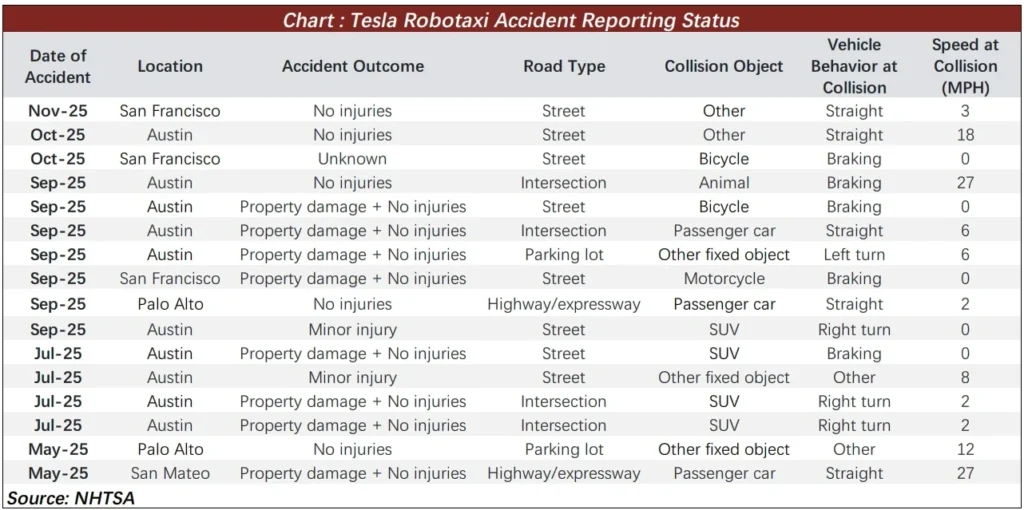
Robust Safety Performance The safety record has been stable since launch with no severe accidents reported. Of the 16 incidents reported to the NHTSA (National Highway Traffic Safety Administration) since May 2025, only two involved airbag deployment—both caused by other vehicles. Tesla’s vehicles sustained no structural damage in these cases, and the majority of incidents resulted in no injuries, indicating a high level of overall safety.
FSD: Rising Penetration and “Grok” Integration—China as the Critical Variable

While Robotaxi may not drive significant revenue in the short term, it serves as a powerful catalyst for FSD adoption:

Technical Iteration and Surging Subscription Rates FSD V14 utilizes a unified system compatible with both consumer vehicles and Robotaxis, with only minor functional differences (e.g., consumer cars retain Autopark, which is unnecessary for Robotaxis). V14 features more conservative driving logic and, following an architectural upgrade, may integrate a streamlined version of the Grok AI system, which is expected to further increase MPI (Miles Per Intervention).

The FSD subscription “take rate” has surged from single digits to between 13% and 19% as of September 2025. By the end of 2025, with Tesla’s cumulative production reaching approximately 9 million vehicles, the estimated number of FSD subscribers sits around 1 million. Since subscribers are concentrated in the U.S. (which accounts for roughly 50% of Tesla’s recent sales), the U.S. penetration rate likely exceeds 20%.

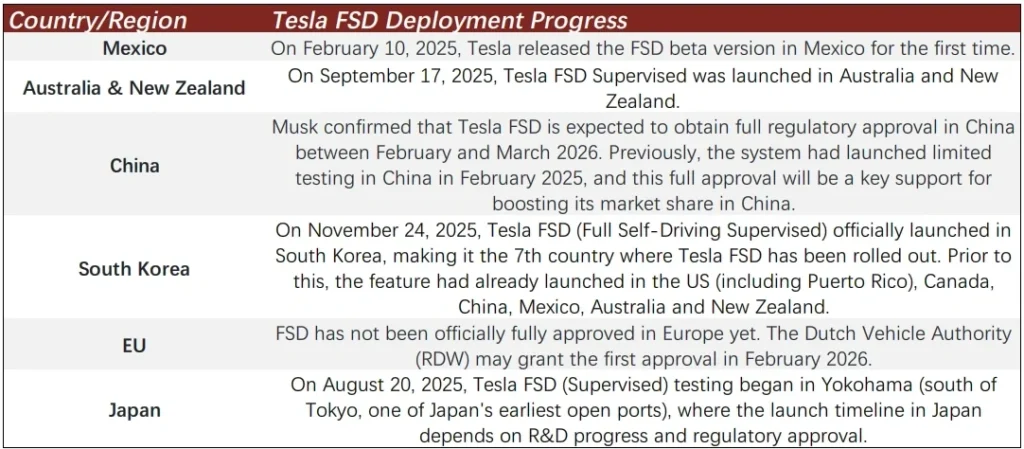
2026 Global Acceleration: Focus on the China Market Following the Grok integration and subsequent performance boosts, the market expects the launch of “unsupervised” Robotaxi operations and a driverless version of FSD. By 2026, commercialization is expected to move into Europe, Southeast Asia, and other regions.

As Tesla’s second-largest market, China remains a crucial growth lever. Currently, FSD is limited to a one-time purchase of 64,000 RMB (~$9,000) with a penetration rate under 5%. If full regulatory approval is granted and Tesla switches to a monthly subscription model, the lower entry barrier is expected to significantly drive adoption in the region.
Cybercab: Mass Production Slated for 2026 with a 2-Million Unit Target

Tesla has already begun testing the Cybercab production system. Elon Musk previously indicated that mass production is scheduled to begin in April 2026. Multiple Cybercab prototypes have been spotted during road tests in Austin. Notably, these test vehicles are equipped with temporary steering wheels and mirrors to satisfy current safety and regulatory requirements.

Tesla envisions the Cybercab as the “highest-volume vehicle in history,” targeting an annual capacity of 2 million units. However, given the realities of automotive manufacturing, achieving this goal in the short term remains a formidable challenge.

Summary: 2026—The Year of Scalability and Execution

Compared to the expectations set in early 2025, many of Tesla’s Robotaxi milestones have already been achieved: accident rates are low, and an unsupervised version is in testing. The core watchpoints for the future are twofold:

  1. Fleet Scaling: Current wait times of 30–40 minutes and the continued need for human supervision mean the service is not yet “fully commercialized.”
  2. Cybercab Production: The pace of the production ramp-up will directly determine whether Tesla’s valuation logic can be realized.

ExxonMobil CEO Calls Venezuela “Uninvestable”; Trump Fires Back: “I’ll Probably Leave Them Out”

President Donald Trump stated on Sunday that he may move to block ExxonMobil (XOM) from investing in Venezuela, following comments by the company’s CEO describing the country as a market that currently lacks investment value.

The dispute stems from a meeting of oil executives held at the White House last Friday. During the session, ExxonMobil CEO Darren Woods told Trump bluntly that Venezuela would not be an attractive investment target unless it overhauled its legal framework.

Woods specifically noted that ExxonMobil’s assets had been confiscated by local authorities on two separate occasions since the company first entered Venezuela in the 1940s. His remarks highlight a persistent reluctance among top energy groups to commit massive capital without security guarantees, despite Trump’s attempts to lure them with promises of future prospects and a push for “at least $100 billion” in investment to boost production and lower U.S. gas prices.

Woods’ stance was a significant blow to Trump, who is currently lobbying U.S. oil giants to spend hundreds of billions to help revitalize Venezuela’s oil industry.

“I didn’t like the response from Exxon,” Trump told reporters Sunday while traveling back to Washington on Air Force One. “I’ll probably leave Exxon out. I wasn’t happy with their answer; they were being very cute.”

ExxonMobil has not yet issued an immediate comment on the matter.

Mixed Reactions from Industry Leaders

In contrast to Exxon’s hardline stance, other executives at the White House meeting reacted more positively to Trump’s proposal, suggesting a potential influx of capital in the short term.

  • Chevron (CVX) stated it could increase production by 50% within 18 to 24 months by expanding its existing 240,000-barrel-per-day project.
  • Shell (SHEL) CEO Wael Sawan noted the European giant has identified “billions of dollars in investment opportunities” and is “ready to go” as soon as U.S. sanction waivers are provided.
  • Repsol claimed it could triple its production to 150,000 barrels per day within two to three years, while Italy’s Eni, which holds 4 billion barrels in reserves, also signaled readiness to increase investment.

Under further questioning from Trump during the meeting, Woods softened his tone slightly, stating that Exxon would send a technical team to Venezuela within weeks to assess the situation and expressed “confidence” that necessary reforms could be implemented.

However, even Harold Hamm, founder of Continental Resources and a long-time Trump ally, declined to make specific commitments. While he praised Venezuela’s reserves as “true gems,” he admitted the country presents both “exciting prospects” and “challenges” that the industry must navigate.

No Compensation for the Past

The mixed signals from Friday’s meeting reflect the dilemma facing oil companies: a desire to capture a share of the market versus a deep-seated fear of a politically volatile nation with a history of expropriating foreign assets.

“Investing heavily in Venezuela to meet the administration’s goals carries extremely high legal, political, and geopolitical risks,” noted Meghan O’Sullivan, a geopolitical and energy expert at Harvard University.

Despite his urgency for investment, Trump does not appear inclined to offer substantive concessions regarding compensation or financial guarantees.

For companies whose assets were previously seized, Trump made it clear that reimbursement is unlikely. He told Ryan Lance, CEO of ConocoPhillips (COP)—which suffered a $12 billion loss due to expropriation—”You’re going to make a lot of money in the future, but we aren’t going to look at the past.”

“We’re starting over,” Trump emphasized. “We’re not going to worry about who lost what in the past; that was their fault. That was during another presidency.”

Furthermore, Trump ruled out using U.S. taxpayer money to indemnify corporate investment risks, despite having mentioned the idea previously. “It’s not going to take government money,” he told the executives. “Our oil giants are going to spend at least $100 billion—that’s your money, not the government’s.”

When asked about financial backstops, Trump said he hoped they wouldn’t be necessary but suggested the U.S. government could provide some form of security and legal guarantees—a key demand from the industry. “You’re going to have absolute security,” he promised.

However, regarding physical security, Trump suggested that protection would be provided by the Venezuelan regime rather than the U.S. military. “I think the people of Venezuela are going to give you very good security.”

A High-Stakes Gamble

Legal experts believe that while there is “intense interest” in Venezuelan investment, there is a long road ahead before intentions turn into action.

“The difficulty right now is that the dust hasn’t settled, and the logistical and political challenges remain severe,” said Carlos Solé, co-chair of the Latin America practice at Baker Botts. He believes the process for obtaining licenses or sanction waivers from the Office of Foreign Assets Control (OFAC) must be streamlined before companies act.

Aurelio Fernandez-Concheso, head of the Clyde & Co office in Venezuela, said that while they have received numerous inquiries from clients in the oil, gas, shipping, and insurance sectors, everyone remains “highly cautious” until the situation clears.

“Picking up the phone to talk to a consultant is one thing,” he remarked. “It is quite another to actually sign a check and put money into that country.”

The Highly Anticipated “AI Business Model”: Google Takes the Lead by Integrating Ads into Gemini

Alphabet (GOOGL) is introducing new personalized advertising features within its AI shopping tools, marking a pivotal step forward for tech giants in the race to monetize artificial intelligence.

On Sunday, Google announced that advertisers will now be able to offer exclusive deals to consumers preparing to purchase items through Google’s “AI Mode,” which is powered by its Gemini model. This move represents a significant evolution of Google’s traditional advertising paradigm.

“This is a new concept that moves beyond our traditional search advertising model,” said Vidhya Srinivasan, Vice President of Google Ads and Commerce. She noted that it enables retailers to provide value to AI-assisted shoppers at the most critical moments “to close the deal.” Google’s AI will determine precisely when to display these offers based on user shopping behavior and purchase probability.

The move comes as AI chatbots pose a potential threat to Google’s traditional “sponsored” ad placements, which generate tens of billions of dollars in annual revenue. Simultaneously, Google seeks to capitalize on the momentum of its latest large language model, Gemini 3, which has gained significant ground in its competition against OpenAI’s GPT-5.

Google also unveiled a “Universal Commerce Protocol,” allowing shopping agents to research products and complete purchases directly within its platform. The protocol was co-developed with major retailers and marketplaces, including Walmart, Target, and Shopify.

Beyond the Traditional Search Ad Model

The new advertising capabilities from Alphabet (GOOGL) allow brands to provide highly personalized ads—such as discount codes—through its chatbot, giving it an edge over AI rivals. This feature leverages contextual information from the user’s conversation with the chatbot and triggers offers based on relevant products the user has clicked on.

Retailers define the offers they wish to provide, while Google’s AI determines the optimal timing to present these deals to potential customers. Existing partners in Google Shopping include pet brand Petco, e.l.f. Cosmetics, and luggage manufacturer Samsonite.

Srinivasan indicated that while the initial pilot focuses on discounts, it will expand to support offers with other attributes. This will help shoppers prioritize value beyond just price, such as bundled deals and free shipping.

The AI Monetization Race Heats Up

Alphabet (GOOGL) is leveraging its massive market share in online search to expose its AI models to billions of users through the “AI Mode” added to search pages last year. Its standalone chatbot, Gemini, currently still trails ChatGPT in terms of popularity.

Last month, OpenAI suspended internal discussions regarding advertising products after CEO Sam Altman declared a “Code Red” to improve ChatGPT. This shift stemmed from concerns that competitors were narrowing OpenAI’s early lead in cutting-edge technology development.

Over the past year, AI firms including OpenAI, Microsoft, and Perplexity have raced to launch e-commerce features within their chatbots to find new ways to generate revenue from their popular but expensive AI products. As first reported by the Financial Times, OpenAI has been rolling out its own checkout feature, where the AI startup takes a commission on sales made via ChatGPT.

Tech Giants Bet on AI Shopping

On Thursday, Microsoft (MSFT) launched “Copilot Checkout,” which also offers recommendations and checkout services to users within its AI chat. Microsoft stated that users shopping through Copilot were 53% more likely to make a purchase within 30 minutes of interaction compared to those not using the feature.

At the National Retail Federation’s annual show in New York, Google CEO Sundar Pichai stated, “We need to work together. I think if we do it well, this will be an extraordinary moment of expansion.”

The “Universal Commerce Protocol” launched by Alphabet (GOOGL) will enable shopping agents to research and purchase products without leaving the platform, further solidifying the partnership between AI and major retailers like Walmart, Target, and Shopify.