Goldman Sachs: “Middle-Class Consumption” to Take the Baton for 2026 U.S. Stock Bull Market After AI Craze

In its latest outlook, Goldman Sachs points out that as the Artificial Intelligence fever potentially cools, “Middle-Class Consumption” is poised to become the primary engine driving the 2026 U.S. stock bull market.

Goldman Sachs strategist Ben Snider and his team noted that with expected economic growth in the U.S., the market focus should shift toward companies benefiting from the expansion of middle-class spending—particularly those in the “lifestyle improvement” and “experience-based” goods and services sectors.

The team favors businesses offering “Want-to-Have” rather than “Need-to-Have” products, such as upscale apparel retailers, home goods manufacturers, tour operators, and casinos. They believe that the fading negative impact of Trump’s tariff policies, a stabilizing labor market, and tax refunds from prior legislation will collectively boost consumer confidence and spending power.

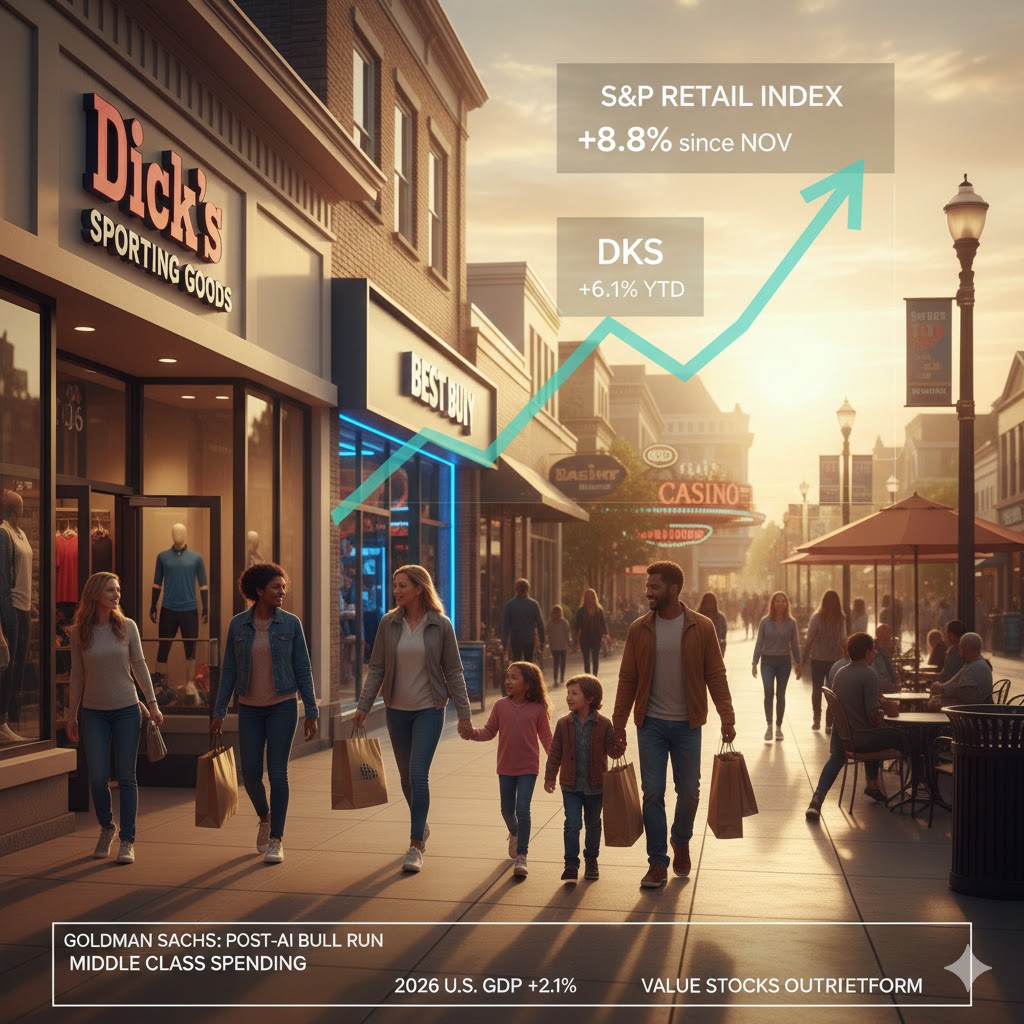
Market data has already begun to validate this trend: the S&P Retail Select Industry Index has risen 3.5% year-to-date and has climbed 8.8% since the start of last November’s holiday shopping season. The index, which includes companies like CarMax, Etsy, and Academy Sports & Outdoors, reflects investors rotating out of the tech sector—which has led gains in recent years—and into consumer stocks that previously lagged.

Rotation from Growth to Value

As valuations for AI-themed trades reach historical highs, Wall Street is initiating a structural rotation from growth stocks to value stocks. A Bloomberg survey shows that economists expect the U.S. economy to grow by 2.1% in 2026, driven by consumer spending. This macro backdrop is guiding capital away from overheated tech valuations toward value stocks directly linked to real economic recovery and middle-class purchasing power.

In a report to investors on January 6, Goldman Sachs stated:

“Stocks linked to middle-income consumer spending are particularly attractive. Value stocks will continue to outperform the broader market in early 2026. Real income growth for middle-income consumers is set to accelerate, which should translate into improved sales growth.”

Charlie McElligott, cross-asset macro strategist at Nomura Securities International, noted that the core of this shift lies in the market’s re-pricing of economic growth expectations. He stated:

“The market is raising growth forecasts, which, if realized, will benefit traditional value sectors. Last year’s market gains were dominated by a handful of stocks (about 12), whereas the current rally’s breadth is significantly widening as capital rotates into more volatile sectors closely tied to the fate of the American ‘Main Street’ consumer.”
Retailers Emerge as Early Winners

Dick’s Sporting Goods (DKS) has emerged as an early beneficiary of this rotation toward the “middle-class consumption” theme. The sporting goods retailer saw its shares rise 6.1% in the first four trading days of 2026, reversing a 13% decline from the previous year. This strong start confirms the recovery expectations held by institutions like Goldman Sachs.

On Tuesday local time, an options trader bet that the stock would return to its early 2025 all-time high of $250 per share. A premium of $84,000 was placed on a trade that could potentially yield up to $3.5 million, signaling significant optimism about the company’s outlook.

Goldman Sachs has explicitly included Dick’s Sporting Goods in its recommended “Middle-Class Consumption” portfolio, alongside six other retail chains including Burlington Stores (BURL) and Best Buy (BBY). The firm also expressed a bullish stance on the Healthcare, Materials, and Consumer Staples sectors, believing these areas will benefit directly from the wealth growth and accelerating real income of the middle-income demographic.
Nvidia-Backed Applied Digital Shares Surge as Q2 Revenue Skyrockets 250%

On Thursday, Applied Digital ($APLD), a company held in Nvidia’s portfolio, surged over 18% in early trading to $34.985. The stock recorded a cumulative gain of approximately 220% last year.

The rally follows the company’s announcement of its financial results for the second quarter of fiscal year 2026 (ended November 30, 2025):

  • Revenue: $126.6 million, representing a 250% year-over-year increase.
  • Net Loss: Basic and diluted net loss per share attributable to common stockholders was $0.11, a narrowing of 82% compared to the previous year.
  • Adjusted Net Income: Reported at $100,000.

Management stated that AI infrastructure represents a “once-in-a-generation” investment opportunity. Capital expenditure by hyperscalers has already exceeded $400 billion annually and continues to grow rapidly.

Applied Digital believes it is well-positioned through its early strategic investments in customized, next-generation data centers. The company expects to achieve its goal of over $1 billion in Net Operating Income (NOI) within the next five years.

Ford Executive Joins L3 Autonomous Driving Race, Plans 2028 Vehicle Launch

Ford Motor Co. (F) plans to introduce Level 3 (L3) autonomous driving technology within two years, a move that could propel the traditional American automaker into the burgeoning Robotaxi sector.

On Wednesday (January 7), local time, Doug Field—Ford’s Chief EV, Digital, and Design Officer—announced that the company will launch L3 (conditional) autonomous driving technology in 2028, building upon its existing “BlueCruise” system.

Currently, BlueCruise offers Level 2 “hands-free” driving but still requires drivers to keep their eyes on the road. In an interview, Field stated that the new version, which will allow for “eyes-off, hands-off” operation, will first debut on Ford’s upcoming affordable electric small pickup platform, priced at approximately $30,000.

Speaking at the 2026 Consumer Electronics Show (CES 2026) in Las Vegas, Field explained that this technology will enable drivers to safely conduct video conferences or enjoy entertainment while on the move. Ford anticipates this feature will become a high-demand necessity for future consumers.

“Time is near the top of the list of what people need most today,” Field said. “We believe this feature will be incredibly compelling.”

If the technology gains the level of adoption Ford expects, Field did not rule out the possibility of using it to enter the Robotaxi business. He noted that such a move would be a “natural extension” for Ford Pro, the company’s commercial vehicle division.

“We don’t want to move too fast right now, but we believe we have a very attractive platform to advance this with partners,” he said. “The extent to which L3 driving ultimately evolves will dictate our long-term strategy.”

Before joining Ford, Field held senior roles at Apple and Tesla. He previously served as Tesla’s Senior Vice President of Engineering, leading the development of the Model 3, and was responsible for Mac hardware development at Apple.

If Ford proceeds with the Robotaxi race, it would mark a significant strategic pivot. In 2022, Ford shut down its autonomous driving subsidiary, Argo AI, and abandoned plans for fully self-driving cars; at the time, Field described the task as “harder than putting a man on the moon.”

However, he now believes “there are many forces encouraging the industry to re-evaluate the potential of automated ride-hailing.” Currently, Tesla and Google (Waymo) are the dominant players in automated mobility—a market Wall Street widely views as having immense profit potential.

For now, Ford remains focused on selling L3 autonomy to everyday consumers. Field stated that the company is still evaluating pricing models, which could include a one-time fee, a per-mile charge, or a subscription service.

Because the technology was developed in-house using lower-cost components, Field claims Ford will have a competitive pricing advantage, making it affordable for a broader range of consumers.

“We are putting this system on a platform starting at the $30,000 level, rather than layering L3 systems onto high-end models priced between $70,000 and $100,000 like most of our competitors,” Field emphasized. “That is a critical distinction.”