Trump’s “Dividend Ban” Turns Bullish? U.S. Defense Stocks Stage Dramatic “V-Shaped” Rebound

On Wednesday (January 7), U.S. defense stocks initially slumped following a rare public rebuke from President Trump during mid-day trading. However, the sector saw a significant rebound during overnight and pre-market sessions, with several companies fully recovering their losses.

Trump’s Criticism of Defense Contractors

Roughly an hour before Wednesday’s closing bell, Trump posted a critique claiming that U.S. defense contractors are issuing massive dividends and conducting large-scale stock buybacks at the expense of investing in plants and equipment. “This situation will no longer be allowed or tolerated!” he wrote.

He accused these firms of being “extremely slow” in delivering critical equipment and failing to provide timely or adequate maintenance. Furthermore, he emphasized that executive compensation packages at these companies are “exorbitant and unjustifiable” given their performance.

Proposed Restrictions and Mandates

Trump demanded that defense companies prioritize building new, modernized production facilities. He outlined several strict conditions to be met until current issues are resolved:

  • Executive Pay Cap: Annual compensation for defense executives must not exceed $5 million.
  • Payout Ban: A total prohibition on shareholder dividends and stock buybacks.
  • Internal Funding: Companies must use existing capital for immediate production rather than seeking government bailouts or loans from financial institutions.

Market Reaction and Financial Data

Following the news, defense stocks dropped sharply in late trading. Northrop Grumman (NOC) closed down 5.5%, while Lockheed Martin (LMT) and General Dynamics (GD) fell over 4%. RTX (RTX) declined by approximately 2.5%.
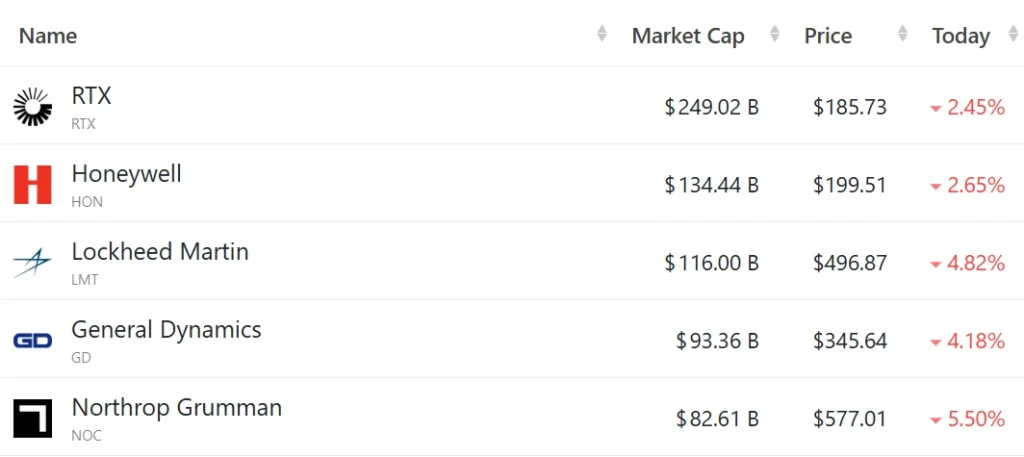
According to financial filings, Northrop Grumman spent $1.17 billion on buybacks and $964 million on dividends in the first nine months of last year. During the same period, Lockheed Martin allocated $2.25 billion for buybacks and $2.33 billion for dividends.

An hour after the close, Trump issued another post specifically targeting RTX. Citing a report from the “Department of War” (Department of Defense), he labeled the company as the “least responsive” and “slowest to expand,” despite being the “most aggressive” in shareholder payouts. RTX, a key supplier for the F-35 fighter jet and advanced missiles, was warned that the Department would cease all business with them unless they increased investments in infrastructure.

The “Deep V” Rebound

The tide turned during overnight trading as defense stocks staged a collective rally. Northrop Grumman and Lockheed Martin rose approximately 6.3%, General Dynamics gained nearly 4.9%, and RTX climbed about 4.8%.

The momentum carried into Thursday’s pre-market session. Northrop Grumman’s gains expanded to nearly 7.3%, Lockheed Martin rose over 6.5%, and RTX increased by 5%.

Analysis: Why the “Ban” is Seen as a Positive

Analysts suggest that Trump’s push to halt dividends can be interpreted as a long-term bullish signal. By redirecting cash into production lines, equipment upgrades, and order fulfillment, contractors could significantly boost their long-term growth potential.

In an era of strained industrial capacity, these policy signals have bolstered investor expectations for future revenue and order growth. Furthermore, Trump proposed on the same day that the FY2027 defense budget be increased from $1 trillion to $1.5 trillion, citing the need for a stronger military in “troubled and dangerous times.”

Industry and Government Perspectives

Palmer Luckey, founder of Anduril Industries—recently valued at $30.5 billion—stated he does not oppose regulatory measures, including pay caps. Luckey noted that he personally “only takes a $100,000 annual salary.”

Additionally, it is worth noting that reports from last August mentioned Commerce Secretary Howard Lutnick hinting that the U.S. government is considering taking equity stakes in the defense industry, similar to its 10% stake in Intel, to ensure better oversight and production.


Amazon Launches Web-Based Alexa+ for Select Users, Aiming Directly at ChatGPT

On Monday, $Amazon (AMZN)$ officially launched a dedicated website for Alexa+, Alexa.com, allowing select users to interact with the assistant via a web browser. This move signals a more direct competition between Amazon and OpenAI’s flagship product, ChatGPT.

The Alexa.com website is currently accessible only to Alexa+ users. As a next-generation AI assistant launched by Amazon last February, Alexa+ is still in its early preview phase. To gain access, users must either join a waitlist or purchase newer compatible devices.

Amazon stated that through Alexa.com, consumers can “get quick answers, dive deep into complex topics, create content, plan travel itineraries, and receive assistance with homework.” The company also noted that users can manage their smart home devices directly within the Alexa+ chat window.

Amazon’s primary motivation for launching a web-based version of Alexa is to ensure that users can interact with the AI assistant seamlessly across different terminal interfaces. Previously, Alexa+ was only accessible via mobile applications or select Amazon Echo smart speakers.

Furthermore, the launch of this website brings Amazon’s service closer to the usage models of other popular AI chatbots. Competitors like OpenAI, Google, Anthropic, and Perplexity all primarily support direct user access through web browsers.

With the successful deployment of generative AI products like ChatGPT and Google Gemini, Amazon has faced increasing pressure to upgrade its hardware and software ecosystems to keep pace with the current technological wave.

Since its launch last year, Alexa+ has been gradually rolled out to the public. Amazon revealed that over one million users currently have access to the service.

In fact, when Amazon first announced Alexa+ last year, it teased the upcoming launch of the Alexa.com website, stating it would go live within months. In July of the same year, the company told The Washington Post that the feature would be available to early preview users during the summer.

How Oracle Can Pivot the Market Narrative: UBS Cites OpenAI Faith Restoration and Manageable Debt Pressure

Since its mid-September peak, Oracle’s stock(ORCL) has undergone a severe correction of -41%. This is more than just a technical retracement; it is a direct reflection of crumbling confidence in the “OpenAI Complex.” Investors are currently fraught with anxiety: Can OpenAI deliver on its trillion-dollar promises? Will Oracle’s staggering $88 billion in net debt crush its balance sheet?

According to the latest report from UBS on January 4, the firm offers a distinct contrarian view, reiterating a “Buy” rating. UBS believes the market has over-priced OpenAI’s default risk and Oracle’s financing pressure. If OpenAI completes its new funding round, GPT-6 launches in Q1 as expected, and Oracle utilizes “off-balance sheet” financing to alleviate CAPEX pressure, the market narrative is poised for a fundamental reversal in the first half of 2026.

For investors, Oracle is currently trading at 29x its projected 2026 earnings and only 11x its 2030 projected earnings, offering a highly attractive risk-reward profile.

OpenAI “Faith Restoration”: Funding In-Place and the Redemption of GPT-6

The plunge in Oracle’s share price was not driven entirely by its own operations, but rather by its role as a key “arms dealer” for OpenAI’s computing power. Markets fear OpenAI cannot fulfill its commitments to suppliers. UBS notes that restoring this faith requires only two catalysts: capital and technology.

  • Completion of Billion-Dollar Funding: Media reports indicate OpenAI is raising $100 billion at an $830 billion valuation. SoftBank has reportedly fully funded its $40 billion commitment, and Amazon is in talks for a $10 billion investment. Once this capital is secured, the counterparty risk for Oracle vanishes instantly.
  • GPT-6 on the Horizon: While ChatGPT user growth is slowing, OpenAI’s CEO has hinted at a major model update (GPT-6) in Q1. If the new model proves that massive compute investment leads to a qualitative leap, it will directly crush competition anxiety from Google’s Gemini and end the “AI bubble” panic.

The Moat Holds: OpenAI Remains the Enterprise King, Gemini Threat Overblown

The release of Google Gemini 3 triggered a “Code Red” crisis within OpenAI and led investors to fear that OpenAI’s growth in the consumer market had peaked. However, UBS’s latest Enterprise AI survey suggests this concern is misplaced in the B2B sector.

  • Rising Adoption Rates: Production-grade adoption of Enterprise AI projects rose from 14% in March 2025 to 17% in December. While the pace is steady rather than explosive, the trend is upward.
  • OpenAI’s Dominance: Among enterprise users, OpenAI models occupy three of the top five spots (1st, 3rd, and 5th). Despite Gemini’s rising rank, OpenAI remains significantly ahead in terms of enterprise-grade productization.

Debt Black Hole or Financial Engineering? Off-Balance Sheet and BYOC to Save the Balance Sheet

Beyond OpenAI risk, investors are most concerned with Oracle’s own balance sheet. As of the end of the November 2025 quarter, net debt stood at $88.3 billion, with a net debt/EBITDA ratio of 2.8x (potentially reaching 4x under S&P criteria if lease liabilities are included). To maintain its investment-grade rating, Oracle must walk a tightrope between massive CAPEX and debt management.

UBS predicts Oracle’s average annual CAPEX for FY26-FY30 will reach a staggering $72 billion. To bridge the funding gap, Oracle is employing aggressive financing strategies:

  • Off-Balance Sheet Financing: By partnering with entities like Crusoe or Vantage to build data centers, Oracle acts only as a tenant, shifting massive infrastructure costs off its balance sheet.
  • Bring Your Own Chip (BYOC): Oracle is exploring a model where large customers (like OpenAI) utilize their own direct contracts with NVIDIA to purchase chips and install them in Oracle’s data centers. This would drastically reduce Oracle’s direct capital outlay. UBS estimates that if 50% of capital requirements are solved through such structures, Oracle’s direct financing needs over the next three years could drop from $80 billion to $40 billion, significantly easing credit pressure.

Infrastructure Powerhouse: Abilene Data Center on Track with 100k GB200s Deployed

Rumors of delays at Oracle’s data centers have been rampant, but UBS refutes this through field research and data analysis.

  • Incredible Delivery Speed: Oracle disclosed in its earnings call that its “supercluster” in Abilene, Texas, has already delivered over 96,000 NVIDIA GB200 chips as planned.
  • Revenue Explosion Imminent: UBS estimates that these 96,000 GPUs contributed only partial revenue in the previous quarter. As capacity ramps up to a peak of 400,000 GPUs, the Abilene project alone could generate $9.5 billion in annualized revenue. UBS expects Oracle Cloud Infrastructure (OCI) revenue growth to accelerate to over 87% in the February/May quarters of 2026.

Valuation Bottom Line: Risks Priced In, A Prime Buying Opportunity?

Despite the uncertainties, Oracle’s growth story remains the most aggressive among tech giants. Company guidance suggests revenue growth will accelerate from 16% to 46% between FY26 and FY28.

UBS conducted a stress test: even in a “disaster scenario” where OpenAI’s revenue contribution drops to zero by FY30, Oracle’s current share price would represent a P/E ratio of only 12.4x for FY30. In the base case, based on the FY30 EPS guidance of $21, the P/E is only 11x. By comparison, Microsoft’s forward P/E is approximately 18x.

UBS argues that the stock’s -36% underperformance (relative to the AI sector average) has over-reflected financing and execution risks. As long as funding lands and infrastructure is delivered as scheduled, Oracle is set for a significant valuation rerating.