Category Archives: Best Stocks To Buy For 2026

Musk Slams Apple-Google Partnership, Alleging “Unreasonable Concentration of Power”

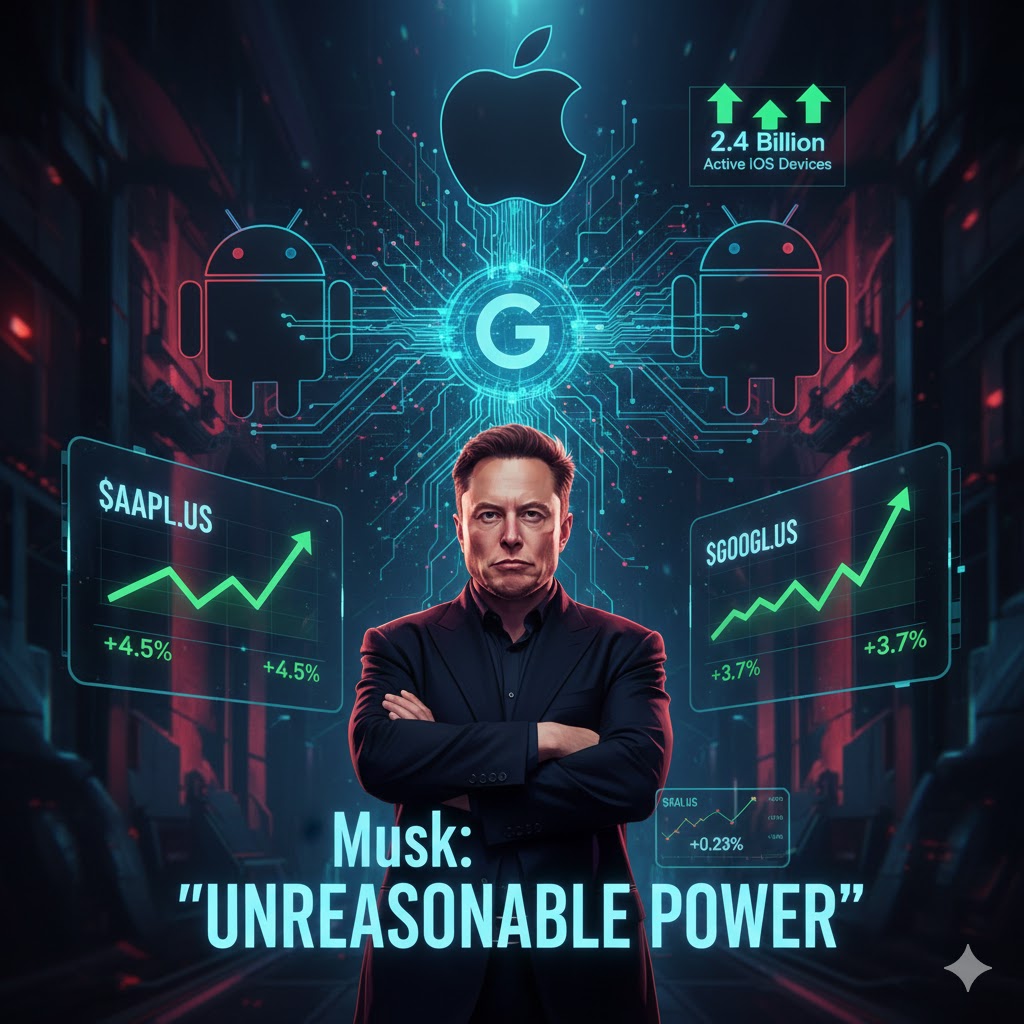
Elon Musk, the world’s wealthiest person, launched a scathing critique on Monday against the new partnership between Apple (AAPL) and Alphabet (GOOGL), claiming it grants the latter an “unreasonable concentration of power.”

Google and Apple announced a new multi-year cooperation agreement on Monday, though specific financial terms were not disclosed.

Under the agreement, Apple will utilize Google’s Gemini model to power a new version of Siri, set to launch later this year. This collaboration deepens the alliance between the two tech giants in the AI era and further solidifies Google’s position in its competition against OpenAI.

In a joint statement, the two companies said: “After a thorough evaluation, Apple determined that Google’s AI technology provides the most capable underlying support for Apple Foundation Models and is excited about the new innovative experiences this will unlock for Apple users.”

Musk responded on his social media platform X, stating: “Given that Google also controls Android and Chrome, this looks like an unreasonable concentration of power.”

Musk founded his own AI company, xAI, to compete with major industry players like OpenAI.

In contrast to Musk’s criticism, Dan Ives, an analyst at Wedbush Securities, believes the deal is a “positive win” for both Apple and Google. He noted that for Google, the partnership serves as a major validation of its status as a top-tier foundation model provider. For Apple, it represents a significant step in accelerating its AI strategy toward 2026 and beyond.

Apple had previously considered partnering with OpenAI or Anthropic to have ChatGPT or Claude power the new Siri but ultimately selected Google’s Gemini. Last November, Google launched its Gemini 3 model, which received widespread acclaim for its performance.

The latest agreement builds upon years of existing collaboration, as Google has long been the default search engine on Apple devices. This partnership not only drives massive traffic to Google but also generates tens of billions of dollars in annual revenue for Apple.

Apple currently has approximately 2.4 billion active iOS devices and 1.5 billion iPhones in use, representing one of the largest installed bases among consumer electronics companies.

Tempus AI Projects 83% Revenue Surge for 2025; Total Contract Value Hits Record High of Over $1.1 Billion

Tempus AI (TEM), a leading technology company dedicated to advancing precision medicine through artificial intelligence, saw its shares jump more than 12% in early trading.

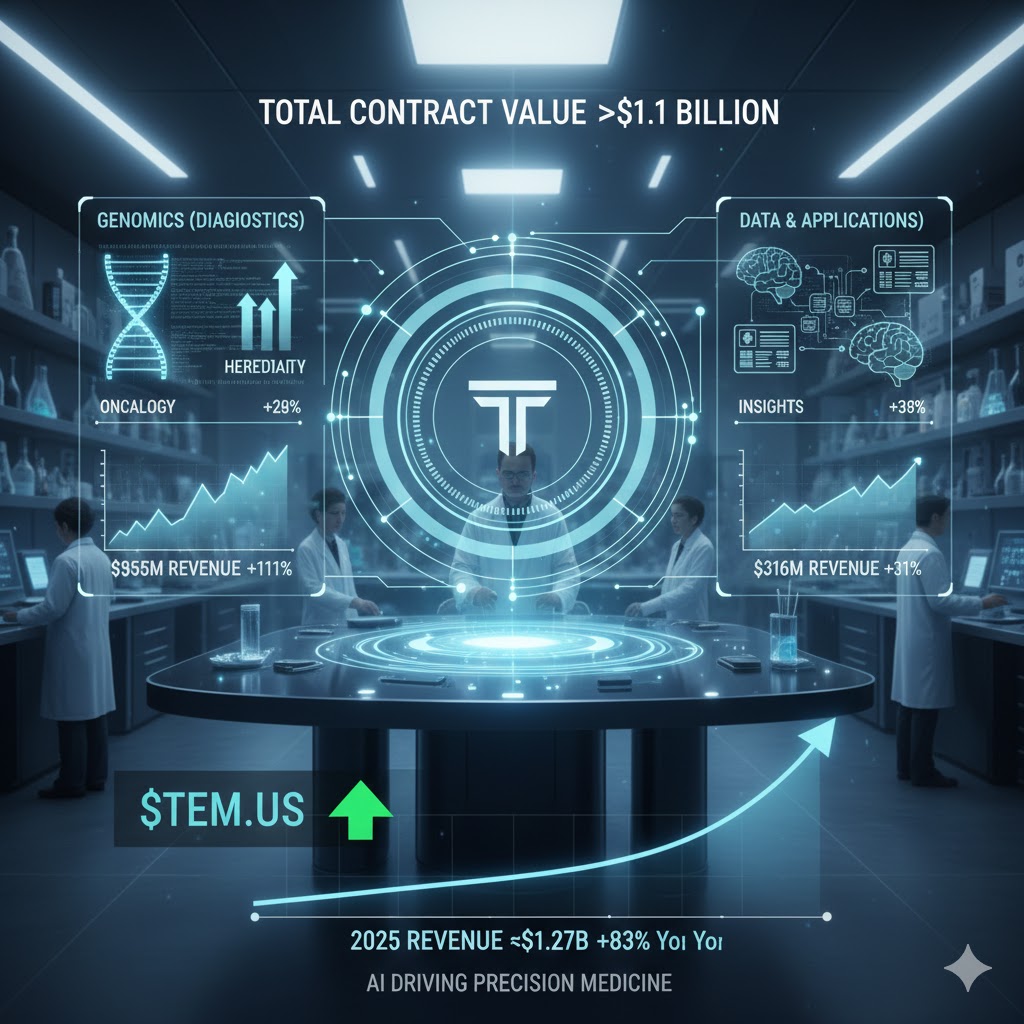
The rally followed the company’s release of its preliminary, unaudited financial summary for the fourth quarter and full year ended December 31, 2025. Tempus reported 2025 revenue of approximately $1.27 billion, representing a year-over-year increase of about 83%. Organic growth, excluding contributions from the Ambry Genetics acquisition, stood at approximately 30%.

Segment Performance and Growth Drivers

According to the preliminary data, the company’s Genomics (Diagnostics) business generated approximately $955 million in revenue for 2025, up 111% year-over-year. This growth was primarily driven by a 26% increase in oncology testing volume and a 29% increase in hereditary testing volume.

The Data and Services (Data & Applications) business reached $316 million in revenue, a 31% increase year-over-year, largely supported by a 38% growth in its Insights business.

Furthermore, Tempus AI announced that its Total Contract Value (TCV) exceeded $1.1 billion as of December 31, 2025, marking a new record for the company.

Fourth Quarter Highlights

For the fourth quarter of 2025, Tempus recorded revenue of approximately $367 million, an 83% increase year-over-year:

  • Genomics (Diagnostics): Revenue was approximately $266 million, up 121%, driven by a 29% rise in oncology testing and a 23% rise in hereditary testing volume.
  • Data and Services: Revenue reached approximately $100 million, a 25% increase. Notably, excluding the impact of the AstraZeneca warrants from Q4 2024, the Insights business grew by 68%.

CEO Commentary and 2026 Outlook

“2025 was an exceptional year for Tempus, with both of our product lines exceeding the expectations we set at the beginning of the year,” said Eric Lefkofsky, Founder and CEO of Tempus. “In our Diagnostics business, volume growth for our genomics (oncology) products has accelerated for three consecutive quarters, reaching its highest unit growth rate in years.”

Lefkofsky added, “Our Data and Services business performed even more strongly, with Q4 revenue hitting a record $100 million. We enter 2026 with extraordinary momentum, as growth in both core businesses accelerates and begins to unlock the financial leverage inherent in our platform. With AI serving as a catalyst across all our products, we are very excited for the year ahead.”

Tesla’s Valuation Anchor: Cybercab Mass Production in April—How Will Robotaxi and FSD Deliver on the Hype?

Tesla’s(TSLA) current high valuation relies heavily on the visionary potential of its Robotaxi and Full Self-Driving (FSD) technology. Based on the latest operational updates and product roadmaps, the core investment logic is summarized below:

Robotaxi Status: Competitive Pricing and Expanding Range, but Scale Remains Limited

More Affordable than Waymo According to DriveTesla and Robotracker, Tesla’s Robotaxi initially launched with a flat fare of $4.20 per trip, later adjusting to $6.90 as coverage expanded. The service has now largely transitioned to dynamic pricing, averaging approximately $1.50 per mile. In comparison, Waymo’s pricing in San Francisco and Phoenix averages around $2.50 per mile—rising above $3.00 during peak hours—giving Tesla a clear price advantage.

Steady Geographic Expansion While currently only operational in two core hubs—Austin, Texas, and the San Francisco Bay Area—Tesla’s coverage area already exceeds that of Waymo. By 2026, the company plans to expand to multiple states, with a confirmed list of cities including Miami, Las Vegas, Houston, and Dallas.

Key Bottlenecks Persist The primary challenge remains fleet size, which leads to prolonged wait times. As of December 2025, approximately 1,655 Robotaxis were registered in California, but only 132 were in active operation; Austin’s fleet stood at just 40 vehicles. Consequently, Robotaxi has yet to contribute significant revenue and remains in the early stages of commercial validation.

Robust Safety Performance The safety record has been stable since launch with no severe accidents reported. Of the 16 incidents reported to the NHTSA (National Highway Traffic Safety Administration) since May 2025, only two involved airbag deployment—both caused by other vehicles. Tesla’s vehicles sustained no structural damage in these cases, and the majority of incidents resulted in no injuries, indicating a high level of overall safety.

FSD: Rising Penetration and “Grok” Integration—China as the Critical Variable

While Robotaxi may not drive significant revenue in the short term, it serves as a powerful catalyst for FSD adoption:

Technical Iteration and Surging Subscription Rates FSD V14 utilizes a unified system compatible with both consumer vehicles and Robotaxis, with only minor functional differences (e.g., consumer cars retain Autopark, which is unnecessary for Robotaxis). V14 features more conservative driving logic and, following an architectural upgrade, may integrate a streamlined version of the Grok AI system, which is expected to further increase MPI (Miles Per Intervention).

The FSD subscription “take rate” has surged from single digits to between 13% and 19% as of September 2025. By the end of 2025, with Tesla’s cumulative production reaching approximately 9 million vehicles, the estimated number of FSD subscribers sits around 1 million. Since subscribers are concentrated in the U.S. (which accounts for roughly 50% of Tesla’s recent sales), the U.S. penetration rate likely exceeds 20%.

2026 Global Acceleration: Focus on the China Market Following the Grok integration and subsequent performance boosts, the market expects the launch of “unsupervised” Robotaxi operations and a driverless version of FSD. By 2026, commercialization is expected to move into Europe, Southeast Asia, and other regions.

As Tesla’s second-largest market, China remains a crucial growth lever. Currently, FSD is limited to a one-time purchase of 64,000 RMB (~$9,000) with a penetration rate under 5%. If full regulatory approval is granted and Tesla switches to a monthly subscription model, the lower entry barrier is expected to significantly drive adoption in the region.

Cybercab: Mass Production Slated for 2026 with a 2-Million Unit Target

Tesla has already begun testing the Cybercab production system. Elon Musk previously indicated that mass production is scheduled to begin in April 2026. Multiple Cybercab prototypes have been spotted during road tests in Austin. Notably, these test vehicles are equipped with temporary steering wheels and mirrors to satisfy current safety and regulatory requirements.

Tesla envisions the Cybercab as the “highest-volume vehicle in history,” targeting an annual capacity of 2 million units. However, given the realities of automotive manufacturing, achieving this goal in the short term remains a formidable challenge.

Summary: 2026—The Year of Scalability and Execution

Compared to the expectations set in early 2025, many of Tesla’s Robotaxi milestones have already been achieved: accident rates are low, and an unsupervised version is in testing. The core watchpoints for the future are twofold:

  1. Fleet Scaling: Current wait times of 30–40 minutes and the continued need for human supervision mean the service is not yet “fully commercialized.”
  2. Cybercab Production: The pace of the production ramp-up will directly determine whether Tesla’s valuation logic can be realized.