UBS Group AG(NYSE:UBS) has released a research report stating that, according to its proprietary long-term investment theme model, five specific themes currently offer the most compelling investment opportunities. These five primary themes are: Digital Consumers, Enabling Technologies, Diversity and Equality, Family Businesses, and Searching for New Frontiers. Conversely, the themes of Gene Therapy and Digital Health are expected to face short-term headwinds; UBS suggests investors take a tactical step back to review their exposure in these areas.
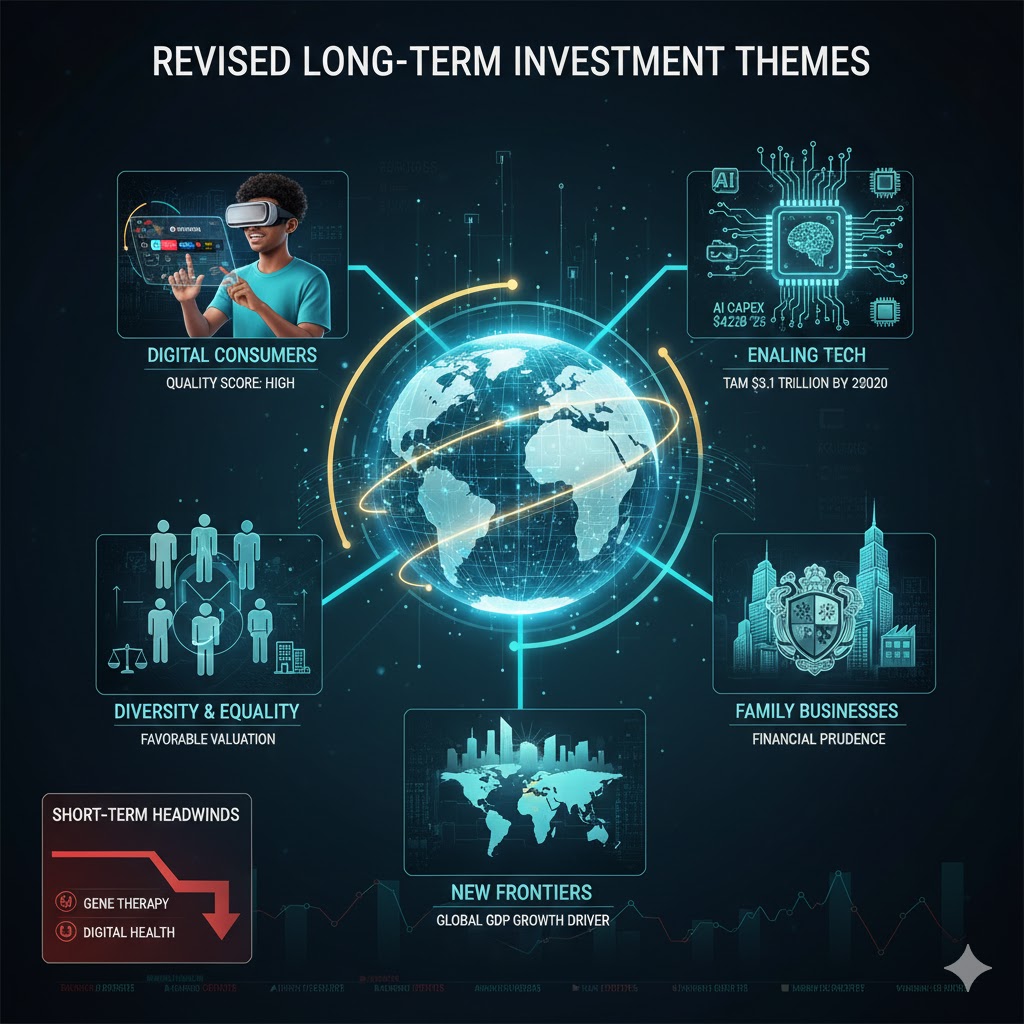
UBS explained that to identify attractive entry points for long-term themes, the bank utilizes a quantitative model combined with qualitative input from thematic analysts. The quantitative model primarily relies on metrics such as valuation, momentum signals, and fundamental quality. Qualitative factors include alignment with the Chief Investment Office’s (CIO) core views, key risks, and potential new catalysts.
Below are the five preferred long-term investment themes identified by UBS:
1. Digital Consumers
Investment Logic: Younger generations are digital natives whose consumption patterns differ from their parents and influence older generations’ behaviors. Due to digitalization, there are more touchpoints influencing consumer decisions than ever before, rewriting the rules of online business. For younger people, sharing experiences or spending on experiences is often more important than owning physical goods. Artificial intelligence will revolutionize every aspect of our lives, giving rise to new experiences. The combination of traditional sectors (travel and leisure) with emerging virtual domains (e-commerce, metaverse, social media, advertising) represents the key investment opportunity within this theme.
Why Invest Now: The Digital Consumer theme ranks first among UBS’s five long-term themes this month, driven by high scores in quality metrics, as it involves companies with robust balance sheets and high returns on invested capital (ROIC). In terms of momentum, it benefits from the solid performance of the tech sector driven by AI trends. However, it is worth noting that its valuation remains relatively high.
2. Enabling Technologies
Investment Logic: As generative AI accelerates technological convergence, UBS has identified five enabling technologies—Artificial Intelligence, AR/VR, Big Data, Blockchain, and other disruptive technologies—which the bank believes will transform numerous industries.
Excluding blockchain, UBS expects the market size of the other four technologies to grow at an average annual rate of 35% from $287 billion in 2022 to $3.2 trillion by 2030. The bank believes AI is likely to drive the largest incremental growth, accounting for 90% of the absolute growth in these markets (in USD terms). The bank continues to view AI as one of the most profound technological shifts of this decade, noting that investors will best benefit by focusing on software and semiconductor companies with strong pricing power and high barriers to entry.
Specifically, UBS forecasts that global AI capital expenditure will reach $423 billion this year and grow to $1.3 trillion by 2030, representing a compound annual growth rate (CAGR) of 25% between 2025 and 2030. Furthermore, the bank has raised its broader AI Total Addressable Market (TAM) forecast to $3.1 trillion by 2030, up from a previous estimate of $2.6 trillion, implying a CAGR of 30% over the same period.
Why Invest Now: Enabling Technologies remains among UBS’s top five themes due to its exceptionally high momentum score. The bank’s thematic bias toward the Information Technology sector provides solid momentum.
3. Diversity and Equality
Investment Logic: UBS expects global regulatory frameworks to gradually improve information disclosure and move toward greater fairness, though this is unlikely for U.S.-registered companies in the near term. Beyond regional regulatory shifts, multiple studies suggest that increasing diversity can close wealth gaps within societies, which, if true, should boost GDP over the next decade. The bank believes companies that promote diversity and equality across their value chains and processes can achieve long-term outperformance.
Primary drivers include increasing regulation, stricter stakeholder scrutiny (social-related shareholder proposals covering civil rights audits to pay inequality), growing evidence of the benefits of diversity, and the economic benefits of a more inclusive world. Recent legal challenges in some U.S. states regarding affirmative action pose short-term risks, as U.S. companies must balance the benefits of investing in their workforce with potential legal exposures. However, the bank remains confident in the long-term drivers.
Why Invest Now: This theme remains in the top five due to favorable valuation and quality scores, as well as alignment with the CIO’s core views. The theme is balanced across industries, offering a good style mix of defensive, value, and growth characteristics.
4. Family Businesses
Investment Logic: Family businesses span the globe, ranging from SMEs to well-known large-cap global listed companies. Market research suggests they account for two-thirds of all businesses worldwide, contributing over 70% of global GDP and providing 50–80% of jobs in many countries.
UBS estimates that family businesses represent 20–30% of global equity market capitalization. The bank believes the theme can continue to benefit from its relatively defensive positioning in terms of prudent balance sheets and capital discipline. These traits should help offset volatility from small-cap exposure. Following an economic downturn, the theme’s tilt toward small-caps provides good leverage for recovery.
Why Invest Now: This theme has high exposure to European markets, where UBS expects industrial activity to gradually exit a three-year slump in 2026. Similarly, the bias toward mid-and-small-cap companies tends to perform better as global economic trends recover—UBS forecasts the global economy will regain growth momentum starting in the second half of 2026. Furthermore, family businesses’ financial prudence offers relative quality and downside protection in volatile environments.
5. Searching for New Frontiers
Investment Logic: UBS believes emerging and frontier economies will be the key engines of global GDP growth over the next decade. Demographics are a major driver; the ten largest developing economies accounted for over 50% of the world’s population in 2024. The bank believes developing economies can outpace developed ones due to both demographic and productivity factors. UBS filters for markets that can better translate GDP growth into earnings growth, as a fast-growing economy does not always equate to a strong stock market.
Why Invest Now: UBS believes growing U.S. fiscal deficits and a weakening dollar are making emerging and frontier economies increasingly attractive. As investors seek to diversify away from U.S. assets, these markets provide compelling opportunities. Additionally, the Federal Reserve’s easing path should support risk assets.
Short-term Headwinds for Gene Therapy and Digital Health
UBS added that the Gene Therapy and Digital Health themes currently rank lower in its quantitative model and have less valuation appeal compared to other themes. Analysts have not identified any positive short-term catalysts to improve these rankings.
- Gene Therapy: Companies in this space and the broader biotech industry face severe capital constraints. The fading of the 2021 biotech funding bubble has put pressure on early-stage, cash-burning firms. While improved liquidity is a positive signal, the overall operating environment has not fundamentally changed.
- Digital Health: Following a period of gains, quantitative signals look less favorable. UBS believes the theme currently lacks strong positive drivers. Excessive capital in 2020–21 led to valuations based on high expectations for digital disruption rather than proven business models. Companies now face pressure to prove profitability and scalability amid tight financial conditions.
UBS noted that while AI applications in diagnostics and medical cost control have potential, they have yet to see scalable, data-driven applications become significant growth drivers in investable vehicles. The bank has adopted a more conservative allocation stance until financing conditions stabilize and execution risks decrease.