Author Archives: admin

Nvidia-Backed Applied Digital Shares Surge as Q2 Revenue Skyrockets 250%

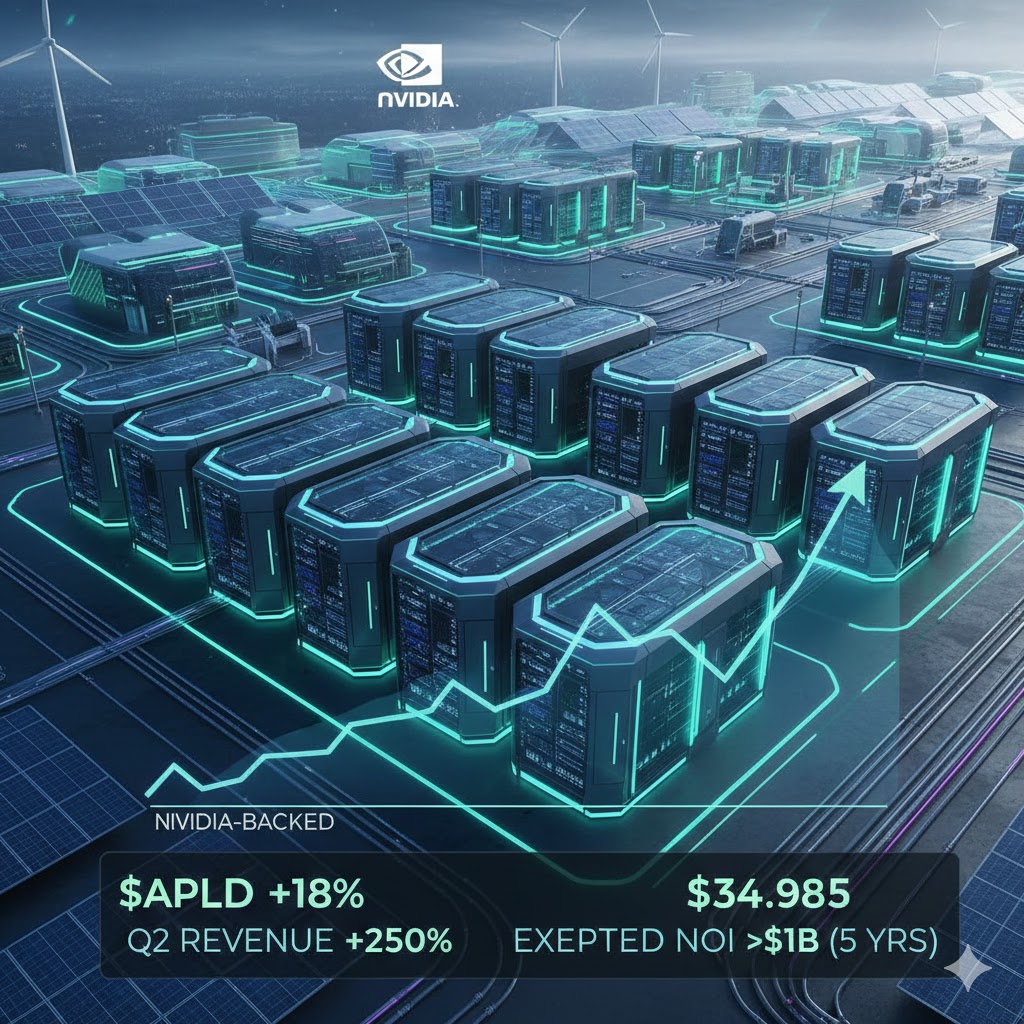
On Thursday, Applied Digital ($APLD), a company held in Nvidia’s portfolio, surged over 18% in early trading to $34.985. The stock recorded a cumulative gain of approximately 220% last year.

The rally follows the company’s announcement of its financial results for the second quarter of fiscal year 2026 (ended November 30, 2025):

  • Revenue: $126.6 million, representing a 250% year-over-year increase.
  • Net Loss: Basic and diluted net loss per share attributable to common stockholders was $0.11, a narrowing of 82% compared to the previous year.
  • Adjusted Net Income: Reported at $100,000.

Management stated that AI infrastructure represents a “once-in-a-generation” investment opportunity. Capital expenditure by hyperscalers has already exceeded $400 billion annually and continues to grow rapidly.

Applied Digital believes it is well-positioned through its early strategic investments in customized, next-generation data centers. The company expects to achieve its goal of over $1 billion in Net Operating Income (NOI) within the next five years.

Ford Executive Joins L3 Autonomous Driving Race, Plans 2028 Vehicle Launch

Ford Motor Co. (F) plans to introduce Level 3 (L3) autonomous driving technology within two years, a move that could propel the traditional American automaker into the burgeoning Robotaxi sector.

On Wednesday (January 7), local time, Doug Field—Ford’s Chief EV, Digital, and Design Officer—announced that the company will launch L3 (conditional) autonomous driving technology in 2028, building upon its existing “BlueCruise” system.

Currently, BlueCruise offers Level 2 “hands-free” driving but still requires drivers to keep their eyes on the road. In an interview, Field stated that the new version, which will allow for “eyes-off, hands-off” operation, will first debut on Ford’s upcoming affordable electric small pickup platform, priced at approximately $30,000.

Speaking at the 2026 Consumer Electronics Show (CES 2026) in Las Vegas, Field explained that this technology will enable drivers to safely conduct video conferences or enjoy entertainment while on the move. Ford anticipates this feature will become a high-demand necessity for future consumers.

“Time is near the top of the list of what people need most today,” Field said. “We believe this feature will be incredibly compelling.”

If the technology gains the level of adoption Ford expects, Field did not rule out the possibility of using it to enter the Robotaxi business. He noted that such a move would be a “natural extension” for Ford Pro, the company’s commercial vehicle division.

“We don’t want to move too fast right now, but we believe we have a very attractive platform to advance this with partners,” he said. “The extent to which L3 driving ultimately evolves will dictate our long-term strategy.”

Before joining Ford, Field held senior roles at Apple and Tesla. He previously served as Tesla’s Senior Vice President of Engineering, leading the development of the Model 3, and was responsible for Mac hardware development at Apple.

If Ford proceeds with the Robotaxi race, it would mark a significant strategic pivot. In 2022, Ford shut down its autonomous driving subsidiary, Argo AI, and abandoned plans for fully self-driving cars; at the time, Field described the task as “harder than putting a man on the moon.”

However, he now believes “there are many forces encouraging the industry to re-evaluate the potential of automated ride-hailing.” Currently, Tesla and Google (Waymo) are the dominant players in automated mobility—a market Wall Street widely views as having immense profit potential.

For now, Ford remains focused on selling L3 autonomy to everyday consumers. Field stated that the company is still evaluating pricing models, which could include a one-time fee, a per-mile charge, or a subscription service.

Because the technology was developed in-house using lower-cost components, Field claims Ford will have a competitive pricing advantage, making it affordable for a broader range of consumers.

“We are putting this system on a platform starting at the $30,000 level, rather than layering L3 systems onto high-end models priced between $70,000 and $100,000 like most of our competitors,” Field emphasized. “That is a critical distinction.”

Trump’s “Dividend Ban” Turns Bullish? U.S. Defense Stocks Stage Dramatic “V-Shaped” Rebound

On Wednesday (January 7), U.S. defense stocks initially slumped following a rare public rebuke from President Trump during mid-day trading. However, the sector saw a significant rebound during overnight and pre-market sessions, with several companies fully recovering their losses.

Trump’s Criticism of Defense Contractors

Roughly an hour before Wednesday’s closing bell, Trump posted a critique claiming that U.S. defense contractors are issuing massive dividends and conducting large-scale stock buybacks at the expense of investing in plants and equipment. “This situation will no longer be allowed or tolerated!” he wrote.

He accused these firms of being “extremely slow” in delivering critical equipment and failing to provide timely or adequate maintenance. Furthermore, he emphasized that executive compensation packages at these companies are “exorbitant and unjustifiable” given their performance.

Proposed Restrictions and Mandates

Trump demanded that defense companies prioritize building new, modernized production facilities. He outlined several strict conditions to be met until current issues are resolved:

  • Executive Pay Cap: Annual compensation for defense executives must not exceed $5 million.
  • Payout Ban: A total prohibition on shareholder dividends and stock buybacks.
  • Internal Funding: Companies must use existing capital for immediate production rather than seeking government bailouts or loans from financial institutions.

Market Reaction and Financial Data

Following the news, defense stocks dropped sharply in late trading. Northrop Grumman (NOC) closed down 5.5%, while Lockheed Martin (LMT) and General Dynamics (GD) fell over 4%. RTX (RTX) declined by approximately 2.5%.

According to financial filings, Northrop Grumman spent $1.17 billion on buybacks and $964 million on dividends in the first nine months of last year. During the same period, Lockheed Martin allocated $2.25 billion for buybacks and $2.33 billion for dividends.

An hour after the close, Trump issued another post specifically targeting RTX. Citing a report from the “Department of War” (Department of Defense), he labeled the company as the “least responsive” and “slowest to expand,” despite being the “most aggressive” in shareholder payouts. RTX, a key supplier for the F-35 fighter jet and advanced missiles, was warned that the Department would cease all business with them unless they increased investments in infrastructure.

The “Deep V” Rebound

The tide turned during overnight trading as defense stocks staged a collective rally. Northrop Grumman and Lockheed Martin rose approximately 6.3%, General Dynamics gained nearly 4.9%, and RTX climbed about 4.8%.

The momentum carried into Thursday’s pre-market session. Northrop Grumman’s gains expanded to nearly 7.3%, Lockheed Martin rose over 6.5%, and RTX increased by 5%.

Analysis: Why the “Ban” is Seen as a Positive

Analysts suggest that Trump’s push to halt dividends can be interpreted as a long-term bullish signal. By redirecting cash into production lines, equipment upgrades, and order fulfillment, contractors could significantly boost their long-term growth potential.

In an era of strained industrial capacity, these policy signals have bolstered investor expectations for future revenue and order growth. Furthermore, Trump proposed on the same day that the FY2027 defense budget be increased from $1 trillion to $1.5 trillion, citing the need for a stronger military in “troubled and dangerous times.”

Industry and Government Perspectives

Palmer Luckey, founder of Anduril Industries—recently valued at $30.5 billion—stated he does not oppose regulatory measures, including pay caps. Luckey noted that he personally “only takes a $100,000 annual salary.”

Additionally, it is worth noting that reports from last August mentioned Commerce Secretary Howard Lutnick hinting that the U.S. government is considering taking equity stakes in the defense industry, similar to its 10% stake in Intel, to ensure better oversight and production.