Key Takeaways from Goldman Sachs’ 2026 Tech Industry Predictions: Apple’s “Foldable” Rescue, the Rise of ASICs, and a Trillion-Dollar Optical Feast

Goldman Sachs’ top ten trends for the tech industry in 2026 focus on core sectors such as AI servers, optical communications, Apple’s foldable screens, semiconductors, intelligent driving, and satellite communications, revealing structural investment opportunities driven by technological innovation and supply chain shifts.

In a recent report, Goldman Sachs’ analyst team led by Allen Chang pointed out that AI server shipments will experience explosive growth in 2026. The penetration rate of ASIC chips is expected to rise to 40%, driving a year-over-year surge of more than 200% in 800G/1.6T optical module shipments. The accelerated penetration of specialized ASIC chips will propel the AI server and optical communications industries to new trillion-dollar heights.

In consumer electronics, $Apple (AAPL)$’s upcoming foldable iPhone is expected to be a powerful catalyst for the smartphone market and a central focus for investors. Meanwhile, the PC market continues to face severe challenges, though leading players remain resilient.

Goldman Sachs emphasized that demand for AI-related technology and high-end hardware will continue to drive earnings growth across China’s semiconductor, optical communication, and PCB (printed circuit board) supply chains. Simultaneously, emerging sectors such as intelligent driving, AI software, and Low Earth Orbit (LEO) satellites are accelerating their commercialization due to policy support and technological breakthroughs, providing diversified opportunities for investors.

AI Servers: The Strong Rise of ASICs and Connectivity Upgrades

The AI server market is undergoing a structural adjustment. Goldman Sachs expects rack-level AI server shipments to surge from 19,000 units in 2025 to 50,000 units in 2026.

A key trend is the diversification of platforms and enhanced network connectivity. Due to their energy efficiency advantages in specific AI workloads, ASIC chips are expected to reach a 40% penetration rate in 2026 and further rise to 45% in 2027.

This trend will make customers more dependent on top-tier suppliers with strong design and manufacturing capabilities, such as Hon Hai and $Foxconn Industrial Internet (601138.SH)$.

Optical Communications: Explosion of 800G/1.6T Optical Modules

The optical communications sector will directly benefit from the expansion of AI infrastructure. As data center networks upgrade from 400G to 800G/1.6T, and the application of Silicon Photonics and CPO (Co-Packaged Optics) technologies increases, demand for optical transceivers will see explosive growth.

Goldman Sachs highlighted that the rising penetration of ASIC chips will further support optical module demand, as ASICs rely more heavily on networking capabilities to execute AI workloads.

Thermal Management: Accelerated Penetration of Liquid Cooling

As computing density increases, thermal management technology is reaching an upgrade inflection point. Goldman Sachs noted that the penetration of liquid cooling technology will rise significantly, particularly in the ASIC AI server domain. To handle the thermal design power (TDP) challenges brought by higher computing power, the supply chain will accelerate its migration toward liquid cooling solutions, benefiting thermal component suppliers like AVC and Auras.

ODM Manufacturers: U.S. Capacity Layout as the Competitive Edge

In the ODM (Original Design Manufacturer) sector, geopolitics and supply chain resilience have become critical considerations. Goldman Sachs believes that manufacturers with firm commitments or capacity plans in the United States will outperform the market. ODMs with strong R&D capabilities, vertical integration advantages, and exposure to comprehensive chipset platforms—such as Hon Hai, Wistron, and Wiwynn—will be preferred by the market.

PCs: Severe Market Challenges, But Leaders Remain Resilient

The PC market faces multiple headwinds in 2026. Goldman Sachs analysis suggests that the Windows 10 replacement cycle is nearing its end, growth expectations for AI PCs have already been priced in by the market, and rising memory costs may lead to lower product specifications or higher prices. In this context, only global market leaders (such as Lenovo) are expected to remain resilient, thanks to stronger supply chain bargaining power and exposure to high-end products.

Smartphones: Will the Foldable iPhone Stand Alone?

The report indicates that Apple will launch a foldable iPhone in 2026, with estimated shipments between 11 million and 35 million units, serving as a powerful catalyst for the smartphone market. The rising penetration of high-end foldable models will drive earnings growth for related component companies.

Goldman Sachs noted that this change in form factor will be a core driver, as the launch of a foldable iPhone will attract consumers and support terminal demand. Although rising memory costs pose a potential risk, high-end branding and new features like foldable screens will reduce consumer price sensitivity.

PCBs: High-End Capacity Shortage Leading to Price and Volume Gains

Despite market disagreements over long-term supply and demand dynamics, Goldman Sachs believes PCB demand remains solid.

Specifically, high-end CCL (Copper Clad Laminate) and PCB suppliers will face a favorable supply-demand landscape, benefiting from increased AI server shipments and ASIC penetration. As CCL grades upgrade to M8+ and M9, the average selling price (ASP) of high-end products is expected to grow by 20-30% annually in 2026 and 2027.

China Semiconductors: AI Driving a New Round of Expansion

The Chinese semiconductor industry will continue its growth momentum. Goldman Sachs is optimistic about the expansion plans of local leaders (such as $SMIC (00981.HK)$ and Hon Hai) in advanced processes, as well as the rise of domestic GPU suppliers.

AI technological innovation and new demand for edge devices (such as AI glasses) will be major drivers. Furthermore, the semiconductor equipment and materials sectors will benefit from the localization trend within the supply chain.

L4 Chips and Robotaxis: Continuous Upgrades in Autonomous Driving

The intelligent driving trend will continue to deepen in 2026. Goldman Sachs expects the popularization of urban NOA (Navigate on Autopilot) and Robotaxis to drive growth for chipset, software, and sensor suppliers. Solutions from companies like Horizon Robotics are being adopted by more vehicle models, while the commercialization process for Robotaxi operators like $Pony.ai (PONY)$ is accelerating, creating new growth poles for the supply chain.

LEO Satellites: Accelerated Launches and Specification Upgrades

The Low Earth Orbit (LEO) satellite industry is entering an acceleration phase. Goldman Sachs pointed out that with the increase in rocket carrying capacity and the reduction in launch costs, satellite launches will speed up significantly.

Meanwhile, satellite specifications are being upgraded, with bandwidth evolving from single-band to multi-band (Ka, E, V, W). Considering the 5-6 year lifecycle of satellites, replacement demand could start as early as 2026, driving the construction of constellation network infrastructure.
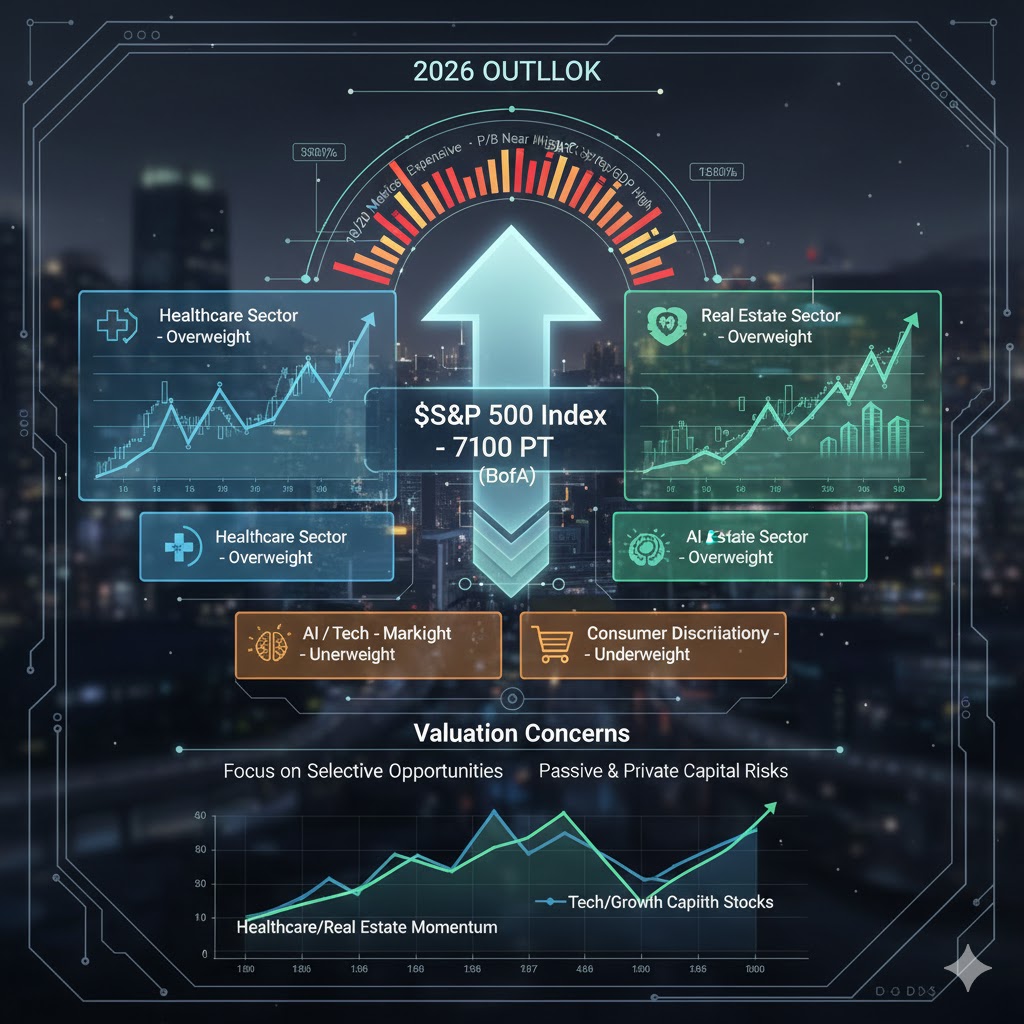

Elevated U.S. Stock Valuations Spark Concern; BofA Names Healthcare and Real Estate as Top Picks for 2026

As the U.S. stock market enters 2026 trading at elevated valuation levels, Bank of America Securities strategist Savita Subramanian is advising investors to look beyond the aggregate market and focus on selective sector opportunities—specifically Healthcare and Real Estate.

In a strategy report released on December 31 titled “Lifelines Beyond AI,” Subramanian noted that the S&P 500 appears expensive across nearly every major valuation metric, though structural differences make direct historical comparisons not entirely precise.

Out of the 20 valuation metrics tracked by the institution, the index shows expensive levels in 18 of them. Key indicators such as Market Cap-to-GDP, Price-to-Book (P/B), Price-to-Operating Cash Flow, and Enterprise Value-to-Sales are all hovering near historical highs. In nine of these metrics, current valuations have already surpassed the levels seen during the peak of the dot-com bubble in March 2000.

While today’s index composition reflects higher-quality, asset-light, and lower-leverage companies compared to previous cycles, Subramanian stated that risk remains high at the index level. Bank of America has set a year-end 2026 target for the S&P 500 at 7,100 points, which is below the general market consensus.

“A bull market always exists somewhere,” the report stated, advocating that investors should focus on industrial sectors rather than simply holding the index.

Healthcare and Real Estate Stand Out

Bank of America’s short-term momentum and valuation models currently rank the Healthcare sector as the most attractive industry, with Real Estate ranking third. For investors with an approximately 12-month horizon, the bank maintains an “Overweight” rating on both sectors in its U.S. equity strategy.

The strategist noted that these two sectors are not only cheap relative to historical market valuations but are also benefiting from upward revisions in earnings estimates and a period of sustained relative outperformance. This combination suggests “true value” rather than just being statistically cheap.

The Tech sector ranked second in the model, but Bank of America maintains a “Market Weight” stance on it, citing increasing uncertainty over how the proliferation of AI will interact with broader economic dynamics in 2026.

AI and the Consumer: A Growing Tension

Subramanian highlighted a potential conflict between the two forces that have driven earnings growth for the $S&P 500 Index (.SPX)$ in recent years: the rise of Artificial Intelligence and the resilience of the U.S. consumer.

Since the 1980s, professional service workers have been the largest contributors to consumption growth. However, recent hiring trends and corporate commentary suggest that AI may reduce the demand for such roles. In turn, if the jobs created by AI do not materialize quickly, it could drag down the consumer-driven economy.

The strategist remarked that it remains unclear what types of new jobs this wave of AI investment will catalyze, prompting the bank to maintain an “Underweight” stance on the Consumer Discretionary and Communication Services sectors.

Passive and Private Capital Heighten Market Risks

Beyond valuation concerns, the report emphasized structural risks stemming from asset allocation trends among U.S. institutional investors. Many pensions and asset owners have leaned toward a “barbell strategy,” simultaneously allocating to passive S&P 500 exposure and private equity or private credit holdings.

Passive funds now account for the vast majority of the S&P 500’s float market capitalization. Subramanian warned that if pressure in the private credit sector persists, or if interest rates fail to return to a “lower for longer” environment, some asset owners might be forced to sell liquid equity positions to manage portfolio valuations.

Whether this pressure manifests gradually or through a sharp wave of forced selling remains uncertain, but the report argues that either scenario reinforces the case for a more selective strategy for U.S. equities in 2026.

Decreased Short-term Appeal for the Staples Sector

Although Bank of America remains strategically Overweight on the Consumer Staples sector, it is currently underperforming in the tactical model. Subramanian described Consumer Staples as a potential “value trap,” noting that its recent cheapness reflects falling prices rather than improving earnings expectations.

By contrast, Healthcare and Real Estate combine attractive valuations with improving fundamentals, making them the preferred areas for investors amidst an expensive market and a changing economic backdrop.

Trump Administration Pressures Oil Giants: Massive Investment in Venezuela Required to Recover Debts!

According to information disclosed by the U.S. side on January 3, local time, the White House has requested major American oil companies to invest heavily in Venezuela to repair the country’s crude oil extraction infrastructure.

Reportedly, officials have told oil executives in recent weeks that if they “hope to receive compensation for drilling rigs, pipelines, and other property seized by the Venezuelan government, they must be prepared to return to Venezuela now and invest on a large scale to revitalize its battered oil industry.”

At the beginning of this century, the late Venezuelan President Hugo Chávez demanded that international oil companies cede more operational control to the state-owned Petróleos de Venezuela (PDVSA). Some companies refused, leading the Chávez government to forcibly expropriate their assets.

At the time, U.S. oil giant $Chevron (CVX) managed to stay in Venezuela through negotiations, forming joint ventures with PDVSA. In contrast, its competitors $Exxon Mobil (XOM) and $ConocoPhillips (COP) chose to exit the country and filed for international arbitration to seek damages for their losses.

In recent discussions with oil executives, the U.S. government has made it clear that American oil companies must first commit their own funds to rebuild Venezuela’s oil industry. This investment will be a prerequisite for eventually recovering the debts related to the expropriated assets.

Sources familiar with the matter stated that for companies like ConocoPhillips, this investment would be extremely costly. For years, ConocoPhillips has been attempting to recover approximately $12 billion in losses resulting from the nationalization of assets during the Chávez era. ExxonMobil has similarly pursued international arbitration to recover $1.65 billion.

Caution Within the Oil Industry

Oil industry insiders are maintaining a cautious stance regarding the Trump administration’s demand for investment in Venezuela. They are concerned about the uncertain prospects of rebuilding Venezuela’s dilapidated oil fields and the political instability that may persist in the country for some time.

Sources say that whether these companies ultimately return to Venezuela will depend on how executives, boards of directors, and shareholders assess the risks of re-investment.

A spokesperson for ConocoPhillips responded recently, stating: “ConocoPhillips is closely monitoring developments in Venezuela and their potential impact on global energy supply and stability. At this time, it is premature to speculate on possible future business activities or investments.”

On January 3, during a press conference at Mar-a-Lago in Florida, President Trump stated that major U.S. oil companies would be heading to Venezuela. He claimed he would have America’s massive oil firms invest billions of dollars to repair Venezuela’s severely deteriorated oil infrastructure and begin “generating revenue” for the United States.

Trump’s assertion that U.S. oil companies were preparing to return to Venezuela came just hours after U.S. forces captured Venezuelan President Nicolás Maduro.

Even if oil companies agree to return, it could take years for the country’s oil production to see a significant recovery. Despite possessing some of the world’s largest proven oil reserves, Venezuela’s production has plummeted over the past few decades due to a combination of mismanagement, lack of investment, and U.S. sanctions.

Analysts point out that companies interested in returning face not only uncertainties regarding local oil contract frameworks but also security risks, backward infrastructure, and legal controversies surrounding the U.S. capture of Maduro—all alongside the risk of prolonged political upheaval.

As a founding member of the Organization of the Petroleum Exporting Countries (OPEC), Venezuela produced as much as 3.5 million barrels of oil per day in the 1970s, accounting for over 7% of total global production at the time. By the 2010s, daily production fell below 2 million barrels; last year, average daily production was only about 1.1 million barrels, dropping its share of global production to just 1%.